




In the breakfast landscape of old Beijing, Miancha is an authentic delicacy with a unique “ritual”. Without exquisite plating or complex fillings, it relies solely on the smooth paste made from broomcorn millet flour, rich sesame paste and savory sesame salt to hold the taste memories of generations. What’s more special is its unique eating rule — it must be eaten by sucking, without stirring at all. This eating method, which hides the dietary wisdom of old Beijing, makes Miancha a distinctive snack and a must-try for foreign tourists to experience the street Culture of Beijing.
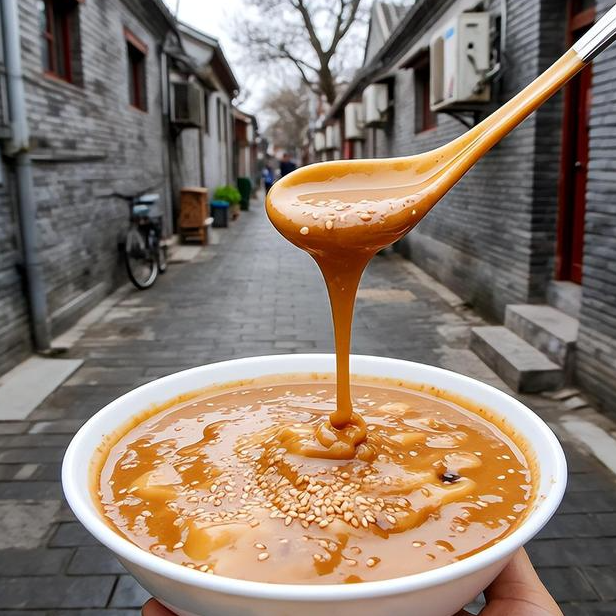
The origin of Miancha can be traced back to the Yuan Dynasty. Initially, it was an affordable staple food made of coarse grains by northern people. With its solid ingredients, strong satiety and simple production, it gradually took root on the streets of Beijing and became a classic breakfast snack. Unlike the exquisite carving of imperial snacks, Miancha has been full of people-friendly attributes since its birth. In the old alleys of Beijing, you could always hear vendors shouting for Miancha in the early morning. A bowl of hot Miancha with Jiaoquan (fried dough rings) was the most comfortable way for old Beijingers to start their day. After hundreds of years of inheritance, the raw materials and core craftsmanship of Miancha have remained unchanged, and its unique sesame flavor and smooth texture have become an irreplaceable symbol in the breakfast Culture of old Beijing.
The soul of Miancha lies in the “smoothness of broomcorn millet paste” and the “layers of sesame flavor”. The perfect integration of the two creates its core trait of mellow and sweet aftertaste. Authentic Miancha has strict requirements for raw materials, and each ingredient directly determines the flavor direction: broomcorn millet flour must be a high-quality variety with plump grains and golden color, ground finely without impurities, so that the boiled paste is smooth without rough particles; sesame paste must be thick pure stone-ground sesame paste, without adding other oils, and its sufficient richness can cling to the paste; sesame salt is made by mixing roasted sesame and fine salt in proportion and grinding, which is savory but not pungent, able to neutralize the thickness of sesame paste and enhance the overall flavor.
The production process seems simple, but the control of heat and technique directly determines the taste of Miancha. First, boil the broomcorn millet paste: mix broomcorn millet flour and water in a ratio of 1:5 in advance, stir into a particle-free thin paste (to avoid caking when directly put into the pot). Add a sufficient amount of water to the pot and bring to a boil, turn to low heat, slowly pour the adjusted broomcorn millet paste into the pot, and stir quickly clockwise with a spoon while pouring to ensure the paste spreads evenly. Then keep boiling on low heat, stirring constantly during the process to prevent burning at the bottom. Boil for 15-20 minutes until the paste becomes thick and translucent, able to hang on the spoon and drip slowly. At this time, turn off the heat and stir for a while with residual heat to make the paste more smooth.
The seasoning step is the finishing touch to the flavor of Miancha, with the technique of “drizzling sesame paste and sprinkling sesame salt”, with distinct layers without mixing. First, add a small amount of warm water to pure sesame paste, stir and dilute to a slowly flowing state (not too thin, otherwise it cannot cling to the surface of the paste). Scoop it up with a spoon and drizzle it around the edge of the bowl filled with boiled Miancha to form a uniform layer of sesame paste; then take an appropriate amount of sesame salt and sprinkle it evenly on the surface of the sesame paste. No additional seasonings are needed to retain the pure integration of sesame flavor and savory taste. At this time, Miancha has the fragrance of broomcorn millet at the bottom, the richness of sesame paste in the middle, and the savory taste of sesame salt on the surface. The three flavors do not interfere with each other, waiting for the unique eating method to unlock.
The most special thing about Miancha is the rule of eating by sucking without stirring. This is not a deliberate formality, but a dietary wisdom that fits the flavor. Since both sesame paste and sesame salt are concentrated on the surface, stirring them evenly will make the sesame flavor too strong, covering the natural fragrance of broomcorn millet flour, and at the same time, the paste will become sticky and lose its smooth texture. The correct way to eat is: hold the bowl with both hands, tilt it slightly, put your mouth close to the edge of the bowl, and suck along the edge. Each bite can taste the sesame salt on the surface, the sesame paste in the middle and the broomcorn millet paste at the bottom at the same time, with interweaving savory, sesame and rice flavors, and rich taste layers. When drinking to the bottom of the bowl, the remaining sesame paste and paste naturally blend, making the flavor more mellow — this is the complete taste experience of Miancha.
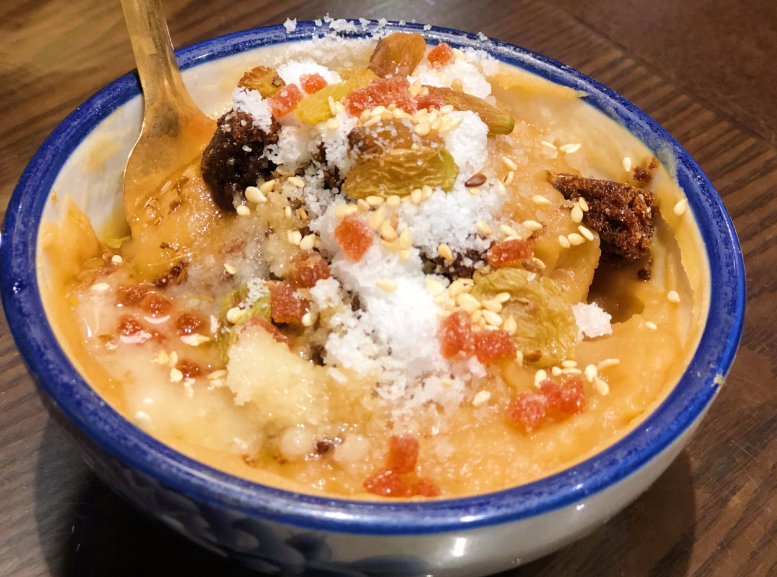
To taste the most authentic Miancha, you can’t go wrong with time-honored brands and alley breakfast stalls that adhere to traditional craftsmanship. Huguosi Snacks (multiple branches) offers classic Miancha. The broomcorn millet paste is boiled smooth and non-sticky, with rich sesame paste and moderate savory sesame salt, perfectly restoring the old Beijing flavor with high cost performance, making it the first choice for foreign tourists trying it for the first time. Yao’s Chaogan Shop (Drum Tower Store) uses solid ingredients for its Miancha, with sufficient sesame paste. Matching it with Jiaoquan in the store reproduces the classic combination of old Beijing breakfast. In addition, old breakfast stalls in alleys, such as the convenience stalls near Xisi, sell freshly boiled Miancha, allowing tourists to experience the purest street taste.
There are several practical tips for tasting Miancha to help foreign tourists better unlock this delicacy. First, eating time: it is best to eat immediately after boiling, when the temperature of Miancha is suitable and the texture is smooth. The paste will harden when cooled, affecting the flavor. Second, matching suggestions: the traditional matching is Jiaoquan. The crispy Jiaoquan can neutralize the smoothness of Miancha and make the texture more rich. Third, eating etiquette: no spoon is needed. Holding the bowl with both hands and eating by sucking is the authentic way. Don’t worry about the posture — this is the street charm of Miancha. Fourth, flavor adaptation: the sesame paste has a strong flavor. If you don’t like the thick texture, you can tell the vendor to drizzle less sesame paste.
Beijing Miancha has no gorgeous appearance or complex procedures, but it occupies a place in old Beijing snacks with a bowl of hot smoothness and unique eating rules. It hides in the alleys in the morning, in the shouts of vendors, and in the daily life of old Beijingers, interpreting the street warmth with the simplest flavor. For foreign tourists, tasting Miancha is not only a taste experience, but also an immersive opportunity to feel the dietary Culture of old Beijing — in a sip of sesame flavor, understand the most authentic taste and wisdom of this city.






暂无评论内容