




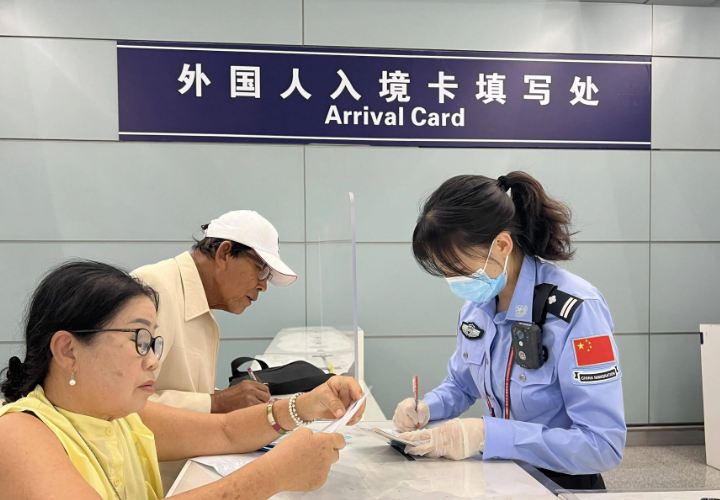
Core Key Points at a Glance:
- To enter China, foreign nationals must hold a valid passport (with a remaining validity of ≥ 6 months) plus a corresponding visa/residence permit (or meet visa-free eligibility criteria).
- All incoming travelers are required to complete the health declaration via the China Digital Arrival Card (CDAC) (within 72 hours prior to entry).
- Frontier inspection authorities will verify travel documents and inquire about the purpose of entry; customs authorities will inspect luggage and articles and collect tariffs where applicable.
- In 2026, China implements a variety of visa-free policies covering 47 countries and regions, with a maximum stay of 30 days under relevant policies.
I. Visa Policies and Types
1. Types of Ordinary Visas (Categorized by Letters)
| Visa Type | Eligible Applicants | Duration of Stay | Key Application Documents |
|---|---|---|---|
| C | Crew members of international transport means, seafarers and their accompanying family members | Short-term stay | Guarantee letter from foreign transport company or invitation letter from Chinese counterpart |
| D | Foreign nationals applying for permanent residence in China | Apply for residence formalities after entry | Confirmation Form for Permanent Residence Status issued by the Ministry of Public Security |
| F | Personnel engaging in exchanges, visits and inspections | Short-term (usually ≤ 60 days) | Invitation letter from the inviting Chinese unit |
| G | Personnel in transit through China | Transit stay (≤ 72 hours) | Connecting air ticket to a third country/region |
| J1/J2 | Resident/temporary foreign journalists in China | J1 for long-term stay, J2 for short-term stay | Approval document from the Information Department of the Ministry of Foreign Affairs |
| L | Personnel traveling for tourism or family visits | Single/multiple entries, maximum 90 days | Itinerary, hotel reservation |
| M | Personnel engaging in commercial and trade activities | Short-term business stay | Business invitation letter, company certification |
| Q1/Q2 | Personnel visiting family for reunion | Q1 for long-term stay (> 180 days), Q2 for short-term stay | Q1: kinship certificate; Q2: invitation letter |
| R | High-end professionals and talents | Long-term/multiple entries | Talent recognition document, invitation letter |
| S1/S2 | Personnel handling private affairs, accompanying family members of foreign nationals working or studying in China | S1 for long-term stay, S2 for short-term stay | Kinship certificate, invitation letter |
| X1/X2 | International students | X1 for long-term study (> 180 days), X2 for short-term study | Admission notice, JW201/JW202 Form |
| Z | Foreign nationals working in China | Apply for residence permit after entry | Work permit notification, invitation letter |
2. Visa-free Policies (2026 Latest Version)
(1) Unilateral Visa-free Policy (47 countries, valid until December 31, 2026)
- Eligible countries: European countries including France, Germany, Italy, the Netherlands, Spain, Switzerland and Sweden; Asian countries including Singapore, Malaysia, Thailand and the Republic of Korea, etc.
- Duration of stay: Maximum 30 days (cumulative stay shall not exceed 30 days within any 180-day period).
- Purpose of entry: Non-work/non-study activities such as tourism, business, family visits, cultural exchanges and transit.
(2) Bilateral Visa-free Agreements (Covering Multiple Countries)
- Inclusive of: the United Arab Emirates, Bosnia and Herzegovina, Serbia, Ecuador, etc.
- Duration of stay: Usually ≤ 30 days for a single entry, and cumulative stay ≤ 90 days within any 180-day period.
- For the full list of eligible countries: List of China’s Bilateral Visa-free Agreements – China Consular Services Network
(3) Transit Visa-free Policies
- 24-hour direct transit visa-free: Applicable at all ports of entry; no entry into China’s mainland and no exit from the international transfer area of airports.
- 144-hour transit visa-free: Available at more than 20 port cities (e.g., Beijing, Shanghai, Guangzhou, Shenzhen), allowing a 6-day stay in the designated areas.
- 240-hour (10-day) transit visa-free: Applicable at some aviation ports for citizens of specific countries.
(4) Other Visa-free Scenarios
- Foreign nationals holding a valid Chinese Permanent Residence Permit.
- Foreign nationals holding a valid Chinese Residence Permit (no additional visa required).
- Holders of the APEC Business Travel Card (marked with “CHN” on the back).
3. Port Visa Policy (Relaxed effective January 11, 2026)
- Eligible applicants: Foreign nationals who urgently need to come to China for trade and economic cooperation, visits and exchanges, investment and entrepreneurship, family visits or private affairs and have no time to apply for a visa overseas.
- Application documents: Invitation letters and other relevant supporting materials.
- Applicable ports: Major aviation ports such as Beijing Capital International Airport, Shanghai Pudong International Airport and Shanghai Hongqiao International Airport.
II. Visa Application Process (Applied Overseas)
1. Online Application Phase
- Visit the China Visa Online Application System (https://consular.mfa.gov.cn/VISA/).
- Fill in the Visa Application Form (Version V.2013) and upload a standard passport photo (48mm×33mm, light-colored background).
- Submit the application and obtain the Visa Application Voucher (print for future use).
2. Prepare Application Documents
- Valid passport (remaining validity ≥ 6 months, with at least one blank visa page).
- Confirmed visa application form (signed by the applicant in person).
- 1 recent passport photo (consistent with the one uploaded online).
- Supporting documents related to the purpose of application (e.g., invitation letter, itinerary, employment certificate).
- Copy of previous Chinese visas (if any).
- Other supplementary documents (e.g., kinship certificate, proof of financial means).
3. Offline Submission and Fee Payment
- Visit the Chinese embassy/consulate or visa application center at the appointed time.
- Submit the original and photocopies of documents, and provide ten fingerprints (exemptions apply to those under 14 or over 70 years old, holders of diplomatic passports, etc.).
- Pay the visa fee (China’s visa fee reduction and exemption policy remains in effect until December 31, 2026).
- Obtain the visa collection receipt.
4. Collect the Visa
- Collect the visa at the embassy/consulate at the time specified on the receipt.
- Verify the accuracy of visa information (name, passport number, validity period, duration of stay, etc.).
III. Pre-entry Preparations
1. Document Inspection
- Confirm that the passport has a remaining validity of ≥ 6 months and the visa is within its validity period.
- Ensure the visa type is consistent with the purpose of entry (e.g., L visa for tourism, M visa for business).
- Prepare round-trip air ticket reservations and hotel reservations (may be inspected by frontier inspection authorities at random).
2. Health Declaration (China Digital Arrival Card – CDAC)
- Complete the declaration within 72 hours prior to entry via the following channels:
- WeChat mini-program: Customs Travelers Fingertip Service.
- Official webpage (https://s.nia.gov.cn/).
- Scan the QR code on-site at the airport to fill in the form.
- Declaration content: Personal information, health status, travel history, contact history, etc.
- Obtain the declaration QR code after submission (save the screenshot to present upon entry).
- Special requirements: Travelers from areas with prevalent infectious diseases such as yellow fever are required to provide a vaccination certificate.
IV. Frontier Inspection Procedures Upon Entry
1. After Arriving at the Port of Entry
- Queue at the Foreign Nationals’ Entry Channel.
- Prepare documents: Valid passport + visa (or proof of visa-free eligibility), CDAC declaration QR code, round-trip air ticket itinerary.
2. Frontier Inspection Verification
- Present travel documents to frontier inspection officers and answer questions about the purpose of entry and intended duration of stay.
- Cooperate with fingerprint collection (exceptions apply to some visa-free travelers).
- Frontier inspection officers will affix an entry stamp in the passport (indicating the date of entry and permitted duration of stay).
3. Common Reasons for Entry Refusal
- Expired passport/visa or inconsistent information on documents.
- The purpose of entry is inconsistent with the visa type.
- Failure to provide a reasonable travel itinerary.
- Having an adverse entry record or being included in the blacklist.
- Abnormal health declaration or showing symptoms of infectious diseases.
V. Customs Inspection and Article Regulation
1. Luggage Declaration and Inspection
- Fill in the Customs Declaration Form when carrying articles exceeding the duty-free quota or restricted articles.
- Duty-free quota: Personal articles for personal use with a value of ≤ 5,000 RMB (for entry via land ports) or ≤ 8,000 RMB (for entry via airports).
- Restricted/prohibited articles:
- Prohibited: Weapons, drugs, obscene materials, endangered wildlife and plant products.
- Restricted: Alcohol and tobacco (200 cigarettes, 50 cigars or 1.5 liters of alcohol); cash (declaration required if exceeding 20,000 RMB or 5,000 US dollars).
2. Tariff Collection
- Tariffs shall be paid in accordance with regulations for articles exceeding the duty-free quota.
- Personal articles for personal use in a reasonable quantity are usually released duty-free.
- Articles for commercial use shall go through customs declaration procedures.
VI. Post-entry Procedures (Long-term Stay/Residence)
1. Application for a Residence Permit (Applicable to long-term visas such as D, X1, Z, Q1, S1)
- Apply to the exit and entry administration department of the public security organ at the place of residence within 30 days after entry.
- Required documents: Passport, visa, temporary accommodation registration certificate, photos, supporting documents related to the purpose of application (e.g., work permit, admission notice).
- Collect the Foreigner’s Residence Permit (a card-type document serving as proof of legal residence in China).
2. Temporary Accommodation Registration
- Staying at a hotel: The hotel front desk will complete the registration automatically.
- Staying at a private residence: The host shall accompany the foreign national to the local police station to complete the registration within 24 hours of arrival (72 hours in rural areas).
VII. Latest Policy Updates 2026
- Visa-free policy extension: The unilateral visa-free policy for citizens of 47 countries is extended to December 31, 2026.
- Visa fee reduction and exemption: The policy remains in effect until December 31, 2026, applicable to tourism, business and other types of visas.
- Port visa relaxation: Expanded application scope, simplified document requirements and faster approval speed.
- Transit visa-free optimization: Extended 240-hour (10-day) stay at some ports.
- Digital declaration upgrade: The CDAC system has been optimized to support multiple languages and feature a more user-friendly application process.
VIII. Important Reminders and Notes
- Document validity: The remaining validity of the passport must be ≥ 6 months; otherwise, entry may be refused.
- Duration of stay: Strictly comply with the permitted duration of stay under the visa/visa-free policy; an extension application must be submitted in advance if needed (usually 7 days before the expiration date).
- Scope of activities: No engagement in activities inconsistent with the visa type (e.g., working in China with a tourism visa).
- Document safekeeping: Keep the passport, visa/residence permit in a safe place to avoid loss or damage.
- Change notification: Report any changes to address, employer and other information to the public security organ within 10 days.
- emergency situations: In case of passport loss, report to the local public security organ immediately and contact the Chinese embassy/consulate to apply for a replacement travel document.
IX. Authoritative Information Channels
- China Consular Services Network (https://cs.mfa.gov.cn/) – The official platform for issuing visa policies.
- National Immigration Administration of China (https://www.nia.gov.cn/) – Frontier inspection and entry policies.
- General Administration of Customs of China (https://www.customs.gov.cn/) – Health quarantine and article supervision.
- Chinese embassies and consulates abroad – Provide specific visa application requirements and procedures for the host country.
© 版权声明
文章版权归作者所有,未经允许请勿转载。
THE END









暂无评论内容