




Nestled in the heart of Xicheng District, at No. 33 Xishiku Street, Beijing, Xishiku Church—also known as Beitang (North Church) or the Church of the Saviour—stands as a timeless testament to cultural fusion, religious heritage, and historical resilience. As one of Beijing’s largest and most well-preserved Catholic churches, it has witnessed over 300 years of the city’s transformation, from the imperial Qing Dynasty to the modern metropolis it is today. For foreign travelers seeking to go beyond the iconic Forbidden City and Great Wall, Xishiku Church offers a unique window into the intersection of Western religion and Chinese Culture, making it a must-visit destination that combines architectural grandeur, historical depth, and spiritual tranquility.
The history of Xishiku Church dates back to 1703, during the reign of Emperor Kangxi of the Qing Dynasty. Legend has it that the emperor granted a plot of land near Zhongnanhai to two French Jesuit missionaries, Jean-François Gerbillon and Joachim Bouvet, as a token of gratitude for curing his illness. On this land, the missionaries built the first church, originally named the Church of the Saviour and commonly known as Canchikou Church due to its location at Canchikou west of Ziguangge Pavilion. However, tensions between anti-Catholic forces and the church in the mid-Qing Dynasty led to the church being seized and demolished by the Qing government in 1827.
It was not until after the Second Opium War, in accordance with the Treaty of Beijing signed with Britain and France in 1860, that the Qing government returned the church’s land and allowed its reconstruction. In 1865, the church was rebuilt at its original site, but its tall Gothic bell tower soon drew dissatisfaction from Empress Dowager Cixi and Emperor Tongzhi, as it was too close to the imperial forbidden area. After negotiations with the Holy See and the French government, the church agreed to relocate to its current site in Xishiku, with the Qing government funding the new construction. The new church was officially completed in 1888, featuring a stunning blend of Western Gothic architecture and traditional Chinese design elements—a style that remains unique among Beijing’s historical buildings today.
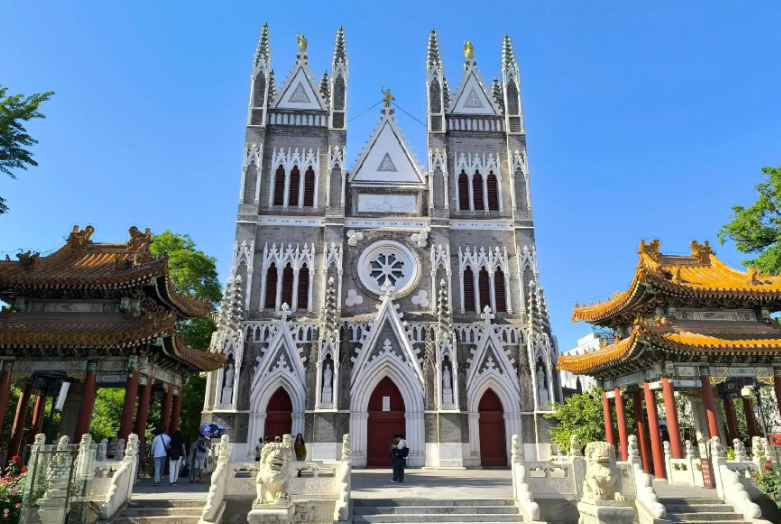
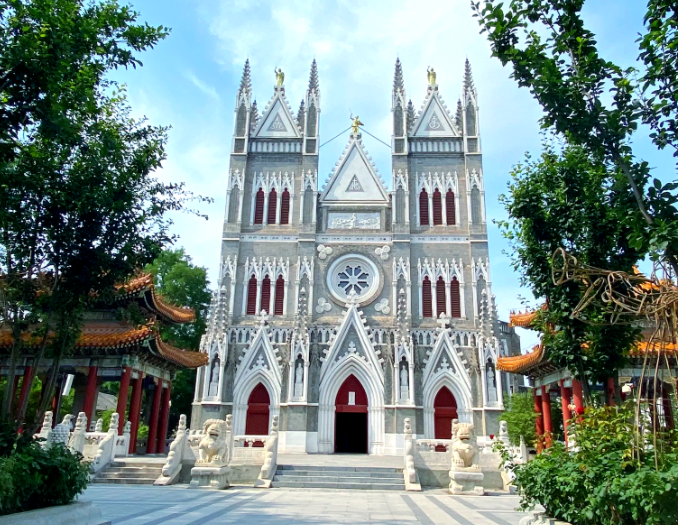
One of the most striking features of Xishiku Church is its architectural fusion. The main building is a three-story Gothic structure covering approximately 2,200 square meters, topped with 11 towering spires that once made it the tallest single building in Beijing’s inner city. The spires soar upward, embodying the classic Gothic pursuit of height and spiritual transcendence, while the building’s cross-shaped floor plan symbolizes Christian faith. The facade of the church is adorned with white marble carvings, including three pointed arch entrances and a magnificent circular rose window in the center—similar to those found in famous European cathedrals like Notre-Dame de Paris. Flanking the entrances are stone carvings of four saints, including St. John and St. Paul, which are rare among Beijing’s churches.
In contrast to its Western exterior, the church is surrounded by traditional Chinese architectural elements that add a unique charm. The main building sits on a Chinese-style platform, enclosed by white marble railings with classic Chinese carvings. On either side of the church’s entrance stand two Chinese-style pavilions with yellow glazed tile roofs, a symbol of imperial dignity in ancient China. Inside these pavilions are two stone steles inscribed by Emperor Qianlong and Emperor Guangxu, recording the church’s history and relocation. Four Chinese stone lions and a pair of stone offerings stand nearby, further blending Eastern and Western aesthetics in a harmonious way that surprises and delights visitors.
Stepping inside the church, visitors are greeted by a grand and serene interior. Thirty-six tall columns, carved with pine leaf patterns at the top, support the golden vaulted ceiling, creating a sense of spaciousness and grandeur. The walls are adorned with 80 colorful stained glass windows, each depicting scenes from the Bible and the history of Catholicism in China. When sunlight streams through these windows, colorful light patterns dance across the floor and walls, creating a sacred and ethereal atmosphere that feels both peaceful and awe-inspiring. The main altar, dedicated to Jesus, is flanked by side altars honoring the Virgin Mary and St. Joseph, while a choir loft above the entrance adds to the church’s musical and spiritual ambiance. A memorial tablet to Bishop Pierre-Marie-Alphonse Favier, the designer of the current church, is also displayed inside, commemorating his contributions to the church’s construction and preservation.
Throughout its history, Xishiku Church has endured numerous challenges. In 1900, during the Boxer Uprising, the church was besieged for over two months by Boxer rebels and Qing troops. The defenders inside, including priests, nuns, and believers, held out bravely, surviving on horses, mules, tree bark, and weeds when food ran out. Many defenders, including the church’s bishop and military commanders, lost their lives during the siege. It was not until the Eight-Nation Alliance captured Beijing in August 1900 that the siege ended, and the church was later restored with funds from the Qing government as compensation. In the following decades, the church served as a school campus, with its spires even being cut down. It was not until 1985 that the Chinese government funded a full renovation, restoring the church to its original glory and resuming normal religious activities. In 1984, Xishiku Church was listed as a Beijing Municipal Cultural Relic Protection Unit, and in 2006, it was designated as a National Key Cultural Relic Protection Unit, recognizing its significant historical and cultural value.
For foreign travelers planning to visit Xishiku Church, here are some practical tips to enhance your experience. The church is open to the public daily, with slightly different hours on weekdays and weekends: from 9:00 AM to 5:00 PM on Monday to Saturday, and from 9:00 AM to 7:00 PM on Sundays. Admission is free, but visitors are required to dress modestly—shoulders and knees should be covered, and avoid wearing overly casual or revealing clothing out of respect for the church’s religious nature. Photography is allowed inside the church, but flash photography and loud talking are prohibited to maintain the serene atmosphere. During religious activities, such as Mass on Sundays, visitors are welcome to observe quietly but should not interrupt the proceedings.
Getting to Xishiku Church is convenient via public transportation. The nearest Subway stations are Xisi Station (Line 4) and Beihai North Station (Line 6). From Xisi Station, it’s a 10-minute walk west along Xishiku Street to reach the church. Several bus routes also stop nearby, including Routes 14, 55, 68, 128, and 612, which drop you off at Beijing No. 39 Middle School Station, a short walk from the church. If traveling by taxi or ride-hailing app, simply search for “Xishiku Church” or “Beitang” to reach the destination directly. There is no Parking lot at the church, so driving is not recommended.
After visiting the church, foreign travelers can explore the surrounding area, which is rich in historical and cultural attractions. Beihai Park, one of Beijing’s oldest imperial gardens, is just a 15-minute walk away, offering beautiful lakes, pagodas, and traditional Chinese gardens. The Forbidden City and Tiananmen Square are also within a 30-minute Subway ride, making it easy to combine a visit to Xishiku Church with other iconic Beijing attractions. The nearby Xishiku Street is also home to many local shops and restaurants, where visitors can try authentic Chinese cuisine and buy souvenirs to remember their trip.
In conclusion, Xishiku Church is more than just a religious site—it is a living Museum of cultural fusion, a witness to Beijing’s complex history, and a masterpiece of architectural art. For foreign travelers, it offers a rare opportunity to experience the collision and harmony of Western and Chinese Cultures, away from the crowds of more famous landmarks. Whether you are interested in history, architecture, religion, or simply seeking a moment of peace in the bustling city, Xishiku Church is sure to leave a deep impression. So, add this hidden gem to your Beijing travel itinerary, and discover the unique charm of one of China’s most iconic cultural and religious landmarks.




暂无评论内容