




On the west side of Guang’anmen Binhe Road in Xicheng District, Beijing, stands a Liao Dynasty multi-eaved brick pagoda that has weathered thousands of years of wind and rain——Tianning Temple Pagoda. First built during the reign of Emperor Xiaowen of the Northern Wei Dynasty, it was originally named Guanglin Temple Pagoda. After reconstruction in the Liao Dynasty and renovations in the Ming and Qing Dynasties, it has a history of nearly 1,500 years. Today, it is one of the oldest existing above-ground buildings in Beijing and a key cultural relic protection unit of the third batch. This 57.8-meter-high octagonal 13-story brick pagoda was praised by architect Liang Sicheng as “a masterpiece of ancient architectural design full of musical rhythm”. It has no the majesty of imperial buildings and is far away from the crowds of popular scenic spots. With a quiet posture, it carries the essence of Liao Dynasty architecture and the heritage of Buddhist Culture, becoming a hidden gem for foreign travelers to deeply explore Beijing’s history and feel the oriental architectural aesthetics. Here, every blue brick is engraved with the traces of time, and every eave corner carries the memory of the times, waiting for every visitor to slow down and listen to the silent story of the millennium-old pagoda.
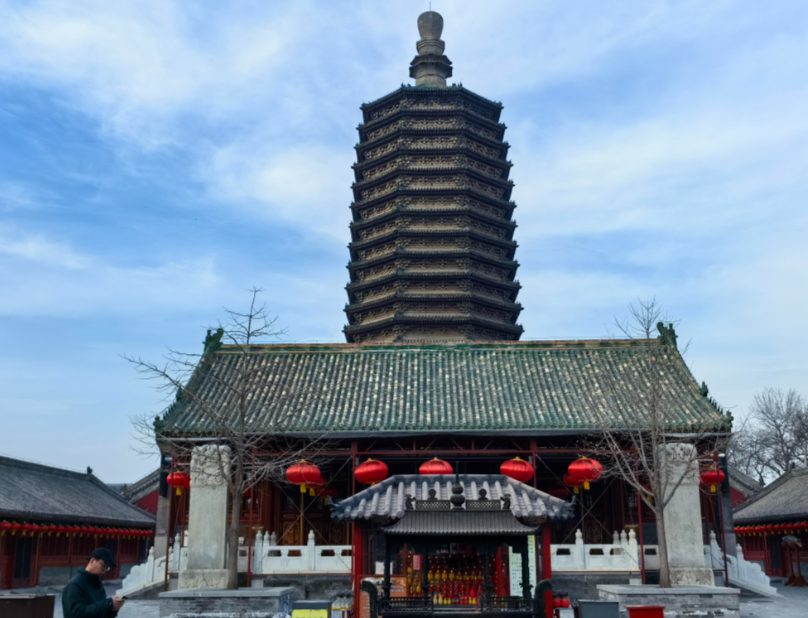
The history of Tianning Temple Pagoda is a history of ups and downs spanning thousands of years, and also an epitome of the integration of Chinese and Western Cultures and the spread of Buddhism. According to historical records, the temple was first built during the Yanxing period of Emperor Xiaowen of the Northern Wei Dynasty (471-476 AD) and was originally named Guanglin Temple. In the second year of Renshou in the Sui Dynasty (602 AD), it was renamed Hongye Temple. It is said that before Emperor Wen of the Sui Dynasty ascended the throne, an Indian monk gave him a bag of Buddhist relics. After he became emperor, he distributed the relics to 30 states in the Central Plains during the Renshou period, and built a pagoda in each state to hide them secretly. Both Famen Temple and Tianning Temple were among them. In the second year of Renshou (602 AD), the Buddhist relics were placed in the pagoda. During the Kaiyuan period of the Tang Dynasty, the temple was renamed Tianwang Temple, and the incense became increasingly prosperous. Unfortunately, at the end of the Yuan Dynasty, the entire temple was destroyed by war, leaving only the lonely pagoda standing alone in the chaotic world. During the Yongle period of the Ming Dynasty, Emperor Chengzu Zhu Di ordered the reconstruction of the temple, replaced the brick carvings of the relic pagoda base according to the original Liao Dynasty style, and expanded the temple scale. Yao Guangxiao, a senior monk who assisted Zhu Di in ascending the throne, once lived in seclusion here. In the tenth year of Xuande in the Ming Dynasty (1435 AD), the temple was officially renamed Tianning Temple. Since then, it has been renovated many times in the Ming and Qing Dynasties, allowing this millennium-old pagoda to continue its vitality. During the 1976 Tangshan Earthquake, the pearl on the top of the pagoda was shattered, and some tiles fell, but the main body of the pagoda remained intact. The protective renovation from 1991 to 1992 made this Liao Dynasty treasure regain its former glory.
As a representative work of Liao Dynasty multi-eaved brick pagodas, the architectural aesthetics of Tianning Temple Pagoda can be called a model of ancient architectural design. Its overall shape and local carvings all show the exquisite craftsmanship of Liao Dynasty craftsmen. The pagoda is 57.8 meters high, octagonal in plane, and entirely built of blue bricks. It has a solid structure with no internal stairs. Although you cannot climb the pagoda to overlook the panoramic view, it is more solemn and majestic. The entire pagoda is composed of four parts: the base, the body, the eaves, and the finial. It has distinct layers and a coordinated proportion. The outer contour is a gentle arc, like a section of solidified music, which perfectly matches Mr. Liang Sicheng’s praise. The base is a square brick platform, on which there are two layers of octagonal Sumeru bases. This is the most exquisitely carved part of Tianning Temple Pagoda and a fine example of Liao Dynasty sculpture art. Each side of the lower Sumeru base is divided into six niche-shaped niches by short columns, with lion heads carved inside, looking powerful and vigorous. Between the niches are carved twining lotus patterns with smooth and delicate lines; at the corners are relief sculptures of Vajra warriors, bare-chested, with tight muscles, holding the upper lintel of the Sumeru base with both hands, showing great momentum. The upper Sumeru base is smaller, and each side is divided into five niche-shaped niches by short columns. Inside the niches are relief sculptures of sitting Buddhas, looking peaceful and serene. Between the niches and at the corners are also relief sculptures of Vajra warriors, echoing the carvings of the lower layer, showing the solemnity and sacredness of Buddhist Culture.
Above the Sumeru base is the platform part. The railings of the platform are carved with twining lotus, treasure flower and other patterns, which are elegant and delicate, showing ingenuity in every detail. Above the platform, three layers of huge upturned lotus bases support the pagoda body. The upturned lotus petals were originally made of iron. In ancient times, on the eighth day of each lunar month, monks in the temple would pour oil into them and light 360 lamps to worship the Buddha. The lights illuminated the pagoda brightly, reflecting with the stars and moon in the sky. People from far and near gathered to watch the lights, praying for good weather and peace for the country and the people, which became a unique scene in the ancient capital. The eight corners of the pagoda body are eight prominent semicircular columns, connected with the pagoda body as a whole. On the columns are relief sculptures of coiling dragons with opposite dragon heads, showing their teeth and claws, lifelike, as if they are about to break through the wall and come out. The four front sides of the pagoda body are equipped with arched doors, with brick-carved Heavenly King statues beside the doors, looking solemn and dignified; the other four sides are straight lattice windows, with brick-carved Bodhisattva statues beside the windows, looking gentle and graceful. Although these statues have been eroded by thousands of years of wind and rain and some are damaged, we can still see the carving skills of that year. Every detail contains profound Buddhist meanings, showing the Liao Dynasty’s respect for Huayan Sect and the integration of Exoteric Buddhism and Esoteric Buddhism.
Above the pagoda body are thirteen layers of dense eaves, overlapping layer by layer. The corner beams of each layer of eaves are made of wood, and the eaves tiles, ridge beasts, set beasts and other decorations are all made of glazed glass, which still have a warm luster after thousands of years. According to “A Study of Ancient Capital Sites”, there were originally 2,928 wind chimes hanging on the eaves of the pagoda, with a total weight of 5,246 kilograms. When the wind blew, the chimes made a distant and clear sound. Unfortunately, they gradually scattered in the early years of Emperor Qianlong of the Qing Dynasty. Although there are no wind chimes ringing now, standing under the pagoda, you can still imagine the quiet artistic conception of “the sound of bells and chimes flowing with the quiet Buddhist chants” in those years. The finial of the pagoda is made of brick, composed of two layers of octagonal upturned lotus bases supporting a pearl. After many renovations, it still maintains its original Liao Dynasty style. The towering finial, like a sharp sword pointing directly at the sky, adds a touch of grandeur to the entire ancient pagoda. It is worth mentioning that the architectural design of Tianning Temple Pagoda strictly follows the teachings of the Huayan Sutra, symbolizing the “Hua Zang World” of Vairocana Buddha, perfectly integrating Buddhist culture with architectural art, and becoming an important example for studying ancient Chinese pagodas, Liao Dynasty architecture and Beijing’s urban history.
For foreign travelers, the greatest charm of Tianning Temple Pagoda lies not only in its profound history and exquisite architecture, but also in its “peace hidden in the busy city”——a wall separates the noise of Beijing’s Second Ring Road. Inside the temple, ancient trees tower into the sky and incense curls, as if it is a Buddhist pure land away from the hustle and bustle. Today, only the central road buildings of Tianning Temple remain. In the middle of the mountain gate is a stone arch door opening, above which is inscribed the golden plaque “Imperially Built Tianning Temple”, which is solemn and grand. Passing through the mountain gate, you come to the main hall, Jiyin Hall, where the Jiyin Buddha is enshrined, meaning to guide all believers into Buddhism and connect with Buddha’s fate. In front of the hall, there are many steles, including the stele recording the renovation of Tianning Temple during the Qianlong period of the Qing Dynasty, which records the ups and downs of the temple. Behind Jiyin Hall is the location of Tianning Temple Pagoda. The ancient pagoda and the ancient hall set off each other, and the ancient trees and blue bricks complement each other, forming a simple and quiet oriental Buddhist picture.
It is very convenient to get to Tianning Temple Pagoda. Located in the core area of Xicheng District, it has convenient transportation around and no need for long-distance travel. Foreign travelers can take Metro Line 7 or Line 16 to Daguanying Station, exit from Exit B, and ride a bike or walk 1 kilometer to reach it; they can also take Bus No. 19, 40, 423 or 390 to Guang’anmen North Station, and walk for a short time to reach the temple entrance. Tianning Temple is open from 9:00 AM to 4:00 PM every day, all year round. It is free of charge and open to all tourists, which greatly facilitates foreign travelers’ visits. It should be noted that Tianning Temple is a religious site. Please keep quiet during the visit, respect religious beliefs and cultural traditions, dress appropriately, and avoid wearing shorts, skirts, slippers, etc.; taking photos of Buddha statues in the hall is prohibited. When walking around the pagoda to pray for blessings, please walk clockwise and do not make noise. In addition, the Galan Hall provides free stamps, including a set of stamps with themes such as pagoda shadows and wind chimes. Foreign travelers can bring their own notebooks to collect stamps and keep travel memories. Ink pads need to be prepared by themselves or purchased on site (10 yuan per box).
The best time to visit Tianning Temple Pagoda is about 1-2 hours. It is recommended to go before 10:00 AM on working days. At this time, there are few pilgrims, few people and good light. You can not only quietly appreciate the architectural beauty and carving details of the ancient pagoda, but also feel the Buddhist atmosphere of the temple; going around 3:00 PM is also a good choice. The afterglow of the setting sun sprinkles on the blue brick ancient pagoda, and the interweaving of light and shadow makes the millennium-old pagoda more vicissitudes and grandeur, with a high photo rate. Tour suggestions: first visit the mountain gate and Jiyin Hall, appreciate the Buddha statues and steles in the hall, and understand the historical changes of the temple; then go to Tianning Temple Pagoda, walk around the pagoda, carefully taste the carving details of the Sumeru base and the pagoda body, and feel the ingenuity of Liao Dynasty architecture and the heritage of Buddhist culture; you can walk around the pagoda three times clockwise to pray for blessings, whisper your wishes, and experience the local folk culture; finally, sit quietly under the ancient trees in the temple, feel the peace away from the hustle and bustle, and freeze this unforgettable Buddhist time.
There are many other scenic spots and delicacies worth visiting around Tianning Temple Pagoda, which are very suitable for foreign travelers to visit in combination to deeply feel Beijing’s historical culture and fireworks. A 5-10 minute walk from the temple is Hongji Baozi Shop, a popular spot for locals to queue up. The beef and mutton buns here are juicy and delicious, and the fried cakes are crispy on the outside and glutinous on the inside, with an average price of only 15 yuan. It is an excellent place to experience old Beijing breakfast. It is recommended to arrive before 9:00 AM to avoid queuing. There are also restaurants such as Pamir Restaurant and Beijing Flavor Zhai nearby, where you can taste special delicacies such as Xinjiang roasted buns, red willow roasted meat, and old Beijing fried sauce noodles to meet different taste needs. In terms of scenic spots, you can ride a bike for 6 minutes to Baiyun Guan, the ancestral court of Chinese Taoism, to feel the charm of Taoist culture; it is only 2 kilometers away from the Capital Museum, which can be visited for free by appointment, allowing you to deeply understand the historical development of Beijing; in the evening, you can go to Beijing Fang to appreciate the retro buildings and brilliant night scenes, and feel the blend of ancient and modern Beijing customs.
This millennium-old Liao pagoda standing in the city has no crowds like the Forbidden City and no grandeur like The Great Wall. However, with its unique architectural aesthetics, profound historical heritage and quiet Buddhist atmosphere, it has become a unique scenic line in Beijing. It has witnessed the millennium changes of Beijing from Nanjing in the Liao Dynasty to a modern city, carried the wisdom of ancient Chinese architecture and the essence of Buddhist culture, and is also a historical witness to the integration of Chinese and Western cultures. For foreign travelers who are eager to deeply experience Beijing’s culture and avoid crowds, Tianning Temple Pagoda is definitely a must-visit hidden gem. Here, you can slow down, touch the temperature of the millennium-old blue bricks, appreciate the ingenuity of Liao Dynasty carvings, feel the integration of Buddhist spirit and fireworks, understand the unknown profoundness and tenderness of Beijing, and leave a travel memory spanning thousands of years.



暂无评论内容