




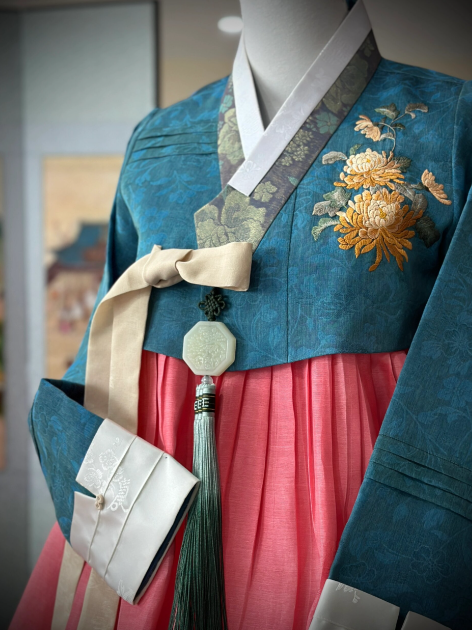
In the ethnic costume exhibition area of Beijing’s National Community Experience Hall, a plain white Korean jeogori and chima are on display. The buttonless slanted placket is tied with a long cloth belt, and the simple Embroidery on the fabric conceals gentleness, embodying both the cultural gene of the Korean “White-Clad Nation” and the warmth of multi-ethnic integration. Koreans call themselves “White-Clad Compatriots”, and white costumes are their most distinctive symbol, representing purity, nature, sacredness, as well as the nation’s emphasis on education and etiquette. For foreign travelers, visiting Beijing’s Korean communities and characteristic venues and wearing this simple and elegant costume offer an immersive experience of the Korean way of etiquette and life aesthetics—every detail tells the cultural inheritance of “upholding etiquette through white clothing”.
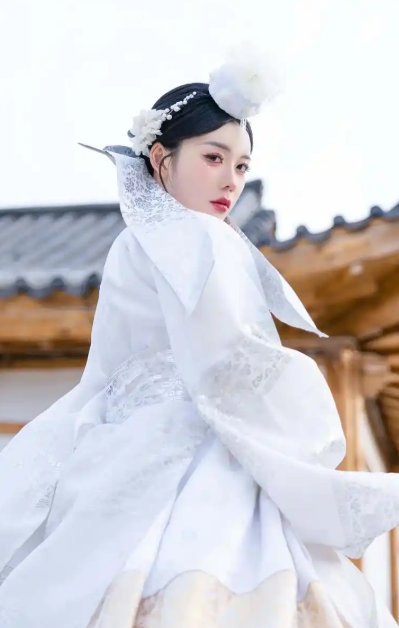
traditional Korean costumes are centered on “simplicity and regular structure”. Men’s and women’s costumes are distinctly different but share the core of “white clothing”, perfectly adapting to farming and daily social scenarios. Women’s costumes feature the classic combination of “jeogori (short jacket) + chima (long skirt)”. The jeogori is a slanted placket design without buttons, only reaching the chest, with wide cuffs. The neckline, cuffs and placket edges are embroidered with elegant flower and grass patterns. Traditional fabrics are mainly hand-woven linen and native cloth, and now satin is mostly used to improve texture. The base color is white, and soft tones such as pink and light blue can be matched for festivals.
The chima is divided into wrapped skirts and tube skirts, reaching the instep with a wide hem, swaying gracefully when walking. A 3-4 meter long cloth belt is tied around the waist to fix the skirt and adjust tightness, highlighting women’s gentle posture. Men’s costumes focus on the combination of “white jacket + waistcoat + trousers”, showing calmness and capability. The traditional men’s white jacket is a slanted placket short coat, made of white linen or cotton, breathable and cool in summer, and can be lined with cotton for warmth in winter.
A dark waistcoat is worn outside to add a sense of hierarchy, mostly in navy blue, black and other tones, some embroidered with simple geometric patterns. The trousers have wide crotches and legs, with cuffs tied tightly with cloth belts, facilitating cross-legged sitting and field work, which fits the Korean lifestyle. Both men’s and women’s costumes adopt flat cutting, with smooth lines, reflecting the integration of straight and curved beauty, and hiding the philosophy of “complying with nature”.
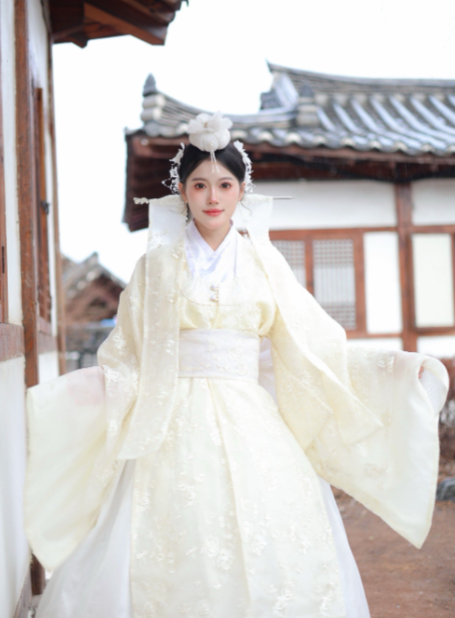
The cultural connotation of “white clothing” goes far beyond clothing itself, embodying the Korean spirit and etiquette. Koreans prefer white not only because dyes were precious in ancient times and linen was naturally white for economic reasons, but also out of pursuit of purity and sacredness—white symbolizes natural authenticity, conforming to the nation’s concept of living in harmony with nature without violating it, and also represents noble character and cleanliness. Even ancient officials would change into white clothing when returning home.
Color matching follows the principle of yin-yang and five elements, mainly plain white in daily life, with a few bright colors dotted in festivals, which is neither ostentatious nor solemn, perfectly interpreting the national trait of “valuing education and etiquette”. Patterns are mostly derived from nature, mainly flowers, plants and birds, with simple lines and no complicated decorations, highlighting simple aesthetics.
As a core of multi-ethnic integration, Beijing has many high-quality spots to experience traditional Korean costumes. The National Community Experience Hall is the first choice, displaying physical Korean costumes of different eras and providing rental services for jeogori, chima and men’s white jackets. Combined with professional explanations, visitors can learn about the cultural origin and costume evolution of “White-Clad Compatriots in detail, and participate in traditional cloth belt tying and simple Embroidery experiences to feel the ingenuity of costume craftsmanship.
Wangjing area, as a Korean community in Beijing, has many ethnic costume shops, not only providing customization and rental services, but also matching traditional embroidered shoes, hairpins and other accessories to create a complete look. The surrounding halal restaurants and Korean food shops allow visitors to experience food Culture while enjoying the costumes.
When personally experiencing Korean costumes, it is necessary to balance cultural etiquette and scenario adaptation to make the experience more meaningful. For daily check-ins, the classic white jeogori and chima or men’s white jacket with waistcoat are recommended; for festival performances, grand costumes embroidered with flower and grass patterns on cuffs can be chosen. When wearing, women should keep the slanted placket of the jeogori neat, tie the cloth belt moderately tight, and let the skirt hem hang naturally; men should keep the white jacket clean, match the waistcoat with the white jacket harmoniously, and tie the trouser cuffs tightly without looseness.
Photo spots can be the ethnic scene exhibition area of the experience hall and Wangjing Park, with oil-paper umbrellas and gayageum models as props to freeze the simple atmosphere. If encountering Korean wedding or 60th birthday banquet performances, wearing white clothing to participate will better feel the solemnity of traditional etiquette.
Wearing Korean costumes requires following basic etiquette to show respect for ethnic Culture. Costumes should be kept clean and neat, reflecting Koreans’ love for cleanliness; when interacting with others, do not touch their cloth belts and accessories at will, which is a respect for others. For major occasions such as weddings and 60th birthday banquets, pure white costumes should be chosen to symbolize holiness and auspiciousness. In ancient times, both bride and groom’s wedding dresses were plain white, embodying longing for a happy life; for daily occasions, matching can be flexible without excessive formality. In costume shops and experience halls, follow the guidance of staff to understand the etiquette stories behind the costumes, do not arbitrarily change the structure, and protect cultural inheritance.
Beyond costume experience, visitors can deeply feel the close bond between Korean Culture and costumes in Beijing. Some cultural venues regularly hold Korean costume shows, combined with nongak dance performances, to display the flexible posture of jeogori and chima in dances and fully experience cultural charm. In intangible cultural heritage workshops in Wangjing area, senior craftsmen demonstrate linen weaving and traditional Embroidery techniques on site. Visitors can closely observe the production process of white clothing fabrics and understand the ingenuity of “white clothing” from raw materials to finished products. In addition, tasting Korean delicacies such as tteok, naengmyeon and kimchi while wearing white clothing allows for an immersive experience of the ethnic lifestyle where “clothing and food are of the same origin”.
As a cultural carrier of “White-Clad Compatriots”, traditional Korean costumes take plain white as the base, regular structure as the bone, and profound etiquette as the soul, carrying the nation’s historical memories and value pursuits. In the integration with Beijing’s ancient capital culture, this set of costumes not only retains the pure characteristics of the nation, but also blooms inclusive charm. When you walk in Beijing’s venues and streets wearing white clothing, touching the soft fabric and exquisite embroidery with your fingers, you can understand the Korean cultural core of “upholding etiquette through clothing and taking simplicity as beauty”, adding a unique etiquette temperature and cultural depth to your Beijing trip.



暂无评论内容