




In the dessert spectrum of old Beijing, Wandouhuang (Pea Cake) is by no means an ordinary street snack, but a “royal delicacy” with imperial marks. It became famous for being a favorite of Empress Dowager Cixi, made from high-quality white peas through multiple cooking and setting processes, eventually achieving a unique flavor with pale yellow color, paste-like smooth texture and sweet, refreshing taste. This additive-free dessert that emphasizes natural flavor embodies the exquisite sophistication of royal cuisine and the mild restraint of Chinese desserts, making it an excellent choice for foreign tourists to experience Beijing’s imperial food Culture and soothe their taste buds.
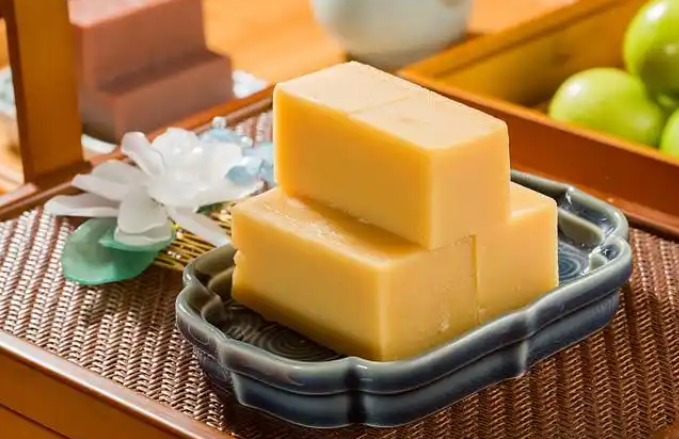
The origin of Wandouhuang can be traced back to folk cuisine, but its rise as a classic is inseparable from the support and improvement of the imperial court. In the early years, folk Wandouhuang was mostly made by directly steaming and mashing fresh peas, with a rough texture and low sweetness, serving as an affordable summer dessert for ordinary people. In the Qing Dynasty, Wandouhuang was introduced into the imperial kitchen. To cater to the royal taste, imperial chefs refined it: selecting plump premium white peas, removing their skins to ensure smoothness, and adjusting the cooking heat and sweetness to make the texture more creamy and sweet. It is said that Empress Dowager Cixi loved this dessert deeply, not only enjoying it as a post-meal treat but also rewarding it to princes and ministers. Thus, Wandouhuang was promoted from a folk snack to a royal delicacy, retaining the essence of imperial craftsmanship to this day.
The soul of Wandouhuang lies in “raw material selection” and “process control”, which together create its core trait of being “smooth as paste”. Authentic Wandouhuang has strict requirements for raw materials: only fresh premium white peas are used, which are round, free of impurities and mildew. These peas are rich in starch and have a creamier texture, unlike ordinary green peas which are sweet but slightly hard. Before production, white peas need to be soaked for 8-12 hours until the shells swell and can be peeled off with a light twist. Then the skins are removed manually (traditional craftsmanship rejects machine peeling to avoid damaging pea fibers), leaving only the smooth kernels — this is the key first step to ensuring a grain-free finished product.
The peeled kernels are put into a pot with an appropriate amount of water (pea-water ratio 1:3), boiled over high heat and then simmered over low heat for 40-60 minutes, stirring constantly to prevent sticking to the bottom, until the kernels are completely mushy and turn into a smooth pea puree. At this point, the puree needs to be sieved through a fine strainer to remove residual fine fibers, making the texture even smoother like paste — this is the core difference between imperial and folk craftsmanship. The sieved puree is poured back into the pot, added with an appropriate amount of rock sugar (traditional craftsmanship uses rock sugar instead of white sugar for its milder sweetness and less greasiness), and continuously stir-fried over low heat until the puree thickens and can cling to the spatula without dripping. A little agar is then added (or set naturally without additives), stirred evenly, poured into a square container, smoothed on the surface, cooled to room temperature naturally, and then refrigerated for more than 4 hours to set, making the texture more firm and smooth.
High-quality Wandouhuang has distinct characteristics: it has a natural pale yellow color without artificial pigments, with a smooth, flat surface free of bubbles; it is firm but not hard when scooped with a spoon, melts in the mouth without graininess, with a just-right sweetness that combines a light natural pea aroma, non-greasy, non-sticky, and refreshing aftertaste. It is perfect as a post-meal dessert or afternoon tea treat. The traditional eating method requires no complex matching — eating it directly allows you to fully experience its natural flavor. For an authentic old Beijing experience, it can be paired with a cup of warm jasmine tea or almond tea; the tea aroma neutralizes the slight sweetness, enhancing the taste layers.
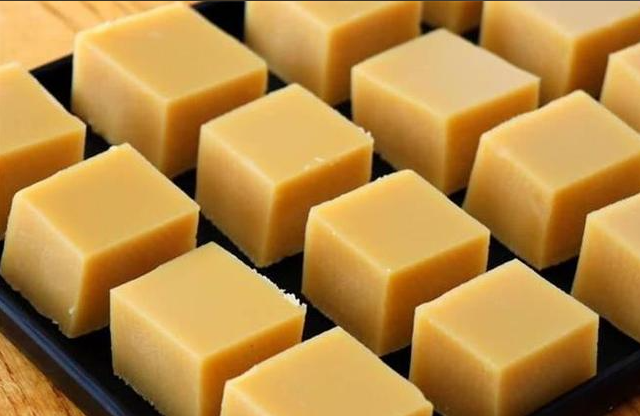
Although the authentic eating method is simple, it has small nuances. Wandouhuang is best eaten chilled, as the texture becomes more creamy and refreshing. It relieves summer heat and greasiness when eaten in summer, and does not irritate the stomach with coldness in winter. When eating, scoop small pieces with a spoon and chew slowly to feel its smooth texture, avoiding swallowing in large bites to miss the flavor. Some time-honored brands cut Wandouhuang into regular cubes with exquisite plating, highlighting the imperial ritual sense, suitable for tourists who love taking photos.
Choosing the right store is crucial to encountering Wandouhuang with the most traditional flavor. Beijing’s time-honored brands have their own characteristics, balancing imperial flavor and affordable taste: Fangshan Restaurant (Beihai Park Store) represents imperial flavor, making Wandouhuang strictly following imperial cuisine craftsmanship, with a smooth, grain-free texture and moderate sweetness. Paired with other imperial snacks in the store, it offers an immersive royal dining experience, suitable for tourists pursuing ritual sense; Huguosi Snacks (multiple branches) offers cost-effective Wandouhuang, retaining traditional flavor while catering to public taste, with a slightly higher sweetness than Fangshan, suitable for tourists who prefer sweet tastes; Niujie Hongji Snacks (Niujie Store) uses solid ingredients, with a strong natural pea aroma and firm texture, a hidden gem among old Beijingers. It can be paired with Ludagun and Ai Wo Wo in the store for a one-stop Beijing dessert experience; Daoxiangcun (multiple branches) offers vacuum-packed Wandouhuang that is easy to carry. Although the texture is slightly inferior to freshly made ones, it retains the core flavor, suitable as a souvenir.
There are several practical tips for tasting Wandouhuang to help foreign tourists better unlock this royal dessert. First, storage method: freshly made Wandouhuang can be refrigerated for 2-3 days, and vacuum-packed ones for about 7 days. It should be eaten as soon as possible after opening to avoid spoilage. Second, sweetness adaptation: if you don’t like overly sweet food, choose the version from Fangshan Restaurant with milder sweetness. Third, matching suggestions: in addition to tea, it can be paired with light Chinese pastries to avoid overlapping sweetness. Fourth, portion control: Wandouhuang is high in starch, so it should be eaten in moderation to avoid excessive satiety affecting main meals.
Beijing Wandouhuang has no complex flavor combinations, but achieves a century-old unchanged imperial flavor with the simplest ingredients and exquisite craftsmanship. It hides in the windows of time-honored brands and on the afternoon tea tables of old Beijingers, carrying the imperial memories and culinary ingenuity of this city. For foreign tourists, tasting Wandouhuang is not only a sweet taste experience but also an immersive opportunity to feel Beijing’s imperial Culture — in one bite of creaminess and smoothness, understand Chinese desserts’ persistence in natural flavor and pursuit of sophistication.



暂无评论内容