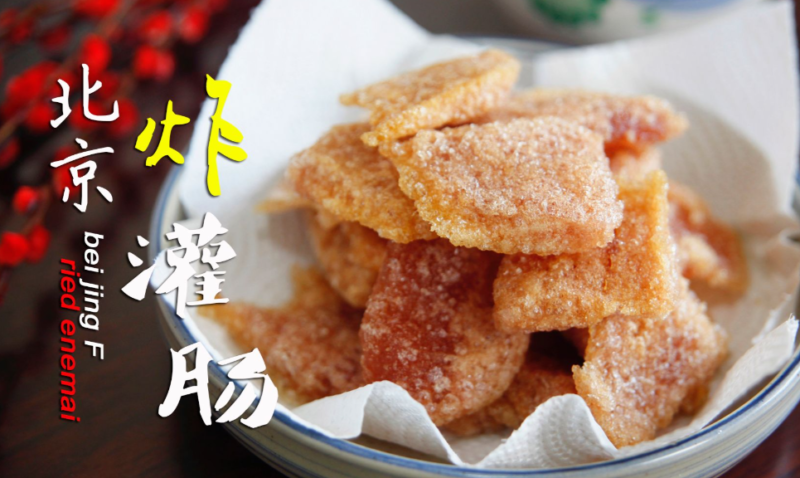





In the snack spectrum of old Beijing, Fried Guanchang is a highly recognizable delicacy with a “contrasting charm”. Named “Guanchang” (intestine), it contains no meat at all, but is a “fake intestine” made entirely of starch. Though seemingly plain, it has become an unforgettable street flavor for generations with its crispy-tender texture and fragrant garlic sauce. This snack, which requires no complex ingredients, embodies old Beijingers’ minimalist pursuit of flavor. It is not only an affordable delicacy on the streets, but also a friendly choice for foreign tourists to experience local snack Culture without encountering offal flavors.
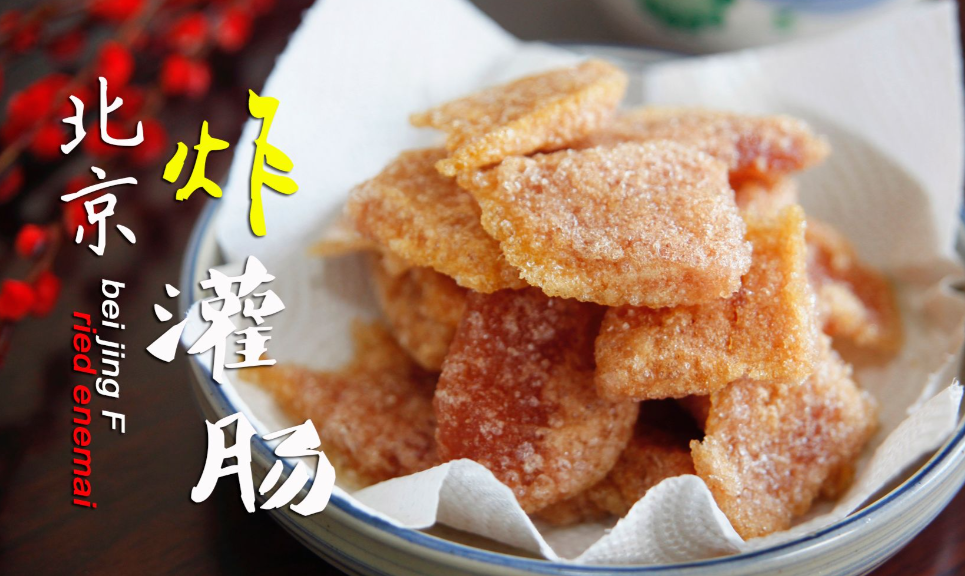
The origin of Fried Guanchang is deeply rooted in the street life of old Beijing in the late Qing Dynasty and early Republic of China, catering to the people’s demand for “affordable satisfaction”. In the early years, most Guanchang sold on Beijing streets was meat-based, with a relatively high price that ordinary people could not afford often. To satisfy the public’s taste buds, vendors used mung bean starch and sweet potato starch as the main ingredients, mixed with water and a little salt to make a paste, poured it into a container, steamed and set it into a meat-free “starch Guanchang”, sliced and fried it for sale. Due to its chewy texture and affordable price, it quickly became popular. After a hundred years of evolution, Fried Guanchang not only retains traditional craftsmanship, but also becomes one of the iconic representatives of old Beijing snacks, commonly seen as breakfast and night market food on the streets.
The soul of Fried Guanchang lies in the “texture of the starch base” and the “control of frying heat”, which together create the core texture of being crispy outside and tender inside. The ratio of raw materials for authentic Fried Guanchang is extremely particular, mostly mung bean starch as the main component and sweet potato starch as a supplement. Mung bean starch brings a chewy texture, while sweet potato starch adds softness. They are mixed in a ratio of 3:1, added with an appropriate amount of water and salt, and stirred into a smooth paste without particles. Pour the paste into a square or cylindrical container, steam it in a steamer over high heat for 20-30 minutes until it is completely solidified and set, take it out to cool, then slice it into thin pieces — the thickness of the slices must be uniform, about 0.5 cm is optimal. Too thin slices are easy to burn and dry, while too thick ones will have an uncrispy outer skin and a hard inner part.
Frying is a key step determining the texture of Fried Guanchang, testing the chef’s experience and heat control. Pour a sufficient amount of peanut oil into the pot and heat it to 160-180℃, at which point the oil surface smokes slightly and a chopstick will float up quickly and bubble when put in. Put the sliced Guanchang into the pot in batches, avoiding overcrowding to ensure even heating, and gently turn them with chopsticks to make each slice fully contact the oil. When the Guanchang slices are fried until golden on both sides, with slightly crispy edges and small bubbles on the surface, take them out quickly to drain the oil. At this time, the outer skin of the Guanchang is crispy and dry, while the inner part still maintains the soft and chewy texture of starch. When bitten, you can feel the wonderful layer of “crispy shell wrapping soft core” without any greasiness.
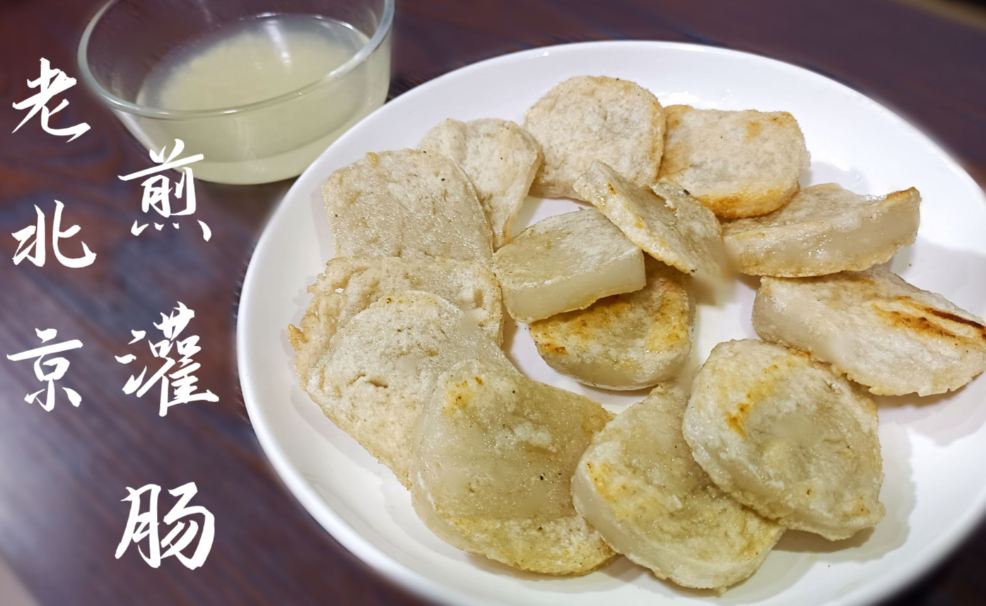
If frying determines the texture of Fried Guanchang, then garlic sauce is the “finishing touch” that highlights the flavor, and neither can be separated from the other. The preparation of traditional garlic sauce is simple yet sophisticated: select fresh garlic and mash it into a fine paste, dilute it with an appropriate amount of cold boiled water (to avoid excessive spiciness), then add soy sauce and a little vinegar in proportion. Some shops also drizzle a few drops of sesame oil to enhance the aroma, making a dipping sauce that is salty, slightly sour and rich in garlic flavor. The sour aroma of the garlic sauce can neutralize the thickness of the starch, making the flavor of Fried Guanchang more layered. It can not only highlight the crispness of the outer skin, but also set off the softness of the inner part. This is also the fixed matching for old Beijingers to eat Fried Guanchang, which is irreplaceable.
The authentic eating method can maximize the flavor of Fried Guanchang and also contains small customs of old Beijingers. Fried Guanchang should be eaten while it’s hot after being taken out of the pot, as the crispness of the outer skin is at its best at this time. It will become soft and sticky when cold, losing the core texture. When eating, pick up a slice of Guanchang with chopsticks, dip it evenly in the garlic sauce to let the garlic aroma fully penetrate every part of the Guanchang. Take a bite, the crispy outer skin breaks in the mouth first, followed by the soft and chewy inner part, paired with the salty, slightly sour garlic sauce, the taste is rich. Some old Beijingers also prefer to “dip while eating”, ensuring fresh garlic aroma in every bite without wasting any flavor.
Choosing the right store is crucial to encountering the most authentic flavor of Fried Guanchang. Beijing’s time-honored brands and characteristic small shops have their own advantages: Beixinqiao Luzhu Laodian (Dongsi North Street Store) adheres to traditional craftsmanship for Fried Guanchang, with an authentic starch ratio and precise frying heat, highlighting the crispy-tender texture. The garlic sauce is thick and rich in garlic flavor, and you can experience old Beijing snacks in one stop with Luzhu in the store; Huguosi Snacks (multiple branches) offers Fried Guanchang with a mild taste and moderately sour garlic sauce, suitable for foreign tourists trying it for the first time. It can also be paired with Douzhi and Jiaoquan to form a classic set meal; Menkuang Hutong Century Luzhu (multiple branches) serves Fried Guanchang with large portions, a more crispy outer skin and a soft, non-sticky inner part, loved by young people; home-style small restaurants in hutongs are more full of fireworks. The owners steam Guanchang by hand and fry it on order, hiding the most local home-style flavor.
There are several practical tips for tasting Fried Guanchang to help foreign tourists better unlock this Beijing-style snack. First, texture choice: if you prefer a crispy texture, you can ask the store to fry it a little longer; if you like a soft texture, inform them to “fry for a shorter time” in advance. Second, garlic sauce adaptation: if you are not good at eating spicy food or are afraid of excessive garlic flavor, you can ask the store for “less garlic and light taste”, or pair it with jasmine tea and sour plum soup to relieve greasiness. Third, eating time: be sure to eat it immediately after frying, do not leave it for a long time to avoid affecting the crispy texture. Fourth, matching suggestions: in addition to eating alone, it can also be paired with sesame cakes and fried dough sticks as a staple food, which is more filling and has a more coordinated flavor.
Beijing Fried Guanchang has no complex ingredients or tedious procedures, but achieves a century-old unchanged flavor with the simplest starch and precise heat. It hides in small shops on streets and alleys, in the taste memory of old Beijingers, carrying the street warmth of this city and the extreme pursuit of simple flavor. For foreign tourists, tasting Fried Guanchang is not only a relaxed taste experience, but also an immersive opportunity to feel the local life of old Beijing — in the collision of crispness and softness, garlic aroma and starch aroma, understand the unique charm of old Beijing snacks.







暂无评论内容