




In the food spectrum of old Beijing, Zhajiangmian (noodles with soybean paste) is never a grand banquet dish, but a home-style flavor that runs through three meals and carries the memories of generations. It has no complex ingredients or tedious procedures, but relies on the triple collision of “chewy handmade noodles, mellow sauce, and refreshing toppings” to achieve the unique charm of “diverse flavors from different families” — every Beijing family has its own secret sauce recipe, and every old store has its own flavor focus. This bowl of noodles hides the simplest Beijing-style fireworks, and is also an excellent choice for foreign tourists to get close to local life and feel street warmth.
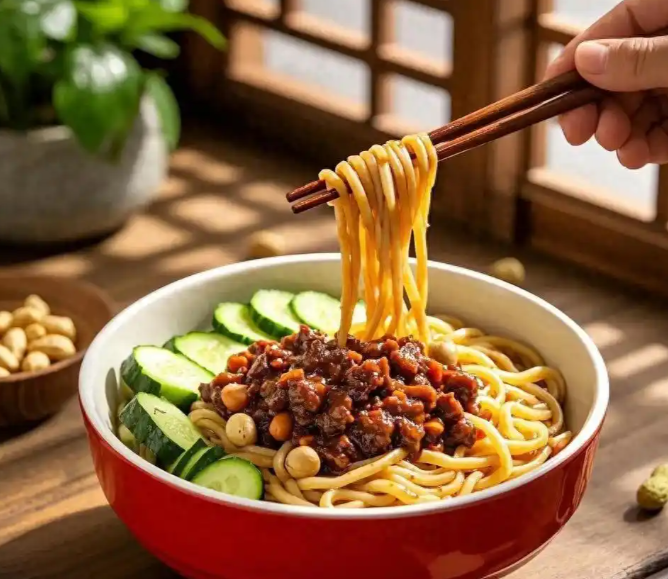
The origin of Zhajiangmian is deeply rooted in northern farming Culture and street life. In the early years, wheat was abundant in the north, and noodles became a common staple on people’s dining tables. The sauce was created to add flavor to simple noodles and facilitate preservation. The initial sauce used simple ingredients, mostly stir-fried with yellow soybean paste fermented from soybeans and seasonal vegetables. Later, with the improvement of living standards, diced pork belly was gradually added, making the taste more fragrant and mellow. After hundreds of years of evolution, Zhajiangmian has not only become a daily staple of Beijingers, but also integrated into regional cultural characteristics. Different families and regions adjust the sauce ratio and topping types according to taste preferences, eventually forming a pattern of “diverse flavors from thousands of families”, becoming a vivid symbol of old Beijing’s food Culture.
The soul of an authentic bowl of Zhajiangmian lies first in the chewy texture of handmade noodles. Authentic old Beijing Zhajiangmian prefers hand-rolled wide noodles, using high-gluten flour, mixing with warm water, adding a little salt to increase toughness, kneading repeatedly until the dough is smooth and firm, and letting it rest for more than 30 minutes to fully stretch the gluten. Roll the rested dough into thin slices, fold it, and cut into evenly wide noodles (the width can be adjusted according to preference; wide noodles are better for holding sauce, while thin noodles are more refreshing). Cook the noodles in boiling water, remove and rinse with cold water (in summer) or serve directly (in winter). The toughness and chewiness of handmade noodles are core advantages that machine-made noodles cannot replace, as they can firmly absorb the aroma of the sauce, making every bite full of flavor.
The sauce is the flavor core of Zhajiangmian. The combination of “diced pork belly + yellow soybean paste/sweet bean sauce” is the foundation, and the ratio and heat determine the final taste. Choose fat and lean pork belly, cut into evenly sized diced pieces, with a fat-to-lean ratio of 3:7, which can ensure the sauce is fragrant without being too greasy. The sauce usually adopts a golden ratio of 2:1 for yellow soybean paste and sweet bean sauce — yellow soybean paste is salty and fragrant, while sweet bean sauce neutralizes the saltiness and adds a warm sweetness, avoiding being too salty with only yellow soybean paste or too greasy with only sweet bean sauce. When stir-frying, first put the diced pork belly into the pot and stir-fry to extract oil. When the diced pork is golden and crispy, add chopped green onions and ginger to sauté until fragrant. Pour in the mixed sauce, turn to low heat and stir-fry slowly for 15-20 minutes, stirring constantly to ensure each diced pork is evenly coated with the sauce. Continue until the sauce is thick and shiny on the surface, then drizzle with a little sesame oil to enhance aroma. A bowl of mellow and fragrant sauce is ready.
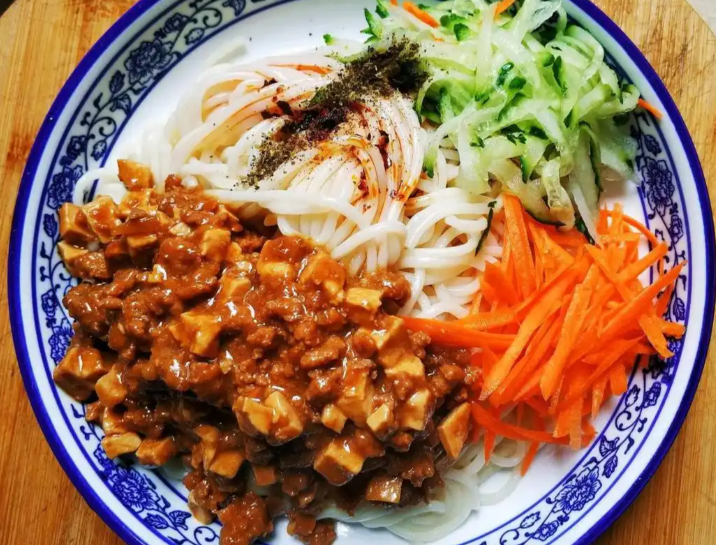
Toppings are the finishing touch of Zhajiangmian. The rich side dishes not only enrich the taste layers, but also embody the dietary wisdom of old Beijingers. Toppings emphasize “changing with the seasons and refreshing to relieve greasiness”. Common ones include cucumber shreds, mung bean sprouts, celery mince, carrot shreds, green peas, soybeans, Chinese toon sprouts, and garlic puree. In summer, it is often paired with refreshing cucumber shreds and bean sprouts; in winter, warm carrot shreds and green peas are added. These toppings can not only neutralize the richness and greasiness of the sauce, but also add a crispy texture and natural fragrance, while making the color of the whole bowl of noodles more vivid. When eating Zhajiangmian, old Beijingers match toppings according to personal preference, which can be more or less, simple or complex — this is also an important embodiment of “diverse flavors from different families”.
The authentic eating method can better highlight the flavor essence of Zhajiangmian and also carry the ritual sense of old Beijingers. The standard way is “mix sauce first, then add toppings”: put the cooked handmade noodles into a bowl, scoop 2-3 spoons of sauce on top, stir quickly with chopsticks to ensure each noodle is evenly coated with sauce, then add an appropriate amount of toppings according to preference and stir well before eating. Some people prefer to eat “a bite of noodles with a bite of toppings”, allowing the freshness and fragrance to alternate in the mouth; others will match with garlic cloves and chili oil to enrich the taste layers. It is worth mentioning that old Beijing Zhajiangmian emphasizes “mix and eat immediately” to avoid the noodles becoming soft and the sauce getting cold, which affects the taste.
Choosing the right store allows you to experience different styles of Zhajiangmian and feel the charm of “diverse flavors”. Beijing’s time-honored brands and characteristic stores have their own advantages: Haiwan Ju (Nanluoguxiang Store) is a well-known store focusing on old Beijing flavors. Its handmade noodles are chewy, the sauce is moderately salty and fragrant, with a variety of toppings. Matching with the store’s Beijing-style snacks, the atmosphere is full, suitable for tourists pursuing traditional flavors; Fangzhuanchang No.69 Zhajiangmian (Fangzhuanchang Hutong Store) is a popular time-honored brand. The sauce is rich in ingredients, with a large amount of diced pork belly, fresh and refreshing toppings, and high cost performance, loved by Chinese and foreign tourists; Sijiminfu (multiple branches) improves Zhajiangmian on the basis of tradition, with slightly less sweet sauce, more suitable for tourists who prefer light taste. Eating it with Peking duck is a classic combination; home-style small restaurants in hutongs are more full of fireworks. Most owners are old Beijingers, and the sauce has an authentic taste, allowing you to experience the most local home-style flavor.
There are several practical tips for tasting old Beijing Zhajiangmian to help foreign tourists better unlock this Beijing-style staple. First, handmade noodles can be chosen in width and thickness according to taste preference — wide noodles are good for holding sauce, while thin noodles are easier to eat. Second, the sauce has a high salt content. Pairing with light drinks such as barley tea and jasmine tea can effectively relieve greasiness. Third, toppings can be freely matched. For the first try, it is recommended to take a small amount of each to feel the collision of different textures. Fourth, some stores provide “single-person set meals”, including noodles, sauce, and a variety of toppings, with high cost performance, suitable for first-time experience.
Old Beijing Zhajiangmian has no exquisite plating or rare ingredients, but with its simplest matching, it has become an unforgettable taste memory of old Beijingers. It hides on the dining tables of ordinary families and in small restaurants deep in hutongs, carrying the street warmth of this city and the persistence in flavor. For foreign tourists, tasting Zhajiangmian is not only a taste experience, but also an immersive opportunity to feel the local life of old Beijing — in the rich and fragrant taste of a bowl of noodles, understand the life attitude and dietary wisdom of old Beijingers.







暂无评论内容