




In the snack spectrum of old Beijing, Douzhi (fermented mung bean drink) with Jiaoquan (crispy fried dough rings) is a highly recognizable “taste card”. Unlike the world-famous Peking duck or the delicate Baodu, it has become a daily flavor deeply rooted in old Beijingers’ bones with the wonderful combination of “sour and astringent Douzhi + crispy Jiaoquan”. This seemingly “niche” pairing hides the most authentic Beijing-style fireworks — the mellow fermented taste of Douzhi neutralizes the extreme crispness of Jiaoquan, and together with the salty aroma of preserved vegetable shreds, every bite embodies the dietary wisdom of old Beijingers. For foreign tourists, it is not only a unique challenge for the taste buds but also a necessary way to deeply experience local Culture.
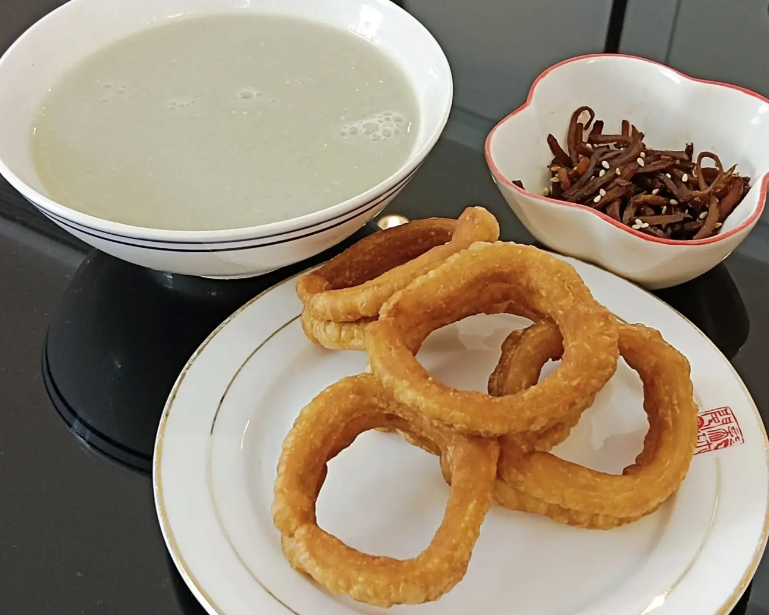
The origin of Douzhi with Jiaoquan is deeply rooted in the street life of old Beijing, carrying the life philosophy of “making the best use of everything”. In the early years, when Beijing’s mung bean processing workshops made mung bean starch and vermicelli, a large amount of mung bean dregs and juice were produced. Unwilling to discard them, vendors tried to seal and ferment the juice, accidentally creating Douzhi. Initially, Douzhi was a cheap drink for ordinary people. Due to its rich nutrition and easy preservation, it gradually became popular on the streets. The history of Jiaoquan can be traced back to the Yuan Dynasty, when it was called “Jian Huan Bing” (fried ring cakes), and was deeply loved by people for its crispy taste. Over time, old Beijingers found that the crispness of Jiaoquan could neutralize the sourness and astringency of Douzhi. When paired with preserved vegetable shreds, the taste level became more coordinated, thus forming the fixed combination of “Douzhi + Jiaoquan + preserved vegetable shreds”, which has been passed down for a hundred years.
The soul of this pairing lies first in the fermentation process of Douzhi. Its unique sour and astringent flavor comes from the rigorous production process. Authentic Douzhi uses high-quality plump mung beans, processed through multiple procedures: first, soak the mung beans until they are full and swollen, grind them into fine mung bean paste, and separate the soybean milk from the dregs with gauze; pour the filtered juice into a container, seal it and place it in a cool place for natural fermentation. The fermentation time must be strictly controlled between 24-48 hours — too high temperature will cause deterioration, while too low temperature will result in insufficient flavor. The fermented Douzhi is pale yellow, thick in texture, and emits a strong fermented aroma. It tastes sour first, then astringent, with a faint bean aroma in the aftertaste. Beginners often find it hard to adapt, but the more you taste it, the more you can appreciate its mellow connotation.
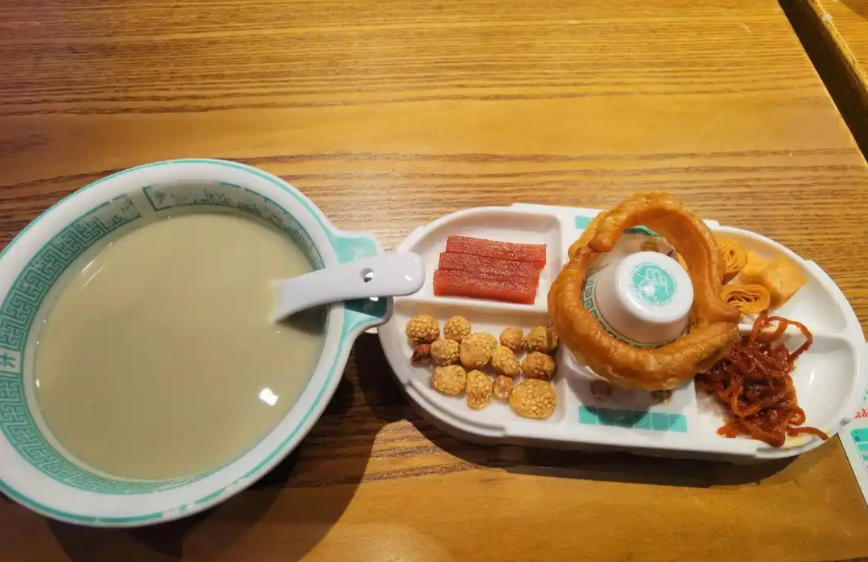
As the “best partner” of Douzhi, the secret of Jiaoquan’s crispy texture lies in dough preparation and frying heat. The dough of traditional Jiaoquan is based on flour, mixed with alkaline water, alum (some shops use alum-free improved formulas) and warm water, kneaded repeatedly until the dough is smooth and elastic, and left to proof for more than 1 hour to fully relax the dough. Roll the proofed dough into thin slices, cut into narrow strips, stack every two strips together, cut a small opening in the middle, pinch both ends with both hands and twist into a spiral shape, then arrange into a ring. This allows even heating during frying, forming a crispy outer layer and hollow inner part. For frying, high-temperature resistant peanut oil is used, and the oil temperature is controlled at about 180℃. Put the raw blanks into the oil and turn them constantly. Remove them when the Jiaoquan is fried until golden and crispy with small bubbles on the surface. Drain the oil for the best taste — it makes a “click” sound when bitten, without any greasiness.
Preserved vegetable shreds, though seemingly insignificant, are the “finishing touch” of the whole pairing. traditional preserved vegetable shreds are made of green radish or leaf mustard, cut into evenly thick shreds, marinated with salt, drained of water, and mixed with a little sesame oil and chili oil. They taste salty, fragrant and crispy, with a faint spiciness. Their function is to neutralize the sourness and astringency of Douzhi and the greasiness of Jiaoquan, forming a balance of “sour, crispy and salty” in the mouth and enriching the taste layers. Some time-honored brands also provide a condiment station with garlic puree, chili oil, etc., for diners to adjust according to their tastes.
Mastering the authentic eating method can make the experience of Douzhi with Jiaoquan more ritualistic. The standard way of old Beijingers is: first pour Douzhi into a bowl, heat it according to preference (hot Douzhi highlights the bean aroma better, while cold Douzhi has a stronger sour taste), pair with 1-2 Jiaoquan, pick up a chopstick of preserved vegetable shreds, hold the bowl with one hand to drink Douzhi, and hold Jiaoquan with the other hand to bite slowly. Or break Jiaoquan into small pieces and soak them in Douzhi, allowing Jiaoquan to absorb the flavor of Douzhi, changing the texture from crispy to creamy. For foreign tourists trying it for the first time, it is recommended to drink a small amount of Douzhi first, and take it with Jiaoquan and preserved vegetable shreds to reduce the impact of sourness and astringency. If the sourness is too strong, you can pair it with a piece of sweet cake to neutralize the taste.
Choosing the right restaurant is crucial to tasting authentic Douzhi with Jiaoquan. Beijing’s time-honored restaurants have their own characteristics, carrying different taste memories: Yin San Douzhi (Tiantan Store) is a recognized time-honored brand for Douzhi. Its Douzhi is fully fermented with rich flavor, Jiaoquan is fried and sold on the spot, crispy and not greasy, and preserved vegetable shreds are moderately salty and fragrant. It is the first choice of old Beijingers, often with long queues during peak hours, suitable for tourists pursuing traditional flavors. Huguosi Snacks (multiple branches) focuses on home-style flavor. Its Douzhi has a mild taste with weak sourness and astringency, Jiaoquan has large portions and rich collocations, suitable for foreign tourists trying for the first time. Laociqikou Douzhi Store (Chongwenmen Outer Street Store) has a long history. Its Douzhi is thick in texture, Jiaoquan is made by traditional craftsmanship, and the store also provides snacks such as Ludagun and Ai Wo Wo, allowing one-stop experience of old Beijing flavors. Beixinqiao Luzhu Laodian (Dongsi North Street Store) not only serves Luzhu but also excellent Douzhi with Jiaoquan, full of street atmosphere, suitable for tourists who like fireworks.
There are several practical tips for tasting Douzhi with Jiaoquan to help foreign tourists better unlock this Beijing-style snack. First, Douzhi has a special flavor. Beginners are advised not to drink it on an empty stomach, but to pair it with Jiaoquan, preserved vegetable shreds or other staple foods. Second, Jiaoquan is best eaten immediately after frying; it will become soft and lose its crispy texture when cold. Third, Douzhi is rich in nutrition, containing dietary fiber and probiotics, but its acidity is relatively high, so people with sensitive stomachs should eat it in moderation. Fourth, some stores provide “Douzhi set meals”, including Douzhi, Jiaoquan and preserved vegetable shreds, with high cost performance, suitable for first-time experience.
Douzhi with Jiaoquan has no exquisite plating or complex ingredients, but with its simplest pairing, it has become a vivid carrier of old Beijing’s food Culture. It hides in snack shops on streets and alleys, in the breakfast tables of old Beijingers, carrying the street warmth of this city and the persistence in flavor. For foreign tourists, tasting Douzhi with Jiaoquan is not only a unique taste experience but also an immersive opportunity to feel the local life of old Beijing — in the collision of sourness, astringency and crispness, understand the taste feelings and life attitude of old Beijingers.







暂无评论内容