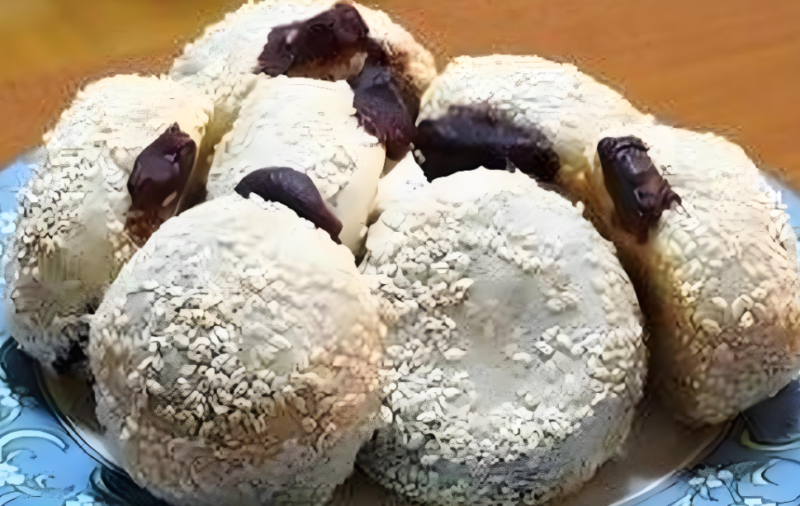





Among the diverse types of pancakes in old Beijing, Hama Tumi (Frog Spitting Honey) is a distinctive sweet representative. It has no fancy name, but with its straightforward and humorous appearance, as well as the interweaving taste of crispness and sweetness, it has become a classic snack rooted in the streets. This red bean paste-filled pancake, after being baked over charcoal fire, has plump filling bursting naturally from the edge, resembling a frog opening its mouth to spit honey. It is both interesting and exquisite in craftsmanship. The rich sweet flavor is the daily sweetness in old Beijingers’ memories, and also an excellent choice for foreign tourists to explore authentic Beijing street food.
The origin of Hama Tumi is rooted in the streets of Beijing in the late Qing Dynasty and early Republic of China, and its name is straightforward and full of life charm. In the early years, most pancake shops on Beijing’s streets served ordinary people. Chefs made sweet pancakes with simple flour and red bean paste. They accidentally found that when the filling is plump and the heat is properly controlled, the pancake crust will expand due to heating during baking, making the red bean paste squeeze out from the edge crack, which looks like a frog opening its mouth to spit pulp. Thus, it was jokingly named “Hama Tumi”. This down-to-earth name spread quickly, and it also made this snack full of familiarity. Unlike the exquisiteness of imperial snacks, it has been full of street attributes since its birth. It can be bought for a few cents, serving as a delicious treat for children and a light meal for adults. After hundreds of years of inheritance, it is still a vivid flavor on the streets of old Beijing.
The soul of Hama Tumi lies in the “ratio of filling to crust” and the “heat control for baking cracks”, which together create the core trait of excellent shape and taste. Authentic Hama Tumi has strict requirements for raw materials, and every detail affects the final taste: medium-gluten flour must be used, mixed with warm water, yeast, a small amount of sugar and edible oil to knead into a dough of moderate hardness. It must not only ensure the crispness and toughness of the pancake crust but also naturally crack during baking; the red bean paste filling must be hand-fried pure red bean paste, refusing to add preservatives and excessive sugar. Red beans are soaked, steamed, crushed and stir-fried slowly to make it dense and smooth without particles. The sweetness should highlight the original flavor of red beans, as excessive sweetness will cover the crispness of the pancake crust.
The production process seems simple, but in fact, every step of kneading dough, wrapping filling and baking has its secrets, especially the baking step, which directly determines whether the iconic “frog mouth” shape can be formed. First, knead and ferment the dough: add warm water to medium-gluten flour to knead into a smooth dough, and proof until it doubles in size. The fully proofed dough has both toughness and ductility, laying the foundation for subsequent cracking; then divide the proofed dough into evenly sized pieces, roll each piece into a ball and press into a thin pancake, put in a sufficient amount of red bean paste filling (the filling accounts for about 40%, which should be plump but not overflow), pinch the mouth tightly, gently press into a round pancake blank. The edge of the pancake should be slightly thinner than the body to leave enough space for cracking during baking.
Baking is the key to achieving the soul shape and taste of Hama Tumi. The traditional method uses charcoal fire baking. Although electric ovens are used instead modernly, the core heat control remains unchanged. Put the pancake blanks into an oven preheated to 200℃ (for charcoal ovens, control the distance from the charcoal to ensure uniform heating), bake for 5 minutes to set the crust, then turn to 180℃ and bake slowly for 10-12 minutes. During baking, the pancake crust expands when heated, and the internal red bean paste softens and overflows due to high temperature. The edge of the pancake, which was processed to be thinner in advance, will crack naturally, forming irregular cracks. The red bean paste squeezes out from the cracks, shiny in color, resembling a frog opening its mouth to spit honey. At the same time, the surface of the pancake crust will be baked into a uniform golden brown, forming a crispy outer shell, while the inside remains soft due to the moisture of the filling.
High-quality Hama Tumi has distinct characteristics: it is round in shape, with natural cracks on the edge, and red bean paste filling overflows from the cracks, looking attractive with bright red color; the outer crust has clear layers, crispy and dry, falling off crumbs when bitten gently but not loose; the inner filling is dense and smooth, with a strong original flavor of red beans, sweet but not cloying, moist but not greasy. The salty crispness of the crust and the sweetness of the red bean paste interweave, with rich taste layers. The traditional eating method requires no complex matching; it can be eaten directly. Hama Tumi just out of the oven has the best taste, with crispy crust and warm, soft and sweet filling. Every bite can taste the original flavor of the ingredients. Old Beijingers prefer to pair it with a bowl of warm millet porridge or soybean milk. The salty and fresh taste neutralizes the sweetness, making the taste buds more comfortable. It can also be paired with jasmine tea, whose fragrance can resolve slight greasiness and highlight the overall flavor.
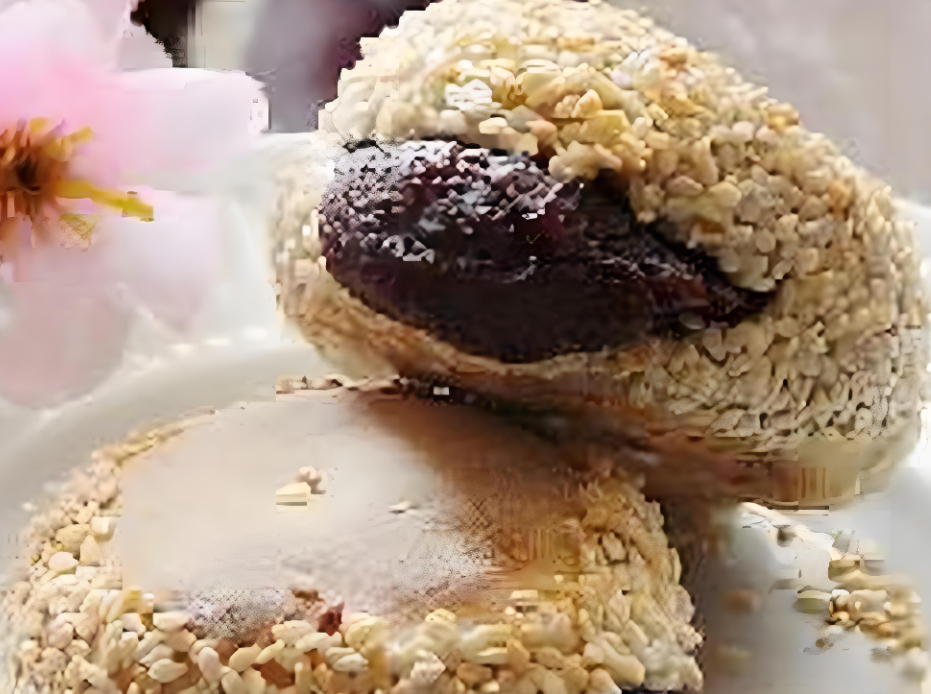
To taste the most authentic Hama Tumi, you can’t go wrong with time-honored brands and alley pancake shops that adhere to traditional craftsmanship. Time-honored brands in Niujie area are the first choice, such as Hongji Snacks (Niujie Store), which insists on hand-kneading dough, hand-frying filling and charcoal baking. The produced Hama Tumi has natural cracks, plump filling and rich sweet flavor, perfectly restoring the old Beijing flavor, making it the first choice for foreign tourists trying it for the first time. Baiji Rice Cake (Niujie Store) has Hama Tumi with a crispier crust and dense red bean paste filling, with moderate sweetness, suitable for tourists who prefer crispy taste. In addition, old pancake shops in alleys, such as convenience stalls near Xisi and Nanluoguxiang, sell freshly baked Hama Tumi full of street charm, allowing tourists to experience the purest street taste.
There are several practical tips for tasting Hama Tumi to help foreign tourists better unlock this delicacy. First, eating time: it is best to eat immediately after baking, when the outer crust is crispest and the inner filling is softest and sweetest. The crust will become soft when cooled, and the filling is easy to solidify, greatly reducing the taste. Second, flavor adaptation: the hand-made red bean paste filling has moderate sweetness. If you don’t like overly sweet food, you can pair it with salty and fresh drinks to neutralize the sweetness and avoid taste fatigue. Third, eating precautions: the inner filling of Hama Tumi just out of the oven is very hot, so it should be eaten after cooling for a while to avoid scalding. Fourth, storage method: freshly made Hama Tumi is recommended to be eaten the same day. For short-term storage, seal it and place it at room temperature for no more than 4 hours. Before eating again, it can be heated in the oven for 2 minutes to restore the crispy taste.
Beijing Hama Tumi has no royal elegance of imperial snacks, nor complex ingredients, but with its humorous appearance and interweaving taste of crispness and sweetness, it occupies a place in old Beijing snacks. It hides in street pancake shops, in the aroma of charcoal fire, and in the daily life of old Beijingers, interpreting street warmth with the simplest flavor. For foreign tourists, tasting Hama Tumi is not only a taste experience but also an immersive opportunity to feel the street Culture of old Beijing — in a bite of crispness and sweetness, understand the most down-to-earth and touching street flavor of this city.








暂无评论内容