




In Shanghai, a city where modernity and tradition blend harmoniously, the Western-style buildings on the Bund show the charm of East-West integration, and the pavilions and waterside pavilions of Yu Garden carry the elegance of Jiangnan gardens. Beside Luodian Ancient Town in Baoshan District, there is a low-key but stunning ancient temple hidden — Shanghai Baoshan Temple. Away from the hustle and bustle of the urban area, it takes pure Late Tang style wooden architecture as its core, and reproduces the grandeur and exquisiteness of Oriental architecture thousands of years ago with its nail-free mortise and tenon craftsmanship. Without excessive commercial packaging, there are only quiet incense and profound history, making it an excellent window for foreign tourists to understand Chinese traditional architectural aesthetics and feel the charm of Buddhist Culture. Here, every wooden beam and every cornice hides the wisdom of the ancients, and every wisp of incense and every shade of green conveys the tranquility of the East. There is no need to rush to check in, just walk calmly and immerse yourself in the architectural beauty and cultural heritage spanning thousands of years.
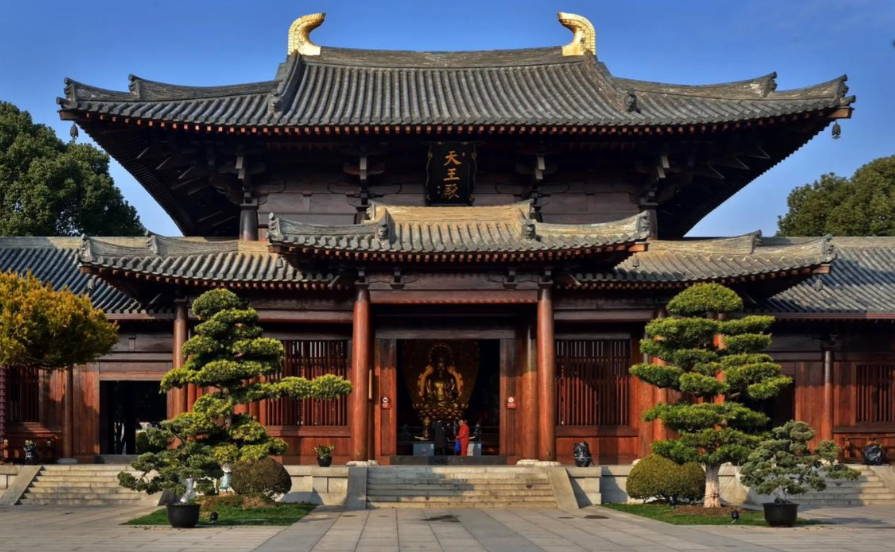
Shanghai Baoshan Temple is located at No. 255 Qilian Road, Luodian Town, Baoshan District, adjacent to Luodian Ancient Town, which is known as “Golden Luodian”. It has a superior geographical location and a quiet environment, covering a total area of more than 12,000 square meters. It is one of the largest Buddhist temples in Shanghai and one of the few pure Late Tang style wooden temples in China. Tracing its history, Baoshan Temple was first built in the sixth year of Zhengde in the Ming Dynasty (1511). It was originally donated and built by Tang Yuexuan, a local gentleman, with his private residence, initially named “Fanwang Palace”. After renovations and changes in the Ming and Qing dynasties, it was once destroyed by wars and the erosion of time, leaving only some relics. In 2005, the reconstruction project of Baoshan Temple was launched, which took five years and was officially completed and opened to the public in 2010. The reconstructed temple strictly follows the architectural regulations of the Late Tang Dynasty, uses African padauk wood as the main building material, and adopts the traditional mortise and tenon structure throughout, without using a single nail or rivet. It perfectly restores the simplicity, grandeur and momentum of wooden architecture in the Late Tang Dynasty, while retaining the historical heritage of the original temple. It has become a very distinctive ancient temple site in Shanghai and even the whole country. In 2009, it was listed as a cultural relic protection unit of Baoshan District, carrying the religious Culture and architectural art memory of Shanghai.
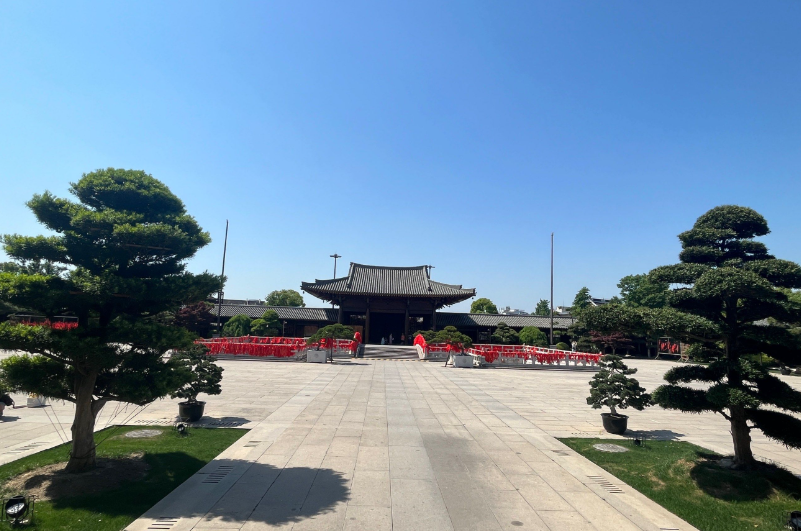
Walking into Baoshan Temple, you are first shocked by its grand, simple and elegant architectural style. The entire temple adopts the traditional Buddhist temple vertical axis layout, with a series of buildings arranged from south to north in turn, including the Mountain Gate, Heavenly King Hall, Bell Tower, Drum Tower, Mahavira Hall, Guanyin Hall and Scripture Collection Pavilion. They are symmetrical and scattered, and each building strictly follows the Late Tang Dynasty shape. The overhanging eaves and corners, staggered brackets, without redundant decorations, show the simple but extraordinary Oriental aesthetics. As the entrance of the temple, the Mountain Gate is magnificent, adopting a single-eave gable and hip roof. The wooden beam frame has clear textures, and the brackets under the eaves are stacked layer upon layer, with smooth and powerful lines. The four big characters “Baoshan Jing Temple” on the lintel are vigorous and powerful, and the stone lions on both sides are majestic and solemn, which not only shows the solemnity of the temple, but also conveys the powerful style of Late Tang architecture. After entering the Mountain Gate, a long corridor runs through the north and south of the temple, with a total length of 471 meters. The wooden columns and beams of the corridor are connected by mortise and tenon. Walking on it, you can clearly see the exquisite interlocking between the wooden components, as if you can hear the sound of ancient craftsmen working. On both sides of the corridor, there are green plants such as pines, cypresses and bamboos, which are evergreen all the year round, setting off against the simple wooden architecture. The sunlight sprinkles on the wooden columns through the gaps of the branches and leaves, with staggered light and shadow, full of atmosphere.
The most distinctive and worthy of foreign tourists’ attention in Baoshan Temple is its nail-free mortise and tenon craft, which is also the essence of Chinese traditional wooden architecture. All the buildings in the temple, whether the tall Mahavira Hall, the exquisite auxiliary halls or the corridors, adopt pure hand-made mortise and tenon structure. Different wooden components are closely connected through concave-convex interlocking, without a single nail or rivet, but they can stand firm through wind and rain, showing the superb architectural skills and wisdom of the ancients. Among them, the Mahavira Hall is the core building of the temple, adopting a double-eave gable and hip roof, about 20 meters high. The beam frame and brackets inside the hall are all made of African padauk wood, with delicate texture and warm color. The brackets under the eaves are dense and regular, stacked layer upon layer, which not only plays a load-bearing role, but also adds decorative beauty to the building. From a distance, the overhanging eaves and corners are like eagles spreading their wings, grand and spectacular. Inside the hall, there is a statue of Sakyamuni Buddha, solemn and dignified. The murals on both sides of the Buddha are lifelike, depicting Buddhist stories, with elegant but solemn colors. Foreign tourists can learn the basic connotation of Chinese Buddhist Culture and feel the solemnity and sacredness of Buddhism here.
In addition to the shocking wooden architecture, the courtyard landscape of Baoshan Temple is also quite distinctive, combining Buddhist culture with the elegance of Jiangnan gardens. The interior of the temple is covered with lush green plants. Pines, cypresses, bamboos, sweet-scented osmanthus, wintersweet and other plants are planted scattered, with scenery to enjoy in all seasons: in spring, bamboo shoots sprout and flowers bloom, making the courtyard full of vitality; in summer, the thick shade blocks the sun and the breeze blows, making it an excellent place to escape the heat; in autumn, the sweet-scented osmanthus fills the garden and the fallen leaves fly, quiet and artistic; in winter, the pines and cypresses are evergreen and the snow covers the eaves, showing the solemnity and tranquility of the ancient temple. There are also landscapes such as a release pool, stone lanterns and ancient steles in the courtyard. The release pool is rippling with blue waves, and the fish are playing. The stone lanterns on the bank are simple in shape, carved with exquisite patterns. The ancient steles record the historical changes and renovation process of the temple, silently telling the vicissitudes of thousands of years. In addition, there is a dining hall on the east side of the temple, providing vegetarian food services. The ingredients are fresh and the taste is light. Foreign tourists can taste traditional Chinese vegetarian food here, feel the charm of vegetarian culture and experience different dietary customs.
For foreign tourists, it is very convenient to get to Baoshan Temple, and you can choose Subway, bus or self-driving. Take Metro Line 7 to Meilan Lake Station, get off at Exit 2, then transfer to Bus 834 or Baoshan No.21 to Qilian Road Luotai Road Station, and walk for 5 minutes to reach it; you can also directly take Bus 834, Baoshan No.21 or Baoshan No.81 to Qilian Road Luotai Road Station, directly to the gate of the temple; if you choose to drive by car, there is a Parking lot at the gate of the temple, with a charging standard of 10 yuan per time, convenient and fast. The opening hours of Baoshan Temple are 8:00-17:00 every day, open all year round. The ticket price is 10 yuan per person. Students and the elderly can enjoy half-price discount with valid certificates. Tickets support various payment methods such as cash, Alipay and WeChat, which is convenient for foreign tourists to buy tickets.
It should be specially noted that Baoshan Temple, as a Buddhist temple, has strict etiquette norms. When foreign tourists visit, they need to dress appropriately, avoid wearing shorts, skirts, vests and other exposed clothes. They need to take off their hats when entering the main hall, keep quiet, prohibit noise and fighting, and prohibit smoking and littering; taking photos is allowed inside the temple, but using flash to take photos of Buddha statues is prohibited, and taking photos of the confidential areas of the temple is prohibited; in addition, there is no canteen inside the temple, so it is recommended that foreign tourists bring their own drinking water in advance. When visiting, respect Buddhist customs and do not touch Buddha statues, murals and other cultural relics at will. After visiting Baoshan Temple, foreign tourists can also go to the adjacent Luodian Ancient Town, walk on the bluestone roads of the ancient town, appreciate the ancient bridge relics such as Datong Bridge and Fengde Bridge, feel the Jiangnan style of the ancient town, taste the local characteristic snacks, and connect a small-scale trip of “ancient temple + ancient town” to fully feel the historical heritage and local charm of Shanghai.
Baoshan Temple has no crowds of Internet-famous scenic spots and no excessive commercial speculation, only the architectural wisdom spanning thousands of years, the quiet incense and the profound cultural heritage. It is not only a Buddhist temple, but also a living fossil of Chinese traditional wooden architecture, and an important window for foreign tourists to understand Oriental architectural aesthetics and feel Chinese traditional culture. Here, you can walk in the nail-free mortise and tenon corridor and marvel at the ingenuity and wisdom of the ancients; you can sit quietly under the shade of the courtyard and feel the tranquility and peace of the ancient temple; you can visit the solemn main hall and understand the connotation of Buddhist culture; you can also walk around the surrounding ancient town and experience the style of Jiangnan water town. A short trip to Baoshan Temple can not only let foreign tourists appreciate the shocking beauty of Chinese traditional architecture, but also feel the unique charm of Oriental culture, leaving an unforgettable memory of traveling in Shanghai.




暂无评论内容