




About 40 kilometers southwest of downtown Chengdu, in the Shuangliu District, the Jinjiang River and Luxi River converge to nurture Huanglongxi Ancient Town—a water town with a history spanning over 1,700 years. Known as the “No.1 Ancient Town of Tianfu”, it is a National Famous Historical and Cultural Town, a national AAAA-level tourist attraction, and a living Museum of Western Sichuan water town Culture and intangible cultural heritage. Stepping into Huanglongxi, you will find winding bluestone paths, well-arranged ancient residences from the Ming and Qing Dynasties, clear streams flowing through streets, and ancient banyan trees shading the sky. A vivid scroll of Western Sichuan customs—”small bridges, flowing water, and households”—unfolds slowly, allowing every visitor to touch history, savor daily life, and experience intangible cultural heritage in unhurried time.
The history of Huanglongxi dates back to the Three Kingdoms period. According to records, in the 24th year of Jian’an (AD 219), “a yellow dragon appeared in Chishui of Wuyang for nine days”—an auspicious sign that spread to Chengdu and helped Liu Bei ascend the throne, marking the beginning of the Shu Han regime. The town thus got its name “Huanglongxi” and became an important birthplace of Shu Han Culture. During the Tang and Song Dynasties, relying on its advantageous water transportation, it grew into a key water terminal on the Southern Silk Road, bustling with boats and merchants, reaching unprecedented prosperity. In the Ming and Qing dynasties, the town continued to flourish, perfectly preserving 76 Ming-Qing residences, three ancient temples, and the traditional layout of “seven streets and nine alleys”, forming the unique feature of “three temples in one street, temples in streets, streets in temples”. Millennia of accumulation have made Huanglongxi a living fossil integrating ancient Shu Culture, Shu Han culture, water trade culture, and folk culture.
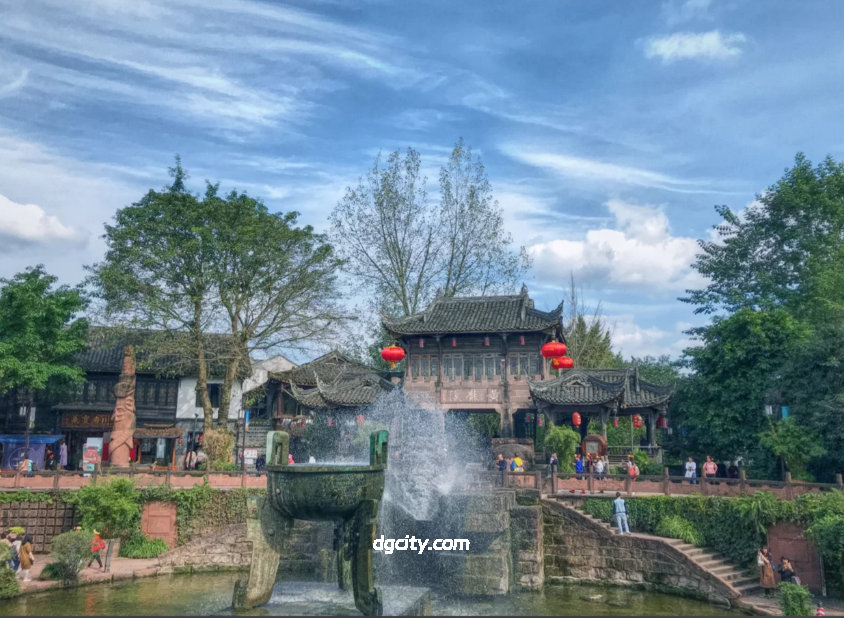
Strolling through the core area of the town, the most captivating sight is the authentic Ming-Qing architecture of Western Sichuan. Grey tiled roofs, wooden bucket-structured houses, bamboo-woven plaster walls, upturned eaves, and stilted buildings are scattered in an elegant, uncommercialized tranquility. With the Main Street as the central axis, it connects Fuxing Street, Shanghe Street, Xiahe Street, and other lanes. The bluestone roads, polished smooth by years, line both sides with old houses featuring carved doors, windows, wooden pillars, and stone foundations—all exquisitely crafted. The town’s “Three Ancient Wonders”—ancient temples, ancient opera stages, and ancient banyan trees—are the finishing touches. Gulong Temple, the oldest temple in the town, has the Qing-dynasty “Wannian Stage” above its main gate, where Sichuan opera and shadow puppet shows are still performed daily. Inside the temple, an 800-year-old banyan tree with tangled roots and lush branches grows alongside the temple, hailed as the “treasure of the town”. Zhenjiang Temple and Chaoyin Temple stand at the two ends of the Main Street: the former was a sacred site for boatmen’s sacrifices in old times, while the latter, built against hills and facing water, exudes peaceful Zen charm—together forming the unique landscape of “three temples in one street”.
The most unique cultural landmark in the town is the only “Three-County Yamen” in China. Located inside Gulong Temple, this Qing-dynasty yamen once served as a joint office for Huayang, Pengshan, and Renshou counties to handle civil disputes and economic affairs—a rare “one official governing three counties” structure nationwide. Well-preserved ancient torture instruments, old documents, plaques, and couplets inside silently narrate the wisdom of ancient local governance, making it a must-visit historical site. Walking along the stream, the dragon-spitting sculpture in Longtan Square is magnificent, echoing the legend of “nine sons of the dragon”; Huanglongxi Covered Bridge spans both banks, with upturned eaves and simple grandeur, a perfect photo spot. In summer, the 800-meter-long stream street becomes a natural water playground where visitors splash and play barefoot, filling the Ancient Town with laughter and vitality.
As the “Hometown of Fire Dragon Art in China”, Huanglongxi’s national intangible cultural heritage—Fire Dragon Dance—is the soul of Western Sichuan folk culture. Originating in the Eastern Han Dynasty and thriving in the Southern Song Dynasty, this traditional art is spectacularly performed from the 2nd to the 15th day of the first lunar month every year. Performers, bare-chested, wield ten-meter-long fire dragons, leaping through fireworks and sParks. The spectacular “Fire Dragon Burning” symbolizes favorable weather and a bumper harvest, full of passion and grandeur. Besides fire dragons, folk performances such as colorful dragon parades, southern lion dances, cattle lanterns, and younger sister lanterns appear on the streets from time to time, immersing visitors in Western Sichuan folk charm. The town’s intangible cultural heritage also delights the taste buds. The district-level intangible cultural heritage “Yigenmian” (One String Noodle) is a must-try: chefs stretch a single noodle to fill a bowl, chewy and smooth, symbolizing longevity. The saying “No Yigenmian, no Huanglongxi visit” has become widely recognized. Other delicacies include crispy-skinned pork elbow with tender meat and no greasiness, stone-ground tofu pudding as smooth as pudding with spicy chili oil, fresh and tasty Jinjiang river fish, sweet and crispy sesame cakes, and snacks like dingding candy, yeerba, and ice jelly—every bite authentic Western Sichuan flavor.
As night falls, Huanglongxi grows even more gentle. Red lanterns light up one by one, reflecting on the gurgling stream; ancient streets, temples, and bridges appear quieter in the dusk. Find a riverside teahouse, order a bowl of covered tea, listen to Sichuan opera and folk music, watch the flowing water, and slow down to feel the town’s leisurely time. There is no urban hustle here—only the calm of years, the depth of culture, and the warmth of daily life. From millennium history to Ming-Qing architecture, from intangible cultural heritage to authentic cuisine, Huanglongxi, with its unique charm, has become the most culturally enriching Ancient Town near Chengdu. It is not only a tourist destination but also a three-dimensional history book and a vivid folk painting, allowing every visitor to read the ancient charm and deep affection of Western Sichuan in the timeless water rhyme.


暂无评论内容