




As the top of China’s Four Great Gardens and a UNESCO site, the Summer Palace blends imperial grandeur with garden beauty. This guide covers its attractions, history and tips for international visitors.
Located at No. 19 Xinjian Palace Gate Road, Haidian District, Beijing, the Summer Palace is the largest and best-preserved Qing Dynasty imperial garden in China. Together with Chengde Mountain Resort, Humble Administrator’s Garden and Lingering Garden, it is known as China’s Four Great Gardens. Covering an area of 30.09 square kilometers, the garden takes Wanshou Mountain and Kunming Lake as its main body, with water accounting for three-quarters of the area. It perfectly integrates the grace of Jiangnan water towns with the grandeur of northern imperialism, and carries the cultural connotations of Confucianism, Buddhism and Taoism, making it a pinnacle of Chinese classical garden art. Listed as a national key cultural relic protection unit in 1961, inscribed on the UNESCO World Heritage List in 1998, and rated as a national 5A-level scenic spot in 2007, it receives tens of millions of Chinese and foreign tourists every year, becoming a core destination for international tourists to explore Chinese garden beauty and imperial history.
The historical context of the Summer Palace is tortuous. Its predecessor was the “Garden of Clear Ripples” built in 1750 during the 15th year of Emperor Qianlong’s reign, initially constructed by Emperor Qianlong to honor his mother, Empress Xiaoshengxian, costing a huge sum of money to create this imperial garden integrating beautiful landscapes and exquisite architecture. In 1860, during the Second Opium War, the Garden of Clear Ripples was burned down by British and French troops, precious cultural relics were looted, and garden buildings were reduced to ruins. In 1886, the Qing court appropriated funds such as naval expenses to start reconstruction, which was completed in two years and renamed the “Summer Palace” as an important place for Empress Dowager Cixi to spend her later years and handle state affairs. In 1953, the Summer Palace was opened to the public as a Park, and after a century of vicissitudes, it finally became a public space carrying national memory and cultural treasures.
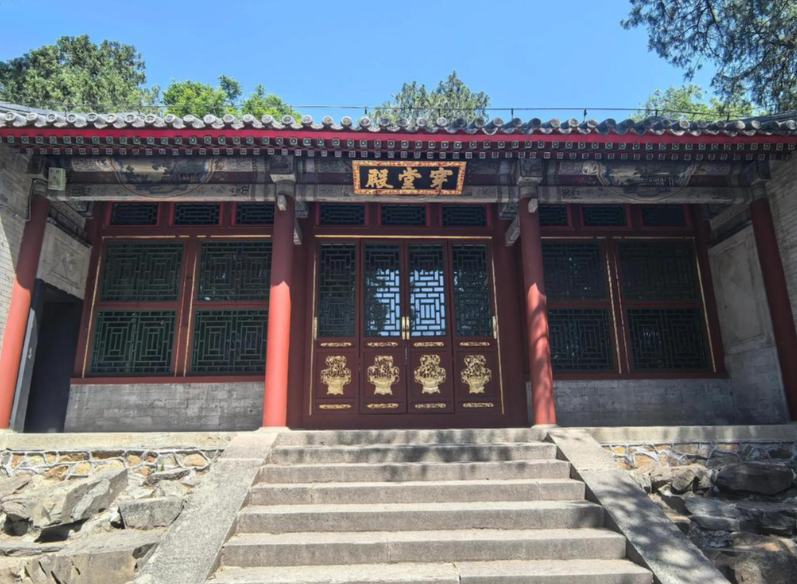
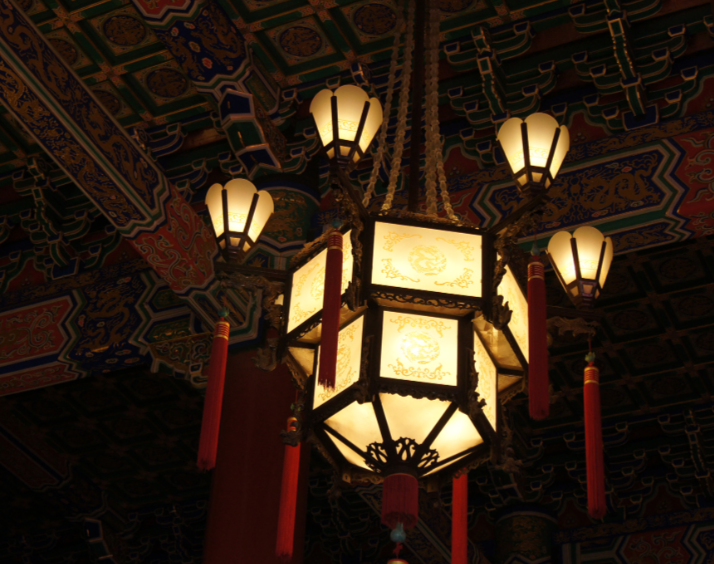
The Summer Palace can be divided into three major areas: the Imperial Court Area, the Front Mountain and Front Lake Scenic Area, and the Back Mountain and Back Lake Scenic Area. Its layout follows the imperial system of “front court and back residence, central axis symmetry”, while integrating the garden concept of “imitating nature”, with changing scenery embodying the essence of Oriental aesthetics. The Imperial Court Area, located in the east of the garden, is the core area where emperors and empresses handled state affairs and lived, represented by the Hall of Benevolence and Longevity and the Hall of Jade Ripples. Originally named the Hall of Diligent Government, the Hall of Benevolence and Longevity was renamed after reconstruction, taking the meaning of “The benevolent live long” from the Analects of Confucius. It was a place where Empress Dowager Cixi and Emperor Guangxu held court meetings with ministers and handled state affairs in the garden. The nine-dragon throne and hundred-longevity screen in the hall show imperial majesty, and the bronze kylin moved from the Old Summer Palace and the bronze dragons and phoenixes from Emperor Guangxu’s period in the courtyard are all precious cultural relics.
Adjacent to the west of the Hall of Benevolence and Longevity, the Hall of Jade Ripples was built during Emperor Qianlong’s reign, once serving as his study. After the failure of the Wuxu Reform, it became the place where Emperor Guangxu was imprisoned, witnessing the political upheavals of the late Qing Dynasty. This courtyard-style building consists of the Hall of Jade Ripples, the Chamber of Rosy Clouds and the Pavilion of Lotus Fragrance. The furnishings in the hall combine the characteristics of a study and a bedroom. The red sandalwood throne and agarwood imperial desk from Emperor Qianlong’s period are exquisitely crafted, showing imperial luxury. The Summer Palace Museum in the Imperial Court Area is a treasure trove of cultural relics, with an exhibition area of 2,777 square meters, displaying thousands of exquisite cultural relics from the Shang and Zhou dynasties to the late Qing Dynasty, covering more than ten categories such as bronzes, jade, porcelain and paintings. Among them, national-level cultural relics such as the Bingfu Jifang Ding and the red sandalwood insert-style screen base represent the top craftsmanship of the time.
The Front Mountain and Front Lake Scenic Area is the core scenic area of the Summer Palace. The buildings on the front of Wanshou Mountain and Kunming Lake depend on each other, forming the main style of the garden. Wanshou Mountain is 58.59 meters above sea level. The Tower of Buddhist Incense on the top is the iconic building of the Summer Palace, 41 meters high, built during Emperor Qianlong’s reign, later burned down and reconstructed. It is a magnificent building in the style of a Tibetan pagoda. Surrounding the Tower of Buddhist Incense are buildings such as the Hall of Dispelling Clouds and the Sea of Wisdom. The Sea of Wisdom is a beamless Buddhist hall, fully built with bricks and stones, with more than a thousand glazed Buddha statues inlaid on the inner wall, shining brightly under the sun, known as the “Glazed Buddhist Hall”. The Long Corridor at the foot of the mountain is 728 meters long, with more than 14,000 colorful paintings on the beams, covering landscapes, flowers, birds, figures, allusions and other contents, no two are the same, making it the longest corridor-style building in China.
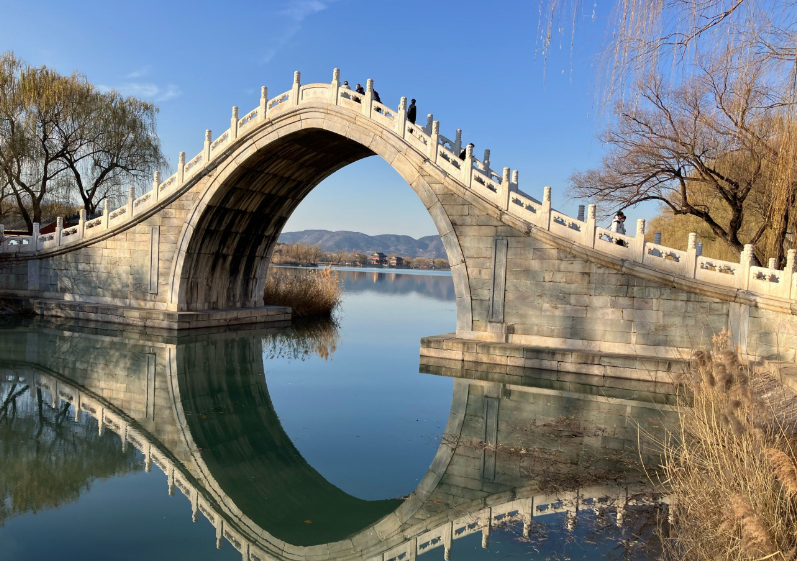
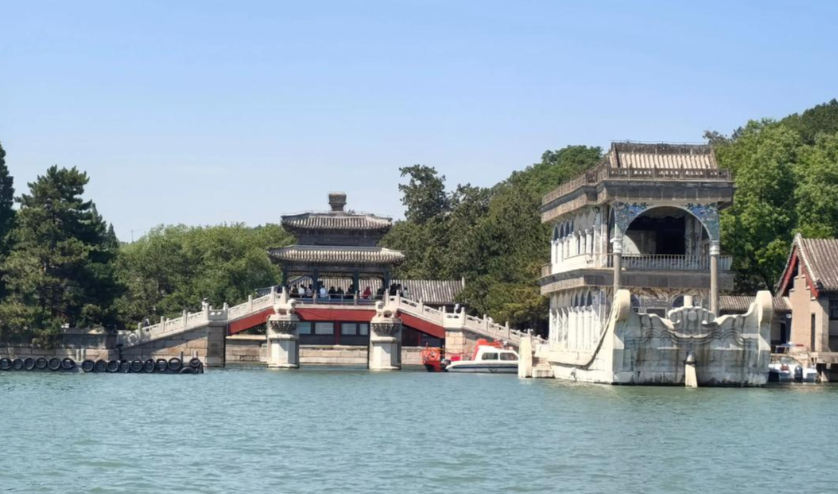
Kunming Lake occupies three-quarters of the garden area, once known as Wengshan Po and West Lake. It was renamed and expanded during Emperor Qianlong’s reign, with a circumference of about 15 kilometers and an average depth of 1.5 meters. The Seventeen-Arch Bridge lying between the east bank of Kunming Lake and South Lake Island is the most famous bridge landscape in the garden, 150 meters long. The white marble railings on both sides of the bridge are carved with 544 stone lions of different shapes. The 17 arches under the bridge have the tallest central arch, gradually narrowing on both sides, implying the imperial meaning of “nine-five supremacy”. The bronze ox at the bridgehead is inscribed with 80 seal characters on its back, used to pray for peace and stability. Every year during the Major Snow solar term in winter, the sun shines through the bridge arches to form the wonder of “Golden Light Through the Arches”, attracting countless tourists to stop and watch. South Lake Island, also known as Penglai Island, has scattered buildings such as the Guangrun Lingyu Shrine and the Hall of Embracing the Void. Empress Dowager Cixi once watched the Beiyang Navy exercises and offered sacrifices to the Dragon King here.
The Back Mountain and Back Lake Scenic Area is quiet and elegant, forming a sharp contrast with the grandeur of the front mountain. The Garden of Harmonious Interest, located in the northeast corner, was built imitating the Jichang Garden in Wuxi, named for “harmonizing the quiet interest outside things with the harmony in the heart”. The central pond is surrounded by pavilions and terraces such as the Spring Dawn Pavilion and the Green Drinking Pavilion. The Fish Knowing Bridge takes the allusion of the debate between Zhuangzi and Huizi, full of literati charm. The Four Great Continents behind Wanshou Mountain is a group of Tibetan Buddhist buildings, built imitating the Samye Monastery of Tibetan Buddhism, including 21 ancient buildings such as sun platforms, moon platforms and lama towers. Although once burned down and reconstructed, it still retains a strong Tibetan cultural characteristics. Suzhou Street at the foot of the back mountain imitates the “one water and two streets” pattern of Suzhou’s Shantang Street, once a water street for emperors and empresses to visit markets. Today, the restored shops reproduce the urban style of the Qing Dynasty.
For travel tips, the Summer Palace requires real-name reservation tickets. International visitors can book tickets through the official website, mini-program or ticket windows with their passports. It is recommended to book 1-3 days in advance during peak seasons (April-October). The scenic area is open from 6:30 to 18:00 (closing at 17:00 in winter). Recommended route: Enter from the East Palace Gate, visit the Hall of Benevolence and Longevity, the Hall of Jade Ripples and the Summer Palace Museum, walk along the Long Corridor to the Hall of Dispelling Clouds and the Tower of Buddhist Incense, take a cruise across Kunming Lake to South Lake Island to admire the Seventeen-Arch Bridge, then go to the Garden of Harmonious Interest. The whole tour takes about 4-5 hours. For transportation, take Metro Line 4 to Beigongmen Station or Xiyuan Station, then transfer to a bus to reach directly. The garden provides cruise ships, sightseeing cars and other means of transportation. When visiting, please protect cultural relics and vegetation, do not carve buildings or climb ancient relics, and respect this world cultural heritage.




暂无评论内容