




Among the folk symbols of old Beijing, the Rabbit God (Tu’er Ye) is a unique existence that combines childlike fun and cultural heritage. As the most representative category of Beijing Clay Sculpture, it is not only a handcrafted work of art but also a spiritual totem carrying thousands of years of Mid-Autumn Culture. This ancient craft, made of loess and decorated with colored brushes, has evolved from a moon-worshipping god statue in the Ming Dynasty to a folk treasure filled with the warmth of old Beijing in the hands of craftsmen. For foreign travelers, exploring the story of the Rabbit God means understanding the most vivid code of Beijing’s Mid-Autumn customs and craftsmanship.
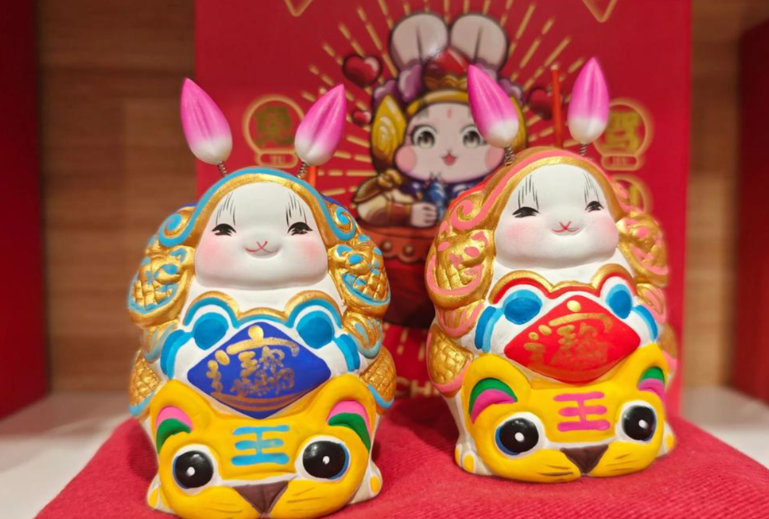
The origin of the Rabbit God is closely linked to Beijing’s Mid-Autumn moon-worshipping customs, and its legend can be traced back to the Ming Dynasty. According to legend, in ancient times, Beijing was hit by a plague. The Jade Rabbit beside Chang’e descended to earth as a doctor to save the people. To repay the Jade Rabbit’s kindness, the people enshrined statues of the Jade Rabbit during the Mid-Autumn Festival, calling it “Rabbit God”. The earliest Rabbit God was a solemn moon-worshipping statue with a simple shape, only a sitting Jade Rabbit. It gradually became secularized and interesting in the Qing Dynasty, becoming a favorite toy for children and a seasonal ornament for the Mid-Autumn Festival. The shapes became more diverse, deriving dozens of styles such as Rabbit God sitting on a tiger, riding a deer, and carrying a medicine box, each with auspicious meanings.
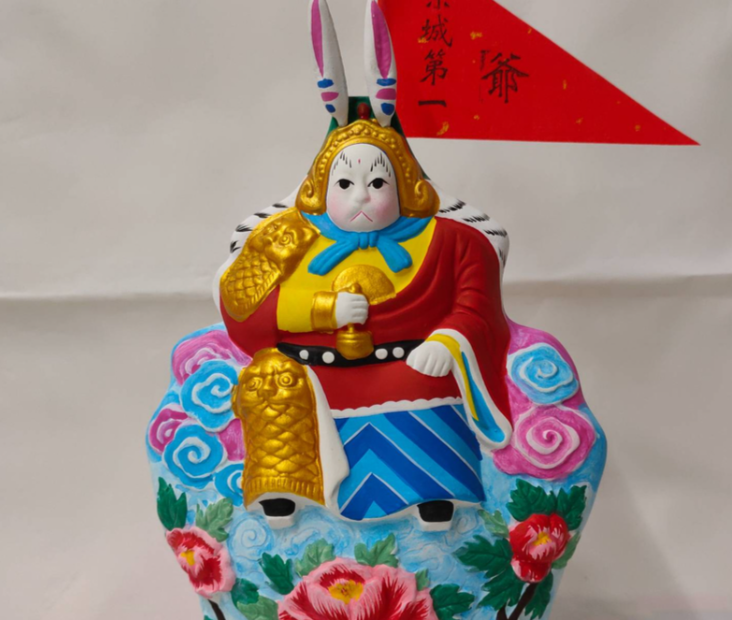
The Qing Dynasty was the heyday of Rabbit God Clay Sculpture. The “Records of Customs in Yanjing” recorded that “every Mid-Autumn Festival, skilled craftsmen in the city knead loess into toad and rabbit statues for sale, which are called Rabbit God”. At that time, in markets around Qianmen and Baita Temple in Beijing, various Rabbit Gods were displayed before the Mid-Autumn Festival, ranging from palm-sized ornaments to half-human-high statues, a feast for the eyes. The shape of the Rabbit God in this period had formed a fixed pattern: rabbit head and human body, wearing armor or official robes, a golden helmet on the head, and a naive face, with both the dignity of a god statue and the agility of a child. During the Republic of China, the Rabbit God remained an iconic symbol of Beijing’s Mid-Autumn Festival. Although production decreased due to wars, the craft was always passed down among folk craftsmen.
The birth of a Rabbit God requires four core processes: material selection, shaping, drying, and painting, all completed by hand, each testing the craftsman’s experience and ingenuity. Material selection is extremely exquisite. Loess from the western suburbs of Beijing is used, which has moderate viscosity and fine texture. Only after screening, settling, and kneading can it become the raw material for shaping. When kneading the clay, it needs to be repeatedly beaten and kneaded to ensure that the clay has no bubbles and uniform texture, laying the foundation for subsequent shaping.
Shaping is the core link. Craftsmen do not need molds, but only use their hands to pinch, press, and carve. First, they shape the Rabbit God’s torso, limbs, and head, then carefully carve facial features and costume patterns. Especially the curvature of the rabbit ears and the folds of the armor need to be accurately controlled to ensure a full shape and vivid expression. After shaping, the Rabbit God needs to be naturally dried in a cool and ventilated place, not exposed to the sun, otherwise, it is easy to crack. The drying time is adjusted according to the size of the shape. Small ornaments take 1-2 days, while large statues take several days or even a week until the clay body is completely dry.
Painting is the link that endows the Rabbit God with soul, following the principle of “white first, then color; light first, then dark”. First, a self-made white base coat is applied to the clay body. After drying, the face, costume, and accessories are painted in sequence. The color matching is extremely bright, mostly using bright colors such as bright red, bright yellow, and sapphire blue. The face is primed with white powder, and the eyes and lips are outlined with red brushes. The costume is matched with corresponding colors according to different shapes. The armor is mostly painted with golden lines, and the official robe is embroidered with auspicious cloud and flower patterns. Finally, the eyes are dotted, making the Rabbit God come alive instantly.
In modern times, with the acceleration of urbanization and the impact of modern toys, the Rabbit God Clay Sculpture craft was once on the verge of extinction. It was not until the persistence and inheritance of Shuang Qixiang, a national-level intangible cultural heritage inheritor, that this ancient craft regained vitality. Shuang Qixiang learned the Rabbit God making craft from his father since childhood and has been deeply engaged in it for decades. He not only completely restored the traditional Rabbit God shape of the Qing Dynasty but also integrated modern aesthetics, developing cultural and creative products such as cartoon Rabbit Gods and mini Rabbit Gods, making ancient folk customs close to contemporary life. He also took apprentices, imparted his skills to young inheritors without reservation, and participated in intangible cultural heritage exhibitions to let more people understand the cultural connotation of the Rabbit God.
Today, to experience the charm of the Rabbit God immersively, you can visit several characteristic venues. Dongyue Temple is an excellent place to appreciate the Rabbit God. Every Mid-Autumn Festival, it holds a Rabbit God cultural exhibition, displaying rare Rabbit God works from past dynasties and contemporary masterpieces, and you can also watch craftsmen’s on-site production performances. Folk cultural and creative stores in Nanluoguxiang and Yandai Xiejie also sell various Rabbit God ornaments, from traditional shapes to modern cultural and creative styles. If you want to experience making it yourself, you can book an experience class at Shuang Qixiang’s intangible cultural heritage workshop, complete an exclusive Rabbit God under the guidance of craftsmen, feel the fun of clay sculpture craft, and take this Mid-Autumn elegance home.
From a moon-worshipping god statue to a folk toy, from an imperial tribute to a cultural and creative product, the Beijing Rabbit God carries not only clay sculpture craftsmanship but also the folk memories and cultural feelings of old Beijing. Every delicate line hides the craftsman’s piety; every bright color reflects the joy of the Mid-Autumn Festival. When you hold a Rabbit God, you can understand Beijingers’ yearning for reunion and auspiciousness, and feel this centuries-old folk craftsmanship and Eastern elegance.




暂无评论内容