




In the Spring Festival memories of the Chinese people, spring festival couplets—red paper inscribed with black calligraphy—are an indispensable symbol of the festive atmosphere. As the Lunar New Year approaches, from urban streets to rural courtyards, every household carefully selects couplets and pastes them solemnly on both sides of the gate and above the lintel. The vibrant red color and auspicious characters add the most intense sense of ritual to the new year. This thousand-year-old custom is not merely a festival decoration, but a carrier of the Chinese people’s historical memories, folk beliefs and good wishes, forming an integral part of traditional Chinese Culture.
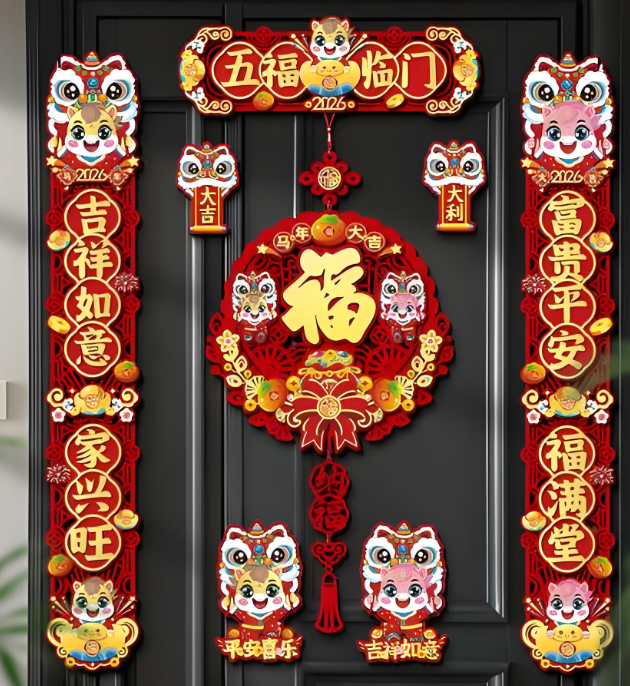
The origin of spring festival couplets can be traced back to the “peachwood charms” in ancient times, whose initial function was to ward off evil spirits rather than pray for blessings. As early as the Qin and Han dynasties, people believed that peach wood possessed the divine power to subdue demons and ghosts. On the eve of the new year, they would hang peach wood boards inscribed with the names of two door gods, “Shentu” and “Yulei”, on both sides of the gate to resist the invasion of evil spirits and protect the safety of their families. This was the earliest form of spring festival couplets. Although the ancient peachwood charms lacked the antithetical elegance of later couplets, they already carried the ancients’ yearning for a peaceful life and laid the foundation for this important Spring Festival custom.
With the development of the times, peachwood charms gradually evolved into spring festival couplets, and their content expanded from a single theme of exorcism to diverse prayers for blessings. During the Sui and Tang dynasties, poetry Culture flourished. Literati and scholars began to inscribe auspicious poems on peach wood boards, replacing the original names of door gods, endowing peachwood charms with both practicality and literariness. In the Song Dynasty, the popularization of papermaking and printing techniques made paper gradually replace peach wood as the carrier, and the prototype of “spring festival couplets” was officially formed. By the Ming and Qing dynasties, the custom of pasting spring festival couplets had fully matured. It not only spread widely among the people but also formed strict format norms—each couplet (upper and lower) has the same number of characters, corresponding parts of speech and coordinated tonal patterns, while the horizontal scroll summarizes the core meaning, forming a unique literary form. Zhu Yuanzhang, the founding emperor of the Ming Dynasty, once ordered that “every family, whether noble or common, must paste a pair of spring festival couplets”, which further popularized the custom nationwide and established its status as a core Spring Festival tradition.
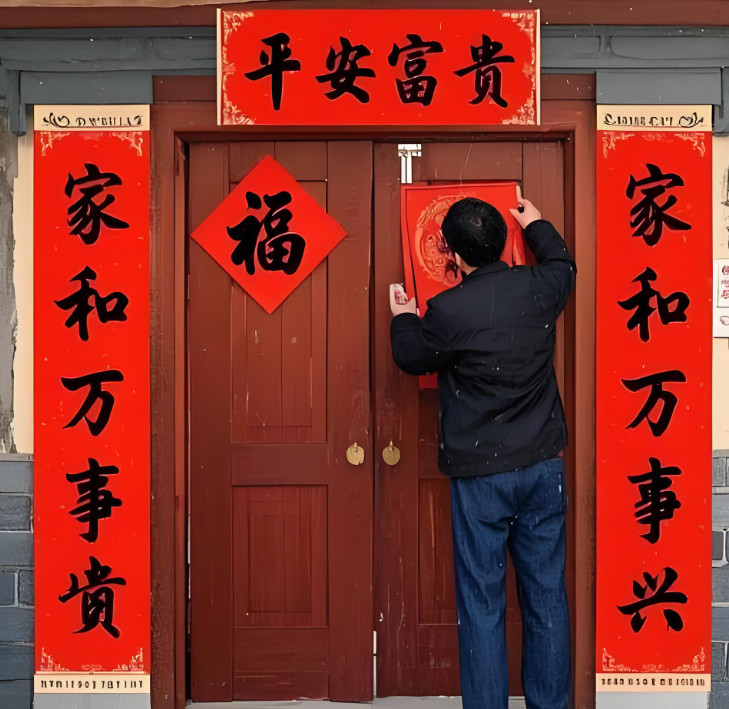
For the Chinese people, the significance of spring festival couplets goes far beyond words and forms, embodying profound cultural connotations and emotional sustenance. Red paper, as the core carrier of couplets, symbolizes joy, auspiciousness and vitality in Chinese Culture. The red color can dispel darkness and bring good luck, aligning with the theme of bidding farewell to the old and welcoming the new in the new year. The black calligraphy represents solemnity and inheritance, and the brush-written characters embody the integrity of literati and the wisdom of the people. The content of couplets is diverse: some depict festival scenes such as “In the sound of firecrackers, the old year passes; the spring breeze brings warmth into the屠苏 wine”, some express wishes for career like “Business thrives across the four seas; wealth flows in from all directions”, and others pray for health such as “Blessings are as boundless as the East China Sea; longevity is as enduring as the Nanshan Mountain”. Each pair of couplets reflects the family’s different aspirations for the new year, making emotions tangible.
The process of pasting couplets is also full of ritual and taboos, demonstrating the Chinese people’s life wisdom. Usually, people paste couplets on New Year’s Eve, symbolizing bidding farewell to the old and welcoming the new, and embracing blessings. When pasting, the rule of “upper couplet on the right, lower couplet on the left” must be followed, adjusted according to the writing direction of the horizontal scroll, reflecting the symmetrical aesthetics and sense of order in traditional culture. Couplets should also be pasted neatly and upright, implying a smooth and stable new year. In addition, some families paste the character “Fu” (blessing) above the lintel, and even paste it upside down, taking the homophone meaning of “Fu arrives” (since “upside down” and “arrive” are pronounced similarly in Chinese), which echoes the couplets and forms a complete New Year prayer ritual.
Today, with the changes of the times, the form of spring festival couplets continues to innovate, with printed couplets and electronic couplets emerging. However, the cultural core carried by red paper and black calligraphy has never changed. It remains an indispensable symbol of the Chinese Spring Festival, a cultural link connecting the past and the present. Every time the Chinese people paste couplets, they can feel the influence of traditional culture and experience the warmth of reunion and the expectation for the new year. For foreign tourists, understanding spring festival couplets means understanding the simplest emotions and profound cultural heritage in the hearts of the Chinese people, and grasping the true essence of the Chinese New Year atmosphere.






暂无评论内容