




Among the traditional snacks of old Beijing, Ludagun (Glutinous Rice Roll with Red Bean Paste) is a representative with both “appearance and connotation” — it has distinct yellow, white and red layers, as exquisite as a painting; the combination of glutinous rice’s stickiness, red bean paste’s sweetness and soybean flour’s richness creates a long and varied taste. More importantly, this folk-originated snack has been included in Beijing’s intangible cultural heritage list, carrying the taste memories and traditional craftsmanship of generations. It is not only an affordable delicacy on the streets but also an excellent carrier for foreign tourists to experience Chinese intangible cultural heritage food Culture.
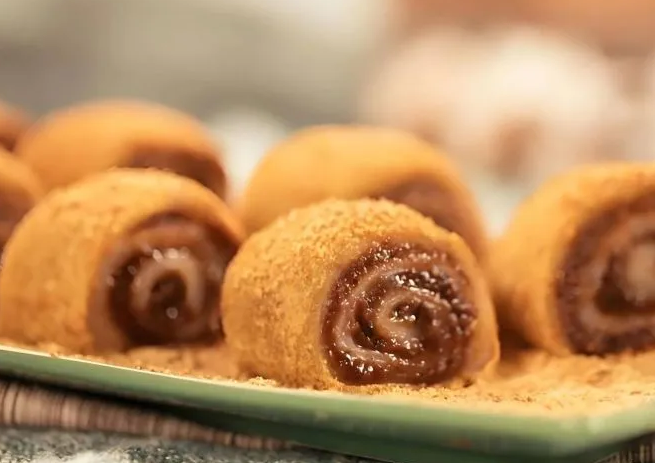
The origin of Ludagun is deeply rooted in northern farming Culture and folk food wisdom, and its name also has a touch of street fun. In the early years, glutinous rice and soybeans were abundant in the north. To make full use of the ingredients, people steamed glutinous rice and wrapped it with fillings. Later, it was improved by rolling the surface with stir-fried soybean flour, which not only prevents sticking but also enriches the flavor. Because the finished product is round after rolling in flour, rolling like a donkey rolling in dirt, it was named “Ludagun”. Initially popular in the suburbs of Beijing, this snack gradually spread to the urban area with its glutinous taste and solid ingredients, becoming a popular delicacy across all classes. After hundreds of years of inheritance, its traditional production techniques have been completely preserved, and it was finally rated as Beijing’s intangible cultural heritage, becoming an important symbol of Beijing’s flavor Culture.
As an intangible cultural heritage snack, the soul of Ludagun lies in “traditional handcraftsmanship” and “accurate matching of ingredients”, which together create its unique color, aroma and taste. Authentic Ludagun has strict requirements for raw materials, and each ingredient directly affects the final taste: glutinous rice must be round glutinous rice with plump grains and strong stickiness, not long glutinous rice. Round glutinous rice is more glutinous and chewy after steaming, not easy to break; soybeans must be fresh and free of mildew, with a stronger aroma after stir-frying; red bean paste filling must be handmade by slow cooking, rejecting industrial products to ensure creaminess without lumps.
The production of glutinous rice skin is the core of Ludagun’s intangible cultural heritage craftsmanship, testing the craftsman’s experience and skills. First, soak round glutinous rice for 4-6 hours in advance until the grains are fully swollen with water, take them out, drain, put into a steamer, add water and steam over high heat for 30-40 minutes until the glutinous rice is completely cooked and can be crushed with fingers. Pour the steamed glutinous rice into a clean stone mortar or large basin, and repeatedly beat and knead it with a wooden mallet while it is hot. During the process, spray a small amount of water until the glutinous rice becomes delicate and sticky, forming a tough rice ball. This step is the key to ensuring that the glutinous rice skin is glutinous and not sticky to the teeth — hand-beaten rice balls can stimulate the stickiness of glutinous rice, and the taste is far better than machine-pressed products. After beating, take out the rice ball, put it on a cutting board covered with soybean flour, and roll it into a thin, uniform rectangular sheet about 0.8 cm thick, which can wrap the filling without being too thin and breaking.
The processing of filling and soybean flour is the finishing touch to Ludagun’s flavor and appearance. Traditional Ludagun only uses red bean paste filling, pursuing pure natural flavor: select high-quality red beans, soak for 8 hours, boil over high heat, turn to low heat and simmer until the beans are soft and rotten, take them out, mash and sieve to remove bean skins, add an appropriate amount of rock sugar and a little cooked oil, stir-fry over low heat until thick and formed, and set aside to cool. The red bean paste filling needs to be stir-fried until neither dry nor thin, which can be easily wrapped without soaking the glutinous rice skin due to excessive water. Soybean flour needs to be stir-fried slowly over low heat in advance, turning constantly until it turns light golden yellow and emits a strong bean aroma, then turn off the heat and cool. It can not only add flavor but also prevent the glutinous rice skin from sticking, and at the same time create the “yellow” outer layer of Ludagun, forming a distinct three-color layer with the “white” glutinous rice skin and the “red” red bean paste filling.
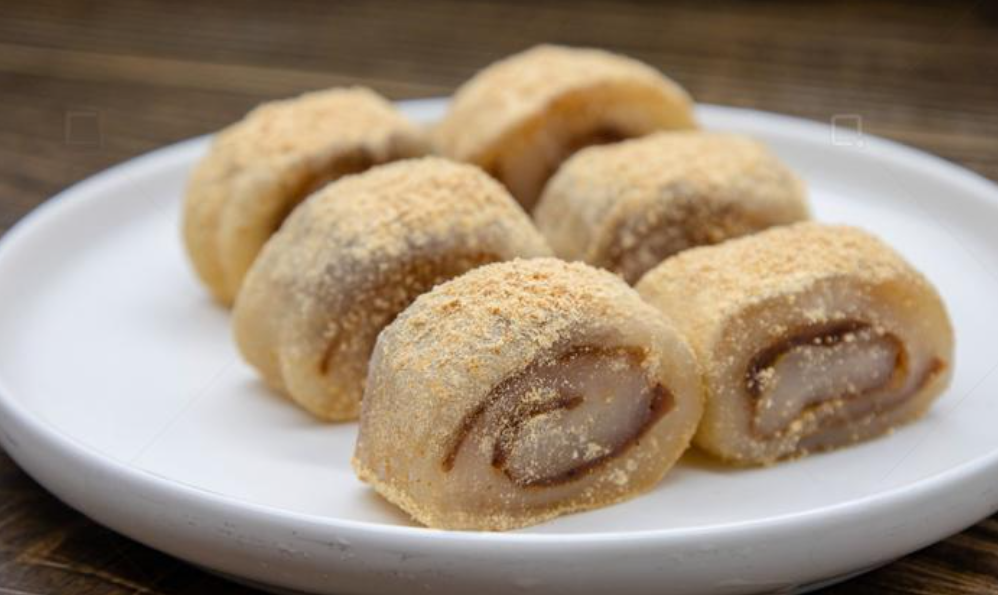
The rolling and shaping process also follows the rigorous requirements of intangible cultural heritage craftsmanship. Spread the cooled red bean paste filling evenly on the glutinous rice skin, with a filling thickness of about 0.5 cm, and leave a 1 cm blank at the edge to avoid overflow when rolling. Then gently roll it up from one end of the glutinous rice skin to form a tight cylinder, press it gently with your hands to shape it, ensuring a neat shape. After rolling, cut the rice roll into 3-4 cm long sections with a knife. For each section, roll the cut surface with a layer of soybean flour to make every surface evenly coated with flour, finally presenting a three-color distinct form of “golden outer layer, milky middle layer and crimson inner layer”, with both appearance and taste.
The authentic eating method can maximize the flavor essence of Ludagun. Ludagun can be eaten at room temperature without heating, and the taste is more refreshing after refrigeration, suitable for summer; it can be slightly warmed in winter to avoid the glutinous rice being too cold to stimulate the stomach and intestines. When eating, pick up a section by hand, chew gently after taking a bite, first feel the mellow roasted aroma of soybean flour, then the glutinous and chewy glutinous rice skin, and finally the sweet and creamy red bean paste filling. The three blend perfectly, sticky but not greasy, sweet but not cloying, with a faint bean aroma and rice aroma in the aftertaste. For matching, it can be paired with warm almond tea or barley tea — the tea aroma can neutralize the stickiness of glutinous rice, making the taste more layered; it can also be combined with imperial snacks such as Wandouhuang and Yundoujuan to experience the diverse charm of Beijing-style snacks.
To taste the most authentic intangible cultural heritage Ludagun, you can’t go wrong with time-honored brands. Many of Beijing’s time-honored brands adhere to traditional craftsmanship and inherit the most authentic flavor: Huguosi Snacks (multiple branches) makes Ludagun following intangible cultural heritage craftsmanship, with glutinous and tough glutinous rice skin, moderately sweet red bean paste filling and rich soybean flour aroma, with high cost performance, suitable for tourists trying it for the first time; Niujie Hongji Snacks (Niujie Store) uses solid ingredients for Ludagun, with thick glutinous rice skin, sufficient red bean paste filling and perfectly stir-fried soybean flour, a hidden gem among old Beijingers; Baiji Rice Cake (Niujie Store) is famous for rice cake snacks, its Ludagun is handmade with distinct three-color layers and delicate, non-sticky taste, which can perfectly show the essence of intangible cultural heritage craftsmanship; Daoxiangcun (multiple branches) offers vacuum-packed Ludagun that is easy to carry. Although mass-produced, it retains the core flavor, suitable as a souvenir for relatives and friends.
There are several practical tips for tasting Ludagun to help foreign tourists better unlock this intangible cultural heritage snack. First, storage method: freshly made Ludagun can be stored at room temperature for 2-3 hours and refrigerated for 1 day. It should be eaten as soon as possible after opening to avoid the glutinous rice skin hardening and the soybean flour getting damp. Second, eating precautions: glutinous rice is highly sticky and should not be eaten in excess, especially for people with sensitive stomachs, to avoid indigestion. Third, flavor adaptation: if you don’t like overly sweet food, you can choose the version with more soybean flour, as the bean aroma can neutralize the sweetness. Fourth, photo taking: Ludagun has distinct three colors, and it can be paired with Chinese tableware when taking photos to highlight its delicacy.
As a Beijing intangible cultural heritage, Ludagun is not only a snack but also a carrier of handcraftsmanship and food culture inheritance. It has no complex ingredients or cumbersome plating, but achieves a century-old unchanged flavor with the simplest matching and most exquisite handwork. For foreign tourists, tasting Ludagun is not only a sweet taste experience but also an immersive opportunity to feel Chinese intangible cultural heritage culture — in a bite of glutinous sweetness, understand the ingenuity and inheritance of old Beijing snacks.






暂无评论内容