




As the warmth of the Spring Festival reunion lingers, the 8th day of the first lunar month arrives with the morning light, serving as an important link between the joy of the New Year and the journey of striving. On this day, the sound of firecrackers (now mostly electronic) echoes through the streets and alleys, lucky money for work resumption conveys warmth, enterprises and businesses open their doors to welcome blessings, and hundreds of millions of workers pack their bags and head to their posts. Amidst a solemn yet lively sense of ritual, they embark on a new year of hard work and expectations in the Year of the Horse. Resuming work on the 8th day is never a simple restart of work, but a cultural ritual engraved with the wisdom of Chinese folk customs and carrying beautiful wishes. Passed down for thousands of years, it glows with new vitality in the new era.
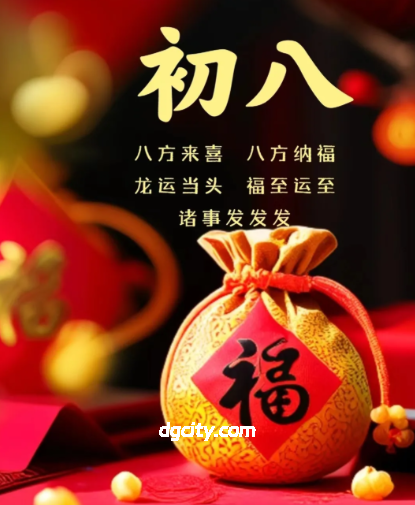
The custom of resuming work on the 8th day is rooted in the profound soil of traditional Culture, and every detail embodies the ancient people’s yearning for a better life and their philosophy of life. The 8th day of the first lunar month has three unique identities in folk customs—the Day of Grains, the Festival of Worshiping Stars, and the Festival of Worshiping the Eight Immortals. These three connotations together lay the foundation for it to be an auspicious day to resume work. According to legend, when Nuwa created the world, she successively created six domestic animals and humans in the first seven days, and specially created the five grains (rice, millet, broomcorn millet, wheat, and beans) on the eighth day. Therefore, the 8th day is designated as the “birthday of grains”, whose core meaning is a bumper harvest of grains and full granaries. As the foundation of human survival, grains also lay a beautiful expectation of “adequate food and clothing” for the new year’s labor and operation.
At the same time, the 8th day is also the Festival of Worshiping Stars. The ancient people believed that on this day, all stars descend to the world to inspect the blessings and misfortunes of the people. People would place lamps and worship the stars, praying for the protection of their zodiac stars, hoping for peace and smoothness in the new year without disasters or difficulties. In addition, the 8th day is also the Festival of Worshiping the Eight Immortals. Worshiping the Eight Immortals can pray for protection from all directions, implying smooth career and all wishes coming true, which is also highly consistent with the expectation of “attracting wealth from all directions” in business operations.
What is more noteworthy is that the number “eight” itself carries an auspicious omen, homophonic with “fa” (meaning prosperity and wealth in Chinese), symbolizing prosperity and development. It also corresponds to the Eight Trigrams and all directions, implying completeness and wholeness, which is another important reason why the ancient people chose to resume work on the 8th day. In the process of integration of agricultural civilization and commercial civilization, the custom of resuming work on the 8th day gradually enriched: in ancient times, shops would set off firecrackers, post Spring Festival couplets for attracting wealth, set up incense altars to worship the God of Wealth and the Eight Immortals, and fill grain jars to “replenish the treasure house”, praying for prosperous business and abundant wealth in the new year; ordinary families would cook a bowl of five-grain porridge or prosperity cake, and eat a bowl of long noodles (symbolizing smoothness), using the auspicious meaning of food to express their expectations for smooth labor and a prosperous life in the new year. These customs have been passed down for thousands of years, and although their forms have been simplified, the core connotation of praying for blessings has never changed, becoming an irreplaceable cultural mark in the hearts of the Chinese people.
Entering the modern society, resuming work on the 8th day of the lunar new year has long surpassed the scope of traditional folk customs and become a social phenomenon with both cultural inheritance and contemporary characteristics. For enterprises, resuming work on the 8th day is an important ceremony to gather team morale and start a new journey: some enterprises will hold a simple and solemn opening ceremony, deploy development goals for the new year, and convey confidence in development; some enterprises continue the tradition of giving lucky money to employees for work resumption, meaning “good luck at the start of work”, allowing employees to quickly get into work mode with warmth and devote themselves to work with a full state; Internet companies are more trendy, adding fun to the work resumption through opening blind boxes, lucky draws and other forms, showing youthful vitality. No matter how the form changes, the essence of enterprises choosing to resume work on the 8th day is respect for traditional Culture, and more importantly, good expectations for the development of the enterprise in the new year—hoping to achieve a “good start” with the auspicious meaning of the 8th day and lay a solid foundation for the whole year’s development.
For every worker, resuming work on the 8th day is the starting point to bid farewell to the holiday and pursue their dreams. The reunion and rest during the Spring Festival are to accumulate strength; resuming work on the 8th day is to transform this strength into motivation for struggle. Whether it is a workplace person organizing their desk and setting work goals for the new year, an entrepreneur preparing for opening and planning business blueprints, or an ordinary worker sticking to their post and working silently, they all start a new journey on this day. The warmth in the lucky money for work resumption, the work resumption blessings between colleagues, and the earnest entrustment from leaders all turn into the power to move forward, allowing people to move forward steadily and work hard with the joy and expectations of the Spring Festival. In this process, resuming work on the 8th day is no longer a simple time node, but a spiritual symbol—it represents the national spirit of hard work and progress, the persistent pursuit of a better life, and the infinite longing of every person for the future.
Today, with the development of the times, customs are innovated in inheritance. Electronic firecrackers have replaced traditional firecrackers, retaining the festive atmosphere while taking into account environmental protection needs; online lucky money for work resumption and cloud-based work resumption blessings allow people thousands of miles apart to convey warmth; the opening ceremony is more simple and pragmatic, but still carries the same good expectations. However, no matter how the form changes, the cultural connotation and spiritual power contained in resuming work on the 8th day have never changed: the simple wisdom of respecting heaven and cherishing grain, the good wish of praying for smoothness, and the fighting spirit of hard work—all these are deeply integrated into the blood of the Chinese people and become an indispensable part of Chinese Culture.
On the 8th day of the first lunar month in the Year of the Horse, the stars start a new journey, and labor starts a new chapter. On this auspicious day, the horn of work resumption has sounded, and the journey of struggle has begun. Every persistence deserves to be cherished, and every effort will eventually be rewarded. May every worker, with the auspiciousness and blessings of the 8th day, achieve success immediately and live up to their prime, write extraordinary stories in ordinary posts, water their dreams with sweat, and create brilliance with struggle; may every enterprise, with the auspicious omen of the 8th day, ride the wind and waves, thrive, and achieve new development and create new brilliance in the tide of the new era. The 8th day starts a new journey, and blessings accompany us forward. In the new year, may we all live up to the time and ourselves, and move towards a better future.


暂无评论内容