




At the foot of Gele Mountain in Shapingba District, Chongqing, two seemingly ordinary buildings hold a heavy yet glorious chapter in modern Chinese history—Bai Mansion and Zhazi Cave. Once secret prisons of the Kuomintang’s Military Intelligence Bureau (Juntong), they were places where countless revolutionaries upheld their beliefs and fought bravely with blood and lives. Today, as national key cultural relics protection units, they stand as important educational bases for inheriting the Hongyan Spirit. For foreign tourists eager to understand China’s revolutionary history and national integrity, these sites are more than just scenic spots—they are essential destinations to touch the warmth of history and feel the power of spirit.
Originally named “Xiangshan Villa”, Bai Mansion was built in the 1930s as a suburban villa for Sichuan warlord Bai Ju. Claiming to be a descendant of Bai Juyi, a great poet of the Tang Dynasty, Bai Ju named the villa after the poet’s courtesy name “Xiangshan Jushi” (Hermit of Xiangshan), but local residents commonly referred to it as “Bai Mansion”. In 1939, Dai Li, the leader of Juntong, was attracted by its strategic and secluded location, forcing a purchase with 30 taels of gold to convert it into a secret prison. More than ten rooms of the villa were turned into cells, an underground storage room without sunlight became a dungeon, and an air-raid shelter was transformed into a torture cave for interrogations. The main gate remained closed year-round, with only a side door for entry and exit, creating an eerie and oppressive atmosphere.
Most of the prisoners held here were political detainees deemed “high-priority cases” by Juntong, including Luo Shiwen, Secretary of the Sichuan Provincial Party Committee of the Communist Party of China, General Huang Xiansheng, a patriotic anti-Japanese general, and Chen Ran, the prototype of “Cheng Gang” in the novel “Red Crag”. The most touching figure is Song Zhenzhong, known as “Little Carrot Head”, the youngest martyr of New China. Imprisoned with his parents at the age of 8 months, he used his privilege of free movement as a child to act as a secret messenger for the underground Party organization in the prison, delivering intelligence and news. On November 27, 1949, on the eve of Chongqing’s liberation, Kuomintang secret agents carried out a brutal massacre here, with only 19 people escaping successfully and the rest sacrificing their lives heroically. Today, stepping into Bai Mansion, the slogans “Reflect on Loyalty When Advancing, Reflect on Atonement When Retreating” on the walls remain clear, and torture instruments such as tiger benches and steel whips in the interrogation room are displayed as they were, silently telling the story of the cruel struggles of the past.
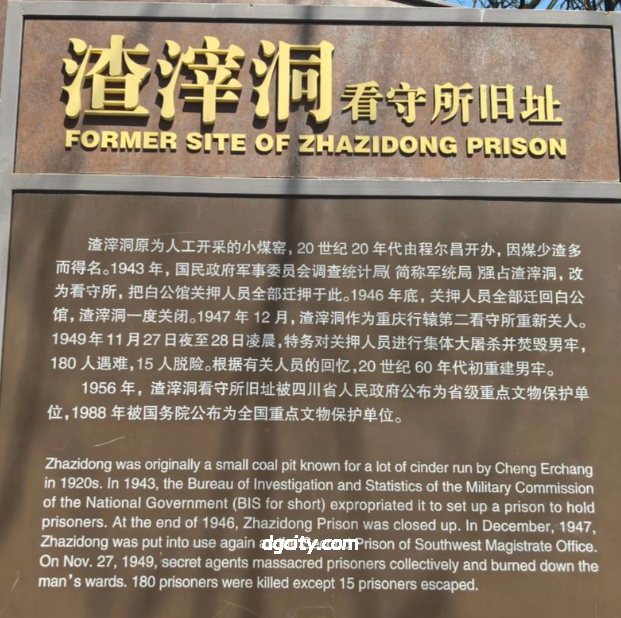
Zhazi Cave, 2.5 kilometers away from Bai Mansion, also bears a tragic history. Originally a coal mine named for its piled coal cinders, it was seized by Juntong in 1943 and converted into a detention center. Surrounded by mountains on three sides and facing a gully on one side, Zhazi Cave was strategically located and concealed, once holding more than 300 political prisoners, including Jiang Zhuyun (the prototype of “Sister Jiang” in “Red Crag”) and members of the “Iron Window Poetry Society”. In this prison, revolutionaries endured various tortures but remained unyielding. Facing bamboo stick torture, Jiang Zhuyun shouted firmly: “You can break my hands and kill my head, but you will never get the Party organization.” The prisoners formed the “Iron Window Poetry Society” in the prison, expressing their aspirations through poems and writing the heroic line: “To spare the next generation from suffering, we are willing to wear through the prison floor.” During the massacre on November 27, 1949, only 15 people survived Zhazi Cave, and the blood of the martyrs dyed this land red.
Today, Bai Mansion and Zhazi Cave have shed their former darkness and become sacred places to cherish the memory of martyrs and inherit their spirit. Both attractions are open to the public free of charge but require advance real-name reservation through the WeChat official accounts “Hongyan Museum” or “Red Village Network”. Special groups such as elderly over 65, active military personnel, and disabled people can enter without reservation with valid documents. For transportation, take Metro Line 1 to Martyrs’ Tomb Station and transfer to the free scenic shuttle bus, or choose to take a taxi or drive—Parking lots are available near the scenic areas.

When visiting, it is recommended to start with Bai Mansion, walking up the stone steps of Songlin Slope to feel the heavy history behind “Xiangshan Villa”. Then proceed to Zhazi Cave, entering cells, torture rooms, and exhibition halls to gain an in-depth understanding of the revolutionaries’ struggle through physical objects, photos, and written materials. The commentator service in the scenic area can help visitors better understand the historical background, and some exhibition areas are equipped with English introductions for foreign tourists. In addition, Gele Mountain Martyrs Cemetery and Hongyan Revolutionary Memorial Hall are not far from the two attractions and can be visited together to fully grasp the connotation of the Hongyan Spirit.
Nestled in the greenery of Gele Mountain, Bai Mansion and Zhazi Cave stand quietly. They are not only witnesses to history but also inheritors of spirit. Here, every cell carries the power of faith, and every story reveals national integrity. For foreign tourists, this red journey not only offers insight into China’s revolutionary history but also allows them to feel the Chinese nation’s indomitable spirit in pursuing freedom and justice, ensuring that the Hongyan Spirit transcends national borders and is passed down from generation to generation.




暂无评论内容