




In the street food scene of old Beijing, Luzhu Huoshao (stewed offal with baked wheat cake) is a controversial yet indispensable delicacy. Those who love it are addicted to its rich and savory flavor, while those who dislike offal stay away from it. This street food evolved from imperial cuisine, taking pork intestines, pork lungs, fried tofu and baked cakes as the core, and boiling them in a decades-old soup to create a unique rich taste. It is a deep-rooted taste memory of old Beijingers and an “advanced choice” for foreign tourists to deeply experience local food Culture. Unlike the delicacy of Peking duck and the tenderness of Jingjiang Rousi, Luzhu Huoshao has a rough and down-to-earth charm, with every bite hiding the street customs and dietary wisdom of old Beijing.
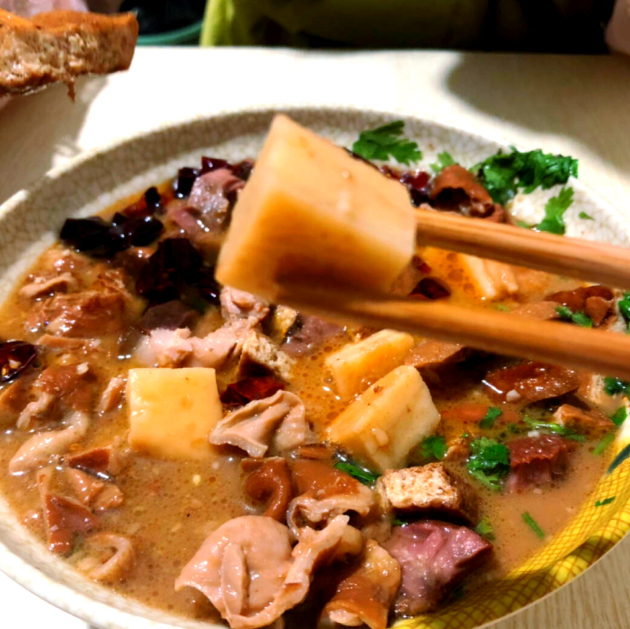
The origin of Luzhu Huoshao hides an evolution history from the imperial court to the people. Its predecessor was “Suzao Rou”, an imperial dish in the Qianlong period of the Qing Dynasty. Brought into the palace by Zhang Dongguan, a famous chef from Suzhou, it was made of pork belly simmered with nine spices such as clove, cinnamon and amomum villosum, and was deeply loved by Emperor Qianlong for its rich flavor. At that time, Suzao Rou was expensive and only available to the royal family and officials. During the Guangxu period, this dish spread to the people. To reduce costs and cater to the consumption capacity of ordinary people, vendors replaced pork belly with cheaper pork head meat and offal (pork intestines, pork lungs, etc.), and added baked wheat cakes to the stew to make the dish more filling. Thus, Luzhu Huoshao was born. Chen Zhaoen, the founder of the time-honored brand “Xiaochang Chen”, was the key figure who transformed Suzao Rou into Luzhu Huoshao. His craft has been passed down for a century and became an important representative of Luzhu making skills.
The soul of this snack lies in the exquisite integration of “aged soup” and “ingredients”, with sophistication hidden in every step of production. The aged soup is the foundation of Luzhu’s flavor. The aged soup of authentic restaurants has often been simmered continuously for decades, with fresh ingredients and spices added daily to enhance the flavor, allowing the soup to precipitate a more mellow and savory taste. This is also the core reason why Luzhu from different restaurants has distinct flavors. The spice combination inherits the essence of Suzao Rou, mainly using nine spices such as clove, cinnamon and amomum kravanh, which not only neutralize the fishy smell of pork offal but also endow the soup with a layered complex aroma, rich but not greasy, fresh but not plain.
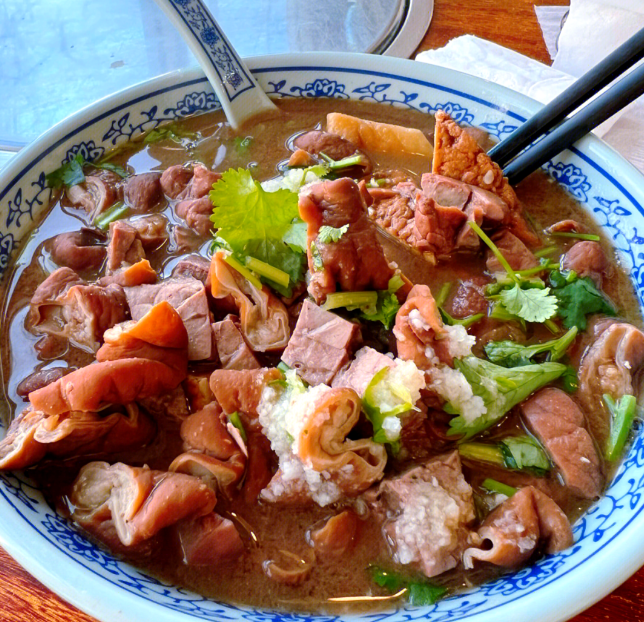
The selection and processing of ingredients directly determine the quality of Luzhu Huoshao. Fresh pork small intestines are selected, repeatedly cleaned to remove impurities and fishy smell, blanched and then simmered in aged soup until tender but not tough. When bitten open, they are full of fat aroma without fishiness. Pork lungs need to have fascia carefully removed, soaked in clear water to remove blood foam, and become soft and juicy after stewing, absorbing the essence of the soup. Fried tofu is made of firm tofu, cut into pieces and fried until golden and crispy. It can quickly absorb the soup after being put into the pot, forming a soft interior and crispy exterior texture. The baked wheat cake is a special hard dough cake, cut into a cross shape and simmered in the soup. It can absorb enough soup to become tender but not sticky, while retaining a certain chewiness to avoid being completely mushy.
Authentic Luzhu Huoshao has a fixed process from serving to eating. The chef takes pork intestines, pork lungs and fried tofu out of the boiling aged soup, cuts them into small pieces quickly, puts them into a bowl with the cut baked wheat cake, and then ladles a spoonful of boiling aged soup to soak them thoroughly. According to the diner’s preference, garlic puree, chili oil, fermented tofu juice, chive flower sauce and other condiments are added, and a bowl of steaming Luzhu Huoshao is ready. When served, first smell the aroma—the mellow aged soup, rich spices and fresh ingredients interweave. Then taste it: the baked wheat cake is full of soup, the pork intestines are tender and rich in fat, the pork lungs are soft and flavorful, and the fried tofu is full of umami. Multiple textures collide in the mouth, with extremely rich layers.
Mastering the correct eating method can enhance the Luzhu experience. Old Beijingers prefer to “hold the bowl and drink along the edge” when eating Luzhu. First, drink a few sips of hot soup to warm up and feel the mellow flavor of the soup, then slowly enjoy the ingredients, and finally finish the baked wheat cake and soup together without wasting a drop of essence. For foreign tourists trying it for the first time, it is recommended to add less chili oil and more garlic puree. The fragrance of garlic can effectively neutralize the richness of the offal and lower the acceptance threshold. If the soup is too salty, you can ask the restaurant for a little boiled water to dilute it, or pair it with refreshing side dishes to relieve greasiness.
Choosing the right restaurant is crucial to tasting authentic Luzhu Huoshao. Restaurants with different time-honored brands and characteristics interpret the diverse flavors of Luzhu: Xiaochang Chen Restaurant (Waiguan Xiejie Store), as a century-old time-honored brand, is an inheritor of Luzhu craftsmanship. Its Luzhu has tender intestines without greasiness, soft baked wheat cakes without stickiness, and mellow aged soup. It was once a late-night snack for opera stars such as Mei Lanfang, suitable for tourists pursuing traditional flavors. Yao Ji Chaogan Store (Gulou Dongda Street Store) is famous for chaogan (stewed liver soup), and its Luzhu is also very distinctive. The ingredients are clean and cost-effective. The store is well-known and often has long queues during peak hours, suitable for tourists who want to experience old Beijing snacks in one stop. Beixinqiao Luzhu Laodian (Dongsi Beidajie Store) focuses on large portions and high cost performance. You can choose to add more pork intestines or lungs, with rich condiments. It becomes more lively in the evening, full of street fireworks. Kailin Hufangqiao Luzhu (Hufang Road Store) is an authentic old store with strong Luzhu flavor and chewy baked wheat cakes. Eating it with the store’s steamed buns is a classic combination. Most regular customers are local elderly people, with a strong atmosphere.
There are a few practical tips for tasting Luzhu Huoshao: first, pork offal is difficult to process. Be sure to choose time-honored brands or restaurants with good reputations to ensure the ingredients are clean and free of fishy smell. Second, Luzhu is best eaten immediately after being made. Enjoy it while it’s hot, as the flavor will be greatly reduced when it’s cold. Third, the soup has a high fat content. Pair it with light drinks such as sour plum soup and jasmine tea to effectively relieve greasiness. Fourth, for the first try, it is recommended to order a small portion, and increase the amount after getting used to the flavor to avoid waste due to taste discomfort.
Luzhu Huoshao has no exquisite plating or rare ingredients, but with the precipitation of century-old soup and authentic ingredient matching, it has become a vivid carrier of old Beijing’s food Culture. It fell from imperial cuisine to street food, inherited for a century on the dining tables of ordinary people, hiding the life wisdom of old Beijingers of “making the best use of everything” and the purest street fireworks. For foreign tourists, tasting Luzhu Huoshao is not only a challenge and exploration of taste buds but also an experience of getting close to the local life of old Beijing. In the rich soup, you can understand the dietary heritage and warm fireworks of this city.






暂无评论内容