




In Jiading, located in the northwest of Shanghai, bamboo is more than just an ordinary plant—it is an artistic carrier bearing 500 years of craftsmanship and the moral integrity of literati. Jiading bamboo carving, a traditional craft born during the Zhengde and Jiajing reigns of the Ming Dynasty (1506-1566), uses knives as pens and bamboo as paper, integrating calligraphy, painting, poetry, prose and seal carving into one. Precipitated by time, it has become one of the first batch of national intangible cultural heritage and a unique scenic spot in Jiangnan Culture.
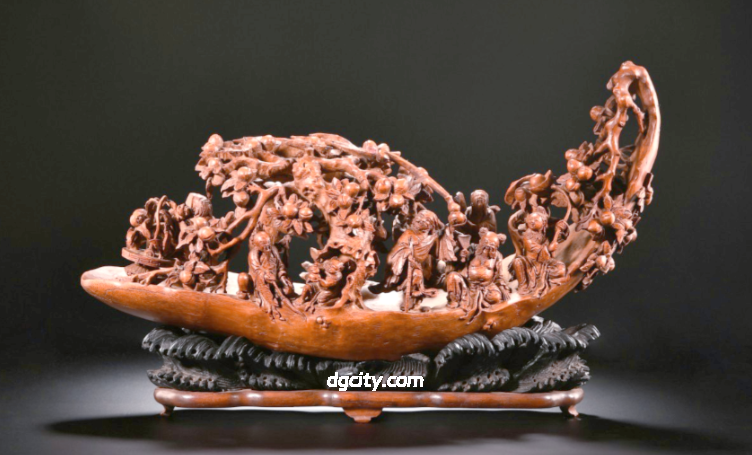
The rise of Jiading bamboo carving is not only nourished by geographical endowments but also promoted by the ingenuity of literati. Jiading, bordering the Liuhe River in the north, is rich in tall and tough bamboo, providing a unique raw material foundation for the development of bamboo carving techniques. The real founder of this craft is Zhu He (courtesy name Songlin), a literatus of the Ming Dynasty. Before that, bamboo carving was mostly simple patterns on practical utensils. Zhu He pioneered the integration of calligraphy and painting art into bamboo carving, creating the “deep carving technique” characterized by openwork and high relief, elevating bamboo carving from a practical craft to an independent ornamental art and laying the artistic foundation of Jiading Bamboo Carving.
After Zhu He, his son Zhu Ying (courtesy name Xiaosong) and grandson Zhu Zhizheng (courtesy name Sansong) inherited and innovated the craft. The three generations, known as the “Three Zhus” in history, jointly established the basic character of Jiading bamboo carving. Zhu Ying’s carving techniques were more diverse than Zhu He’s; he was good at carving ancient immortals and Buddha statues, whose exquisite skills were comparable to the paintings of Wu Daoxuan. Zhu Zhizheng further pushed the skills of his father and grandfather to the peak with his ingenious knife work and elegant style. The figures, landscapes, insects and birds he carved were all exquisite and vivid, combining vitality with simplicity, making Jiading Bamboo Carving “more complete in utensils, more exquisite in techniques, more famous and more learners”.
The Qing Dynasty was the heyday of Jiading Bamboo Carving, with numerous famous artists and various schools. During the Kangxi reign, Wu Zhi created the “thin-ground raised carving” technique, which was elegant, vigorous and multi-layered, praised as “divine craftsmanship” by people at that time. The three brothers Feng Xilu, Feng Xijue and Feng Xizhang were skilled in round carving, especially in figures, and their works were vivid and lifelike, pushing round carving techniques to the extreme. During the Qianlong reign, Zhou Hao integrated the essence of Jiading Bamboo Carving. With the accomplishment of a literati painter, he integrated the distant artistic conception of Southern School landscape painting into bamboo carving, using knives like pens without draft, forming his own artistic style. His works were known as “top-grade” by the world, and he was called the “Three Artists of Jiading” together with Zhou Li and Shi Tianzhang. During this period, Jiading Bamboo Carving not only improved its techniques day by day but also enriched its varieties, including stationery such as brush pots, incense tubes and arm rests, as well as ornaments such as figures, landscapes and beasts carved from bamboo roots, becoming an indispensable treasure on the desks of literati and refined scholars.
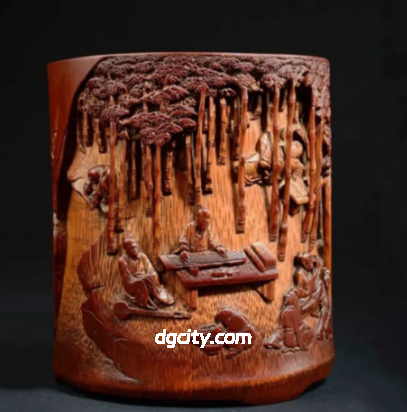
The charm of Jiading Bamboo Carving lies not only in its exquisite knife work but also in its profound cultural connotation. “Using knives as pens and carving bamboo with calligraphy” is its core feature. Artists reproduce the dignity of regular script, the fluency of running script and the boldness of cursive script on bamboo through intaglio, relief and other techniques, endowing bamboo carving works with the elegance of books and the taste of gold and stone. In the Ming and Qing Dynasties, Jiading was a gathering place for literati. Most bamboo carvers communicated with famous literati; they not only understood carving but also were proficient in poetry, calligraphy and painting, making each bamboo carving work contain the aesthetic taste and spiritual pursuit of literati. What was carved on the brush pot might be Su Shi’s “Ode to the Red Cliff”, what was carved on the arm rest could be Ni Zan’s landscape sketch, and even the ordinary fan bone might hide the calligraphic charm of Mi Fu.
After hundreds of years of vicissitudes, Jiading Bamboo Carving has also experienced ups and downs. In the late Qing Dynasty and the early Republic of China, with the influx of Western artifacts and social unrest, the market of Jiading Bamboo Carving shrank day by day, artists turned to other occupations one after another, and the craft was almost lost. After the founding of New China, this ancient craft ushered in a turning point: in 1955, Jiading established a handicraft bamboo carving production group to train a new generation of artists; in 1981, the bamboo carving group was reorganized to focus on the inheritance and innovation of techniques; in 2006, Jiading Bamboo Carving was included in the first batch of national intangible cultural heritage list with the approval of the State Council, gaining more extensive protection and attention. Today, inheritors represented by Fan Xunyuan, Zhang Yingyao, Zhang Weizhong and Wang Wei not only adhere to traditional techniques, focusing on classic crafts such as deep carving, openwork and green retention but also explore innovation, combining bamboo carving with modern design to launch cultural and creative products such as bamboo carving bookmarks and decorative paintings, allowing the ancient craft to enter the lives of young people.
Today, in the exhibition cabinets of the Jiading Bamboo Carving Museum, bamboo carving brush pots from the Ming Dynasty face bamboo carving ornaments from the contemporary era across time and space; on the desks of ordinary people, there may be a bamboo bookmark carved with orchids; in the handcraft classes of campuses, children are feeling the dialogue between bamboo and knives with their immature hands. Jiading Bamboo Carving, an art of writing and painting on bamboo, carries the elegance and ingenuity of Jiangnan literati. After 500 years of baptism, it is still tough and elegant, continuing to write the story of inheritance and rebirth in the soil of the new era.





暂无评论内容