




On Chongming Island, located on the Coast of the East China Sea, the warm sea breeze and fertile sandy soil have nurtured a rare flower known as the “Fairy on the Wave” – Chongming Narcissus. As one of China’s three major narcissus strains, Chongming Narcissus shares the same origin as Zhangzhou Narcissus in Fujian Province but has its own unique charm. It is the only local characteristic flower in Shanghai that has obtained the Agricultural Product Geographical Indication, and even more a treasure of intangible cultural heritage engraved with the context of Jiangnan Culture and island customs. After more than 400 years of precipitation, it still blooms with a pure fragrance in the cold winter.
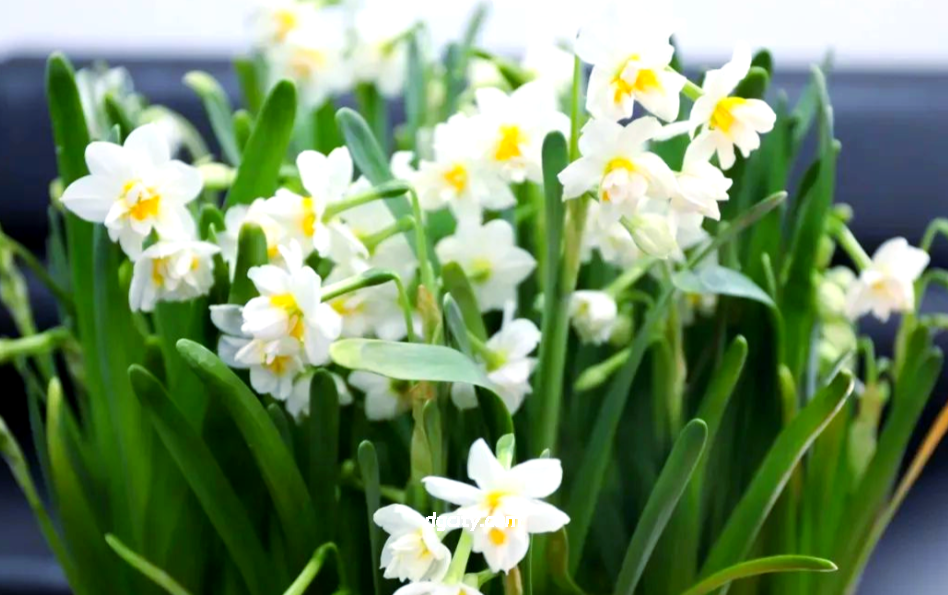
The cultivation history of Chongming Narcissus can be traced back to the Ming Dynasty. Over 400 years of inheritance and development have allowed this small flower to take deep roots in the texture of the island. Different from the paddy field cultivation of Zhangzhou Narcissus, Chongming Narcissus adopts dryland planting. Relying on Chongming Island’s unique subtropical monsoon climate – hot and humid in summer, mild and moist in winter – coupled with loose, breathable and well-drained soil, it provides unique natural conditions for the growth of narcissus bulbs. In the early days, Chongming Narcissus was only planted sporadically among the people for self-admiration or as gifts to relatives and friends. It gradually formed large-scale cultivation in the Qing Dynasty and was sold to Shanghai, Jiangsu and other places in the Republic of China, becoming a well-known local specialty at that time. It even went abroad and won the favor of overseas flower lovers. In November 2018, the traditional cultivation technique of Chongming Narcissus was officially included in the list of the 6th batch of municipal intangible cultural heritage representative projects, enabling this ancient technique to receive more systematic protection and inheritance.
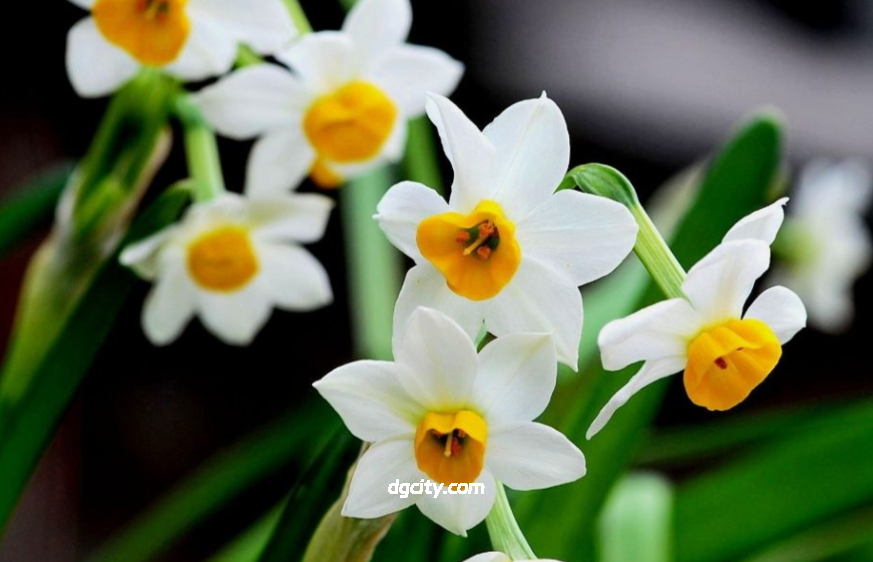
Compared with other narcissus strains, Chongming Narcissus has distinct characteristics, the most prominent of which are its strong and long-lasting fragrance and long flowering period. According to records, the flowering period of Chongming Narcissus can reach about 40 days, far exceeding that of ordinary narcissus. It lasts from around the Winter Solstice to the early spring of the following year, coinciding with the New Year’s Day and Spring Festival, making it the most touching scene in winter. Its fragrance is fresh and mellow, lingering for months. You can smell the faint fragrance in the air without getting close, which refreshes the heart and mind. There is a reputation that “a pot of narcissus fills the room with fragrance”, and it can be comparable to English roses. In terms of flower shape, Chongming Narcissus is mainly divided into two varieties: “Golden Cup and Silver Platform” and “Jade Exquisite”. The former is single-petaled, with petals as white as jade and shaped like a disc, and the flower center is as golden as a cup, resembling a golden cup placed on a silver platform, elegant and dignified. The latter is double-petaled, with complex and overlapping corolla folds, light yellow at the lower end and pale white at the upper end, like an exquisite jade carving, gentle and elegant. Among them, “Jade Exquisite” is the representative variety of Chongming Narcissus, deeply loved by people. In addition, the bulbs of Chongming Narcissus have few natural ramets, dense and plump bulbs, green and dripping leaves, and tall and straight plant shape, giving people a sense of simplicity, elegance, nobility and refinement.
The cultivation technique of Chongming Narcissus is extremely exquisite. It takes three years of careful cultivation to harvest, and every link embodies the wisdom and hard work of flower farmers. As an asexual reproduction plant, Chongming Narcissus does not need flowering and pollination, and mainly relies on bulb reproduction. The key steps include bulb selection, castration, planting, maintenance, harvesting, storage and forcing. First, flower farmers select high-quality bulbs that are plump, free of diseases and insect pests, and more than five centimeters in diameter, and perform professional castration to remove excess lateral buds to ensure that nutrients are concentrated on the main bulbs. Then, the treated bulbs are planted in carefully trimmed dry land. During this period, water and fertilizer must be strictly controlled, diseases and insect pests prevented, shade and cooling in summer, cold protection and warmth preservation in winter, and careful care for the growth of bulbs. Three years later, when the bulbs are mature and harvested, the old roots of the stem disc need to be removed and stored in a cool and ventilated place. In the depths of winter, flowering is promoted as scheduled during festivals through flower forcing techniques such as regulating temperature and water. This set of traditional cultivation techniques has been passed down from generation to generation and continuously optimized, retaining the ancient planting wisdom and integrating modern cultivation techniques, so that the quality and yield of Chongming Narcissus have been steadily improved.
In addition to its high ornamental value, Chongming Narcissus also carries profound cultural connotations, which is a microcosm of the integration of Jiangnan Culture and island culture. Since ancient times, because of its pure and refined characteristics, narcissus has become an object of praise by literati and poets. Chongming Narcissus, with its unique charm, has entered countless poems and paintings. The poems of Sima Guang and Wu Wenying in the Song Dynasty mentioned the elegance of “Jade Exquisite”. The eternal famous line by Huang Tingjian, “The fairy on the wave wears dust-free socks, walking lightly on the water under the faint moon”, has become a vivid portrayal of Chongming Narcissus. Emperor Kangxi of the Qing Dynasty once wrote a poem praising it: “Green robe, yellow crown and white jade ornaments, its pure posture never stains the mud and sand”. Qiu Jin also compared herself to narcissus and wrote the poem “Petals are like jade cups, roots are exiled from the jade platform”, expressing her feelings through the nobility of narcissus. Among the people, Chongming Narcissus also embodies people’s yearning for a better life. Placing a pot of narcissus during the Spring Festival symbolizes purity, auspiciousness and reunion, and has become an indispensable custom symbol in the Jiangnan region. In addition, Chongming Narcissus is also associated with folk legends such as Ehuang and Nüying, Qu Yuan, which further enriches its cultural heritage.
Today, driven by both intangible cultural heritage protection and rural revitalization, Chongming Narcissus is radiating new vitality. The local area has not only established standardized narcissus planting bases to systematically inherit and innovate traditional cultivation techniques, but also promoted the in-depth integration of the narcissus industry and the cultural tourism industry by holding the Narcissus Cultural Tourism Festival. The 4th Chongming Narcissus Cultural Tourism Festival held from the end of 2025 to the beginning of 2026, with the theme of “Building Dreams for Narcissus Development, Adding Color to Flower Township Revitalization”, set up six major sections including narcissus carving exhibition and evaluation, kitchen flower market, and homestay experience, allowing people to appreciate the beauty of narcissus, experience intangible cultural heritage techniques, taste local specialties, and further enhance the popularity and influence of Chongming Narcissus. At the same time, relying on e-commerce platforms, Chongming Narcissus is sold all over the country, extending from traditional cut flowers and bulbs to diversified products such as narcissus cultural and creative products and narcissus bonsai, allowing this famous island flower to enter more families.
More than 400 years of trials and hardships, more than 400 years of continuous fragrance. Chongming Narcissus is not only a flower carrying natural beauty, but also an ancient technique inherited for thousands of years, a symbol containing Jiangnan context, and a nostalgia embodying island feelings. In the cold winter, it breaks through the cold with a pure posture, warms the years with a strong fragrance, witnesses the changes of Chongming Island, and continues the cultural root of the Jiangnan region, becoming the most touching local mark and cultural treasure in Shanghai, an international metropolis.






暂无评论内容