




“A stone slab road, a millennium-old Ciqikou” — this long-circulated folk song tells the vicissitudes and charm of this Ancient Town. Located on the bank of the Jialing River in the northeastern part of Shapingba District, Chongqing, Ciqikou Ancient Town is only 14 kilometers away from the city center, covering a total area of 325,000 square meters, with a core scenic area of 143,000 square meters. As the largest and most distinctive Ba Yu-style ancient town in the main urban area of Chongqing, it is a national AAAA-level tourist attraction and one of the first batch of China’s Historical and Cultural Blocks, known as “the First Ancient Town of Ba Yu” and “the First Water Wharf of the Jialing River”, and also known as “Little Chongqing”. Backed by mountains and adjacent to water, it boasts a unique landform of “one river, two streams and three mountains”: the Jialing River winds eastward, surrounded by Fenghuang Stream and Qingshui Stream, with Jinbi Mountain, Ma’an Mountain and Fenghuang Mountain standing side by side. The original ecological Sichuan-Chongqing stilted buildings are scattered, and the bluestone slab roads wind and turn, perfectly integrating thousands of years of history with the hustle and bustle of daily life, making it a must-visit place to understand Ba Yu Culture.

The history of Ciqikou dates back to the Song Dynasty, originally named Baiyan Chang (White Rock Field). Later, because Emperor Jianwen Zhu Yunwen once took refuge in Baolun Temple here, it was renamed Longyin Town (Dragon Hidden Town). In the early Qing Dynasty, the porcelain industry flourished here, making it an important wharf for the production, marketing and transportation of porcelain. Thus, “Longyin Town” was renamed “Ciqikou” (Porcelain Port), and later changed to “Ciqikou” because “Ci” (porcelain) and “Ci” (magnet) are interchangeable in Chinese. During the Ming and Qing dynasties, it became a commercial and trade hub in the upper and middle reaches of the Jialing River. The folk song “Thousands of people bow their hands during the day, and ten thousand lights shine at night” vividly depicts the prosperous scene of gathered merchant ships and frequent business travel at that time. During the War of Resistance against Japanese Aggression, a large number of schools and scientific research institutions moved to the Shapingba area, making Ciqikou the core of Shaci Culture, with a sharp increase in population and numerous commercial firms, further consolidating its cultural and commercial status. After thousands of years of changes, Ciqikou still retains the street pattern and architectural style of the Ming and Qing dynasties, becoming a “living fossil” of Ba Yu culture.
When you come to Ciqikou, the first thing you see is the bluestone slab road running through the Ancient Town, which has been polished smooth by years. On both sides are scattered Ming and Qing style buildings, mostly made of brick and wood. The stilted buildings are built against the mountains, with overhanging eaves and carved window lattices, showing a strong Sichuan-East residential style. The streets and lanes of the ancient town are distributed like branches, with the main street and cross street as the framework, and 42 lanes extending towards the mountains, connecting ancient houses and shops. The core attraction, Baolun Temple, is located on Ciheng Street, founded in the Western Wei Dynasty, and is a famous Buddhist temple in Chongqing. With red walls and blue tiles, and curling incense, the Mahavira Hall has a plaque inscribed by Mr. Zhao Puchu. The pillars of the hall are made of mulberry wood that can be held by two people. Climbing to the top, you can overlook the entire ancient town and the panoramic view of the Jialing River. In autumn, the golden ginkgo leaves set off the ancient temple, creating a strong atmosphere.
In addition to Baolun Temple, Zhongjia Courtyard, Hanlin Academy and Baoshan Palace are also unmissable cultural attractions. Zhongjia Courtyard combines the characteristics of northern quadrangle courtyards and southern Chuan-style houses, with a spacious patio and surrounding corridors. The courtyard is dotted with water plants and goldfish, forming a sharp contrast with the bustle of the Ancient Town, making it an excellent place to take ancient-style photos[. Hanlin Academy is a Qing Dynasty school, with the reputation of “three Juren in one family, two Hanlin in five li”. The courtyard is fragrant with osmanthus trees, with blue tiles and wooden beams, full of ancient charm. Here, you can immerse yourself in the elegant life of ancient literati. Baoshan Palace is a good place to experience Ba Yu Culture. It holds tea culture exhibitions, silk and bamboo performances and opera shows all year round. Sitting in the ancient courtyard, drinking a cup of covered bowl tea and listening to a Sichuan opera tune, you will feel extremely comfortable.
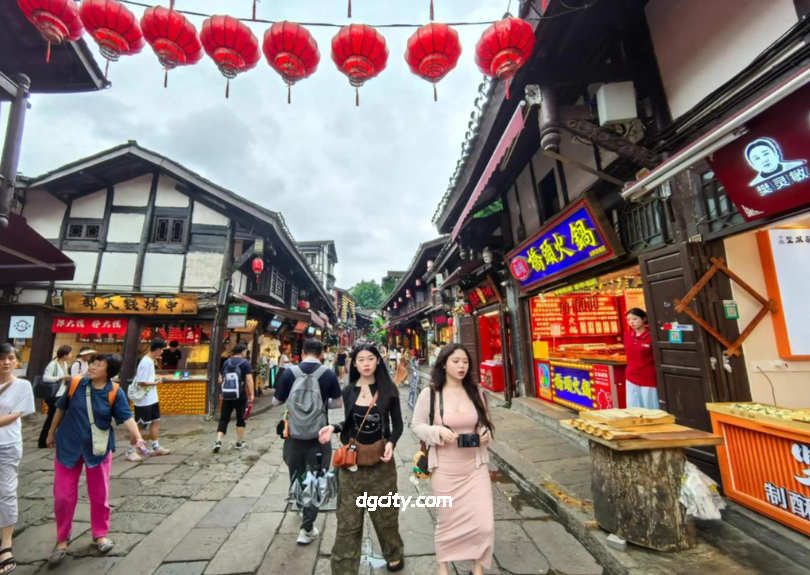
The hustle and bustle of Ciqikou is more hidden in the food along the streets and lanes. Known as “a town on the tip of the tongue”, it has a wide variety of special snacks. The most representative is Chen Ma Hua (Chen’s Fried Dough Twists). Freshly fried, the dough twists are crispy on the outside and soft on the inside, with various flavors such as original, salt and pepper, and sweet. Choose the old shop with a long queue, and you will never be disappointed[. In addition to Chen Ma Hua, Mao Xue Wang (Spicy Blood Curd), handmade hot and sour noodles, Shancheng small glutinous rice balls and handmade glutinous rice cakes are also must-try foods. Mao Xue Wang is spicy and delicious, with a bowl full of duck blood, tripe and lunch meat, a typical Chongqing flavor. Hot and sour noodles are chewy and refreshing, appetizing, and a bowl can refresh you after walking tired. Shancheng small glutinous rice balls are soft, glutinous and sweet, sprinkled with sesame and osmanthus, relieving spicy and greasiness[. In addition, handmade peanut crisp, sugar painting and cold cakes are also very distinctive, each bite is the taste of old Chongqing.
Today’s Ciqikou, while retaining its traditional charm, has also integrated more modern elements. The Back Street of Ciqikou runs through three cultural themes: climbing the mountain city, visiting the old street and tasting creativity, introducing boutique hotels, popular catering and cultural and creative stores, and has become the largest Hanfu culture experience block in Chongqing. From time to time, it holds international music shows, cultural fairs, Hanfu culture festivals and other activities. The large-scale historical stage play “Chongqing · 1949” uses advanced stage art technology to show the heroic deeds of Hongyan martyrs, making the traditional ancient town glow with new vitality. In 2025, the Ciqikou-Fenghuang Mountain Grand Scenic Area plans to invest another 600 million yuan to introduce more new cultural and tourism formats and create new experience scenarios.
Practical Travel Tips: Ciqikou Ancient Town is open for free all day. Transportation is very convenient: take Metro Line 1 to Ciqikou Station, get off and walk for 3 minutes to reach the entrance; you can also take buses such as No. 237 and No. 553 to Jinbi Station or Ciqikou East Station. It is recommended to reserve 2-3 hours for sightseeing. Avoid the peak of holidays and choose to go between 9-11 am or 5-7 pm on working days for a more comfortable experience with fewer people. It is recommended to wear comfortable shoes when visiting the ancient town, and ancient-style clothes are more suitable for taking photos. Remember to compare prices when buying souvenirs and beware of overpriced “intangible cultural heritage crafts”.
A millennium-old wharf hides ancient charm, and the hustle and bustle of daily life warms people’s hearts. Ciqikou Ancient Town has both the weight of history and the warmth of life, both the essence of Ba Yu culture and the vitality of modern trends. Whether you are walking on the bluestone slab roads, visiting ancient temples and houses, tasting special food, or experiencing intangible cultural heritage, you can find your own comfortable time here, which will become the most unforgettable part of your Chongqing trip.



暂无评论内容