




In the food world of Chongqing, Bishan Rabbit and Laifeng Fish are known as the “Two Treasures of Bishan”, which is not only the daily flavor deeply rooted in the hearts of Bishan people, but also a vivid representative of Chongqing’s intangible cultural heritage food. With a history of nearly 300 years, this characteristic delicacy started as a street snack in Dingjia Ancient Town. After years of precipitation and technological improvement, it has now become a famous dish well-known across the country, attracting countless foodies to make a special trip to Bishan just for a bite of the authentic rabbit flavor.
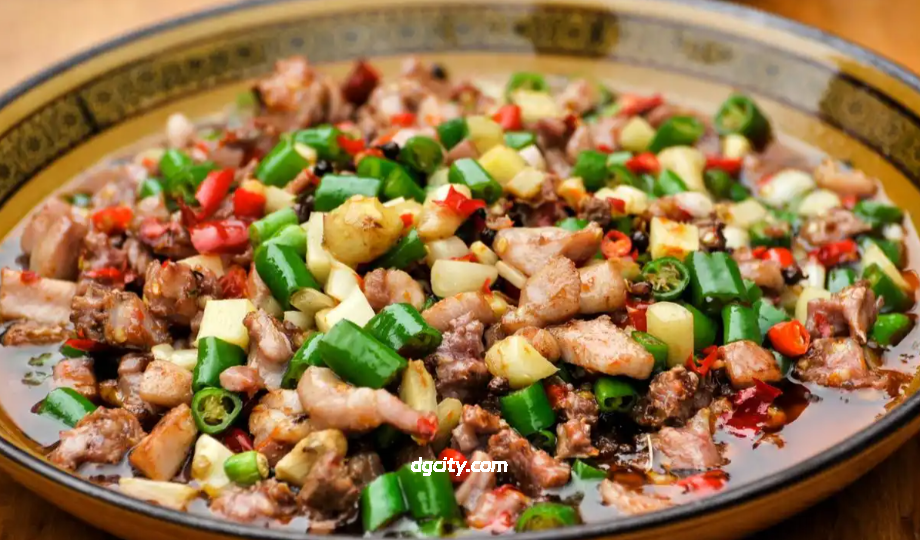
The history of Bishan Rabbit can be traced back to 1728, originating from Dingjia Street, Bishan District. During the War of Resistance against Japanese Aggression, Dingjia was an important town in southern Bishan, where famous universities such as Jiaotong University moved inward. Celebrities such as Zhou Enlai and Feng Yuxiang praised the local White Chopped Rabbit after tasting it, making this snack gradually famous. During the War of Resistance against Japanese Aggression, Bishan Rabbit was already well-known for its traditional White Chopped Rabbit. After the reform and opening up in the 1980s, Luo Yunqing (also known as Hu Ximu), on the basis of the traditional rabbit meat cooking skills inherited from his grandfather, combined the flavor of White Chopped Rabbit with the cooking method of Laifeng Fish, and created a new process of blanching fresh rabbit in water, stir-frying at low temperature and then boiling. This improved process made the taste of Bishan Rabbit better, forming a unique flavor of spicy, fresh, fragrant and tender, with bright red color, salty and fresh taste with a slight sweet aftertaste and a strong aftertaste. In July 2016, Bishan Rabbit was awarded the title of China’s Famous Dish by China Hotel Association, and in 2025, it was shortlisted in the list of Top 100 Famous Products of Bayu “Local Specialties”, becoming a bright food card of Bishan.
The essence of Bishan Rabbit lies not only in the strict selection of ingredients, but also in the ingenuity of the craftsmanship. In terms of ingredient selection, authentic Bishan Rabbit uses local rabbits raised with pure plants, with a weight between 2.25 and 2.5 kilograms. The meat is tender and free of fishy smell, and the freshness of the meat is maintained by draining the rabbit blood. In terms of ingredients, Qixing red peppers from Bishan are preferred, combined with more than ten kinds of natural spices, without additives, ensuring that every bite can taste the freshness of the ingredients themselves. In terms of production technology, different types of Bishan Rabbit have their own characteristics: Tang Rabbit, as a time-honored brand in Chongqing, only uses 9 kinds of hand-made condiments, mainly spicy, five-spice and sweet and sour, which can be adjusted according to the needs of diners. Fresh rabbits can be put on the shelf 1 to 2 hours after production, and the taste varies at different times; Cai Rabbit belongs to the White Chopped Rabbit category, and its unique spice combination gives it a taste of numbness, spiciness, freshness, fragrance and sweetness. Its White Chopped Rabbit processing technology was listed as the second batch of intangible cultural heritage projects in Bishan District in 2014; Laoyao Diving Rabbit is presented in the form of hot pot, with two flavors: red soup and sour soup. It is cooked quickly and does not get old after long boiling. The rabbit meat is QQ and tender, and the soup is fresh and mellow.

Today, Bishan Rabbit has developed a variety of categories. In addition to Tang Rabbit, Cai Rabbit and Laoyao Diving Rabbit, there are also Dingjia Rabbit, Jiafu Jade Rabbit, Bishan Plate Rabbit, etc., deriving more than 60 rabbit dishes and more than 20 rabbit meat series products. Among them, Bishan Plate Rabbit has been rated as a famous agricultural product in Chongqing for three consecutive times. It is refined with aged marinade, with a brownish-red color and firm meat. It is a typical “three highs and three lows” nutritious food – high calcium, high protein, high carbohydrate, low fat, low cholesterol and low calorie. It can be eaten immediately after opening the bag, which is not only a daily snack, but also a good gift. Jiafu Jade Rabbit focuses on high-quality products. After three years of research and development, it not only keeps the rabbit meat tender, but also takes into account the characteristics of high protein and low fat, with exquisite ingredients and precise heat control.
For foodies, there are many tips for tasting Bishan Rabbit. First, look at the color: authentic Bishan Rabbit has a bright and uniform red color, no blackening or darkening, and the combination of chili and rabbit meat is scattered; second, smell the fragrance: Bishan Rabbit made of fresh rabbit has a strong fragrance, no fishy smell, and the layers of spicy fragrance and spice fragrance are distinct; finally, taste the taste: the rabbit meat should be tender and crumbly, not dry or soft. After entering the mouth, the spicy taste spreads on the tip of the tongue, followed by a faint sweet aftertaste and a long aftertaste. When eating, serve with a bowl of rice or local coarse grain snacks in Bishan, which can neutralize the spiciness and highlight the freshness of the rabbit meat. If paired with a bottle of iced beer, it is even more refreshing and relieving greasiness.
When going to Bishan to taste authentic Bishan Rabbit, these stores are not to be missed. Tangcheng Tang Rabbit, as a representative store of Tang Rabbit, is located on the 3rd floor of South District, Nanmen Tangcheng, Donglin Avenue, Bishan District, with a contact number of 023-41802122. The rabbit meat made with hand-made condiments has an authentic flavor; Laoyao Diving Rabbit was founded in 1996, and its store is located at No. 27 Taiping Road, Dingjia Street, Bishan District, with a phone number of 19823685188. Two flavors of red soup and sour soup are available; Cai Rabbit’s store is located at No. 2, Attached to No. 113 Xiangyang Road, Xiangyang Farmer’s Market, Bishan District, with a phone number of 13883696058. The White Chopped Rabbit made by intangible cultural heritage technology is worth trying. In addition, Dajianglong Fish Workshop can unlock both Bishan Rabbit and Laifeng Fish at the same time, experiencing the two treasures of Bishan in one stop. It is located at No. 11, Attached to No. 26 Quanshan Road, Bishan District, with a phone number of 13509407722.
Bishan Rabbit is not only a delicacy, but also a carrier of Bishan Culture. From a street snack to a famous Chinese dish, from manual inheritance to industrial production, Bishan Rabbit carries the ingenuity and nostalgia of Bishan people, and also witnesses the development and changes of Bishan. Whether it is a daily snack for local foodies or a must-try for foreign tourists, this intangible cultural heritage food integrating history, flavor and nutrition can make people feel the unique charm of Chongqing food, which is unforgettable with one bite.





暂无评论内容