




Beside the Laixi River in Rongchang District, Chongqing, there passes down a thousand-year-old hand textile skill, which is known as one of the “Three Treasures of Rongchang” together with Rongchang pottery and Rongchang Folding Fan. In 2008, it was successfully selected into the second batch of National Intangible cultural heritage Lists, and this is the Rongchang Xiabu Weaving Technique, honored as “Soft Gold in Textiles”. Rooted in the Bashu region, this technique has evolved from the prototype of “Shu Bu” in the Han Dynasty to the imperial tribute fabric in the Tang and Song Dynasties, and now becomes a globally renowned intangible cultural heritage card. After thousands of years of inheritance, it still retains the purest essence of hand weaving, weaving a profound chapter of Chinese traditional textile Culture with a wisp of ramie fiber.
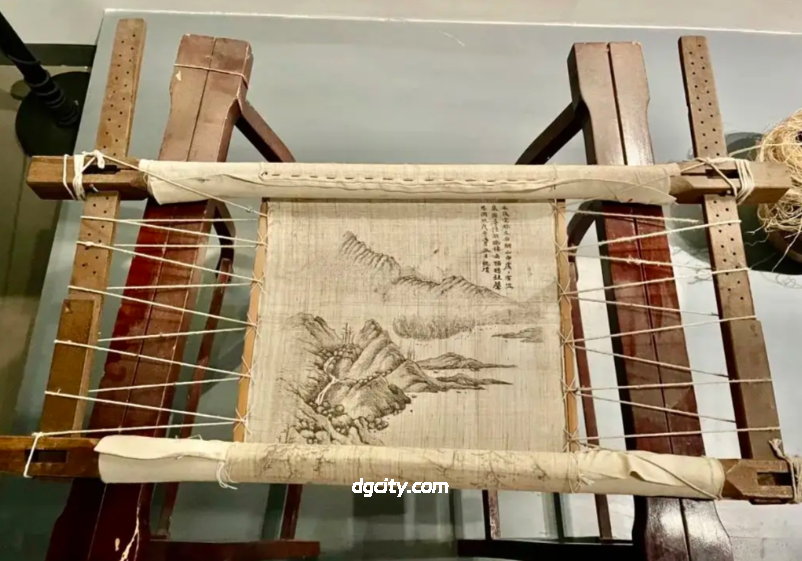
The birth of Rongchang Xiabu Weaving Technique is inseparable from the unique natural conditions of the local area. Located in a subtropical humid monsoon climate zone, Rongchang enjoys mild climate, abundant rainfall and dense rivers and streams. The moderate pH value of the Laixi River water provides an excellent environment for ramie planting, as well as bleaching and rinsing of Xiabu, making it a well-deserved “Hometown of Chinese Xiabu”. As early as the Han Dynasty, ramie textile had begun in Rongchang area, and the Xiabu at that time was called “Shu Bu”, famous for its light and delicate texture. During the Tang and Song Dynasties, the craftsmanship of Rongchang Xiabu became increasingly mature. It was listed as a tribute to the imperial court due to its characteristics of “light as cicada wings, thin as rice paper, smooth as a mirror, and fine as silk”, and was sold widely at home and abroad. In the Ming and Qing Dynasties, Rongchang Xiabu formed large-scale commercial production. Merchants from all over gathered to purchase, and its products were exported to Korea, Japan and Southeast Asian countries, making it one of the earliest exported textiles in China, ranking among the core areas of national ramie textile production a century ago.
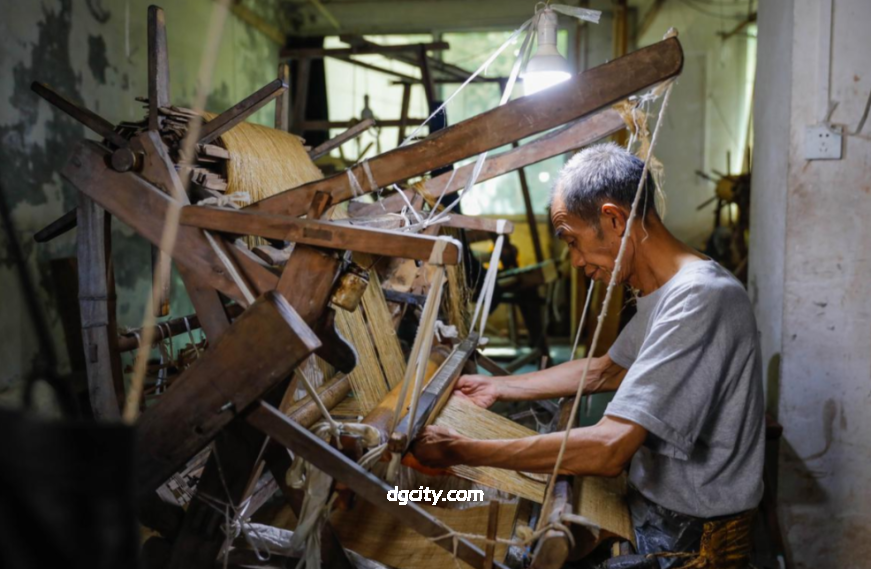
The core charm of Rongchang Xiabu Weaving Technique lies in the whole process completed by pure handwork, with dozens of interlocking and meticulous procedures, none of which can be replaced by machinery. Every step condenses the craftsman’s effort and wisdom. The whole process takes high-quality ramie as raw material, and is mainly divided into five core links: raw material processing, yarn spinning, warping, weaving and post-finishing, each of which tests the craftsman’s patience, care and skills. First is the raw material processing link, including hemp beating, green scraping, bleaching and hemp fumigating. The harvested ramie is stripped of its shell, impurities are removed, and bleached in a natural way to make the ramie fiber white and flexible. Next is the yarn spinning link, the soul process of Xiabu weaving. Craftsmen need to tear ramie fibers into hair-thin filaments by hand, and then connect them one by one into continuous ramie threads. The whole process depends only on fingertip touch, and slight uneven force will affect the thickness of the thread. A skilled craftsman can only spin a small amount of high-quality ramie thread a day. Then comes the steps of winding ramie balls, threading, heddling and sizing, arranging ramie threads into regular warp threads, fixing them on the loom, and brushing natural rice slurry to increase the toughness of ramie threads to avoid breakage during weaving. In the most critical weaving link, craftsmen sit upright in front of the loom, coordinating their hands and feet. They step on the pedal to control the opening and closing of warp threads, push the wooden shuttle to thread back and forth, and compact each thread to form the fine Xiabu. The finer the Xiabu, the higher the warp density, and only a few meters can be woven a day. Finally, after post-processes such as rinsing, shaping, dyeing and printing, a complete piece of Rongchang Xiabu is finished.
According to craftsmanship precision and usage, Rongchang Xiabu is mainly divided into three categories: coarse fabric, fine fabric and ribbed fabric. Coarse fabric has low warp density, mostly used for practical items such as mosquito nets and cloth bags; fine fabric has dense warps, light and soft texture, and strong air permeability, making it an excellent material for summer clothing, home textiles and handicrafts; ribbed fabric has special craftsmanship and unique texture, mostly used for high-end clothing and cultural and creative products. Rongchang Xiabu not only has outstanding texture, but also has the characteristics of natural environmental protection, breathability, sweat absorption, antibacterial and mildew resistance, which is in line with the current green and healthy lifestyle. This is the core reason why it has not been eliminated after thousands of years.
Today, Rongchang Xiabu Weaving Technique is on the road of inheritance and innovation. In the past, this technique was mostly inherited by families and taught orally, facing the risk of being lost due to the shortage of young inheritors. In recent years, the local government of Rongchang has vigorously promoted the protection of intangible cultural heritage, built Xiabu Town, established intangible cultural heritage research bases, trained young craftsmen, and promoted the integration of Xiabu technique with modern life. A variety of cultural and creative products such as Xiabu folding fans, clothing, hanging paintings, sachets and home accessories have been developed, making the ancient skill jump out of the traditional framework and enter the daily life of young people. At the same time, with its unique oriental craft aesthetics, Rongchang Xiabu has gone abroad again, becoming an important carrier of foreign affairs gifts and international cultural exchanges, showing the charm of Chinese traditional handcraft skills to the world.
Rongchang Xiabu Weaving Technique is not only a textile craft, but also a crystallization of the working wisdom of the Chinese nation, and a living cultural heritage carrying regional Culture, folk customs and craftsman spirit. Each piece of Xiabu hides the imprint of thousands of years and the warmth of craftsmen’s fingertips. It uses warp and weft as pens and ramie threads as ink, writing the inheritance and renewal of Chinese traditional intangible cultural heritage, and still exudes its unique cultural glory in the new era.






暂无评论内容