




Rooted in Liangping District, Chongqing, a region with a long history of Bashu Culture, Liangping woodblock New Year paintings are a shining pearl of Chinese traditional folk art. Known as one of the “Three Wonders of Liangping” together with Liangping Bamboo Curtains and Liangshan Lantern Opera, they are the only woodblock new year painting genre in Chongqing. In 2006, they were included in the first batch of National Intangible cultural heritage of China, and rank among China’s top four woodblock new year paintings alongside Taohuawu in Suzhou, Yangliuqing in Tianjin, and Yangjiabu in Weifang. With a history of nearly 500 years, these paintings feature a rustic and bold artistic style and unique handcrafted techniques, carrying the folk customs and festive wishes of local people in the Bashu region, and winning worldwide recognition for their distinctive cultural charm.
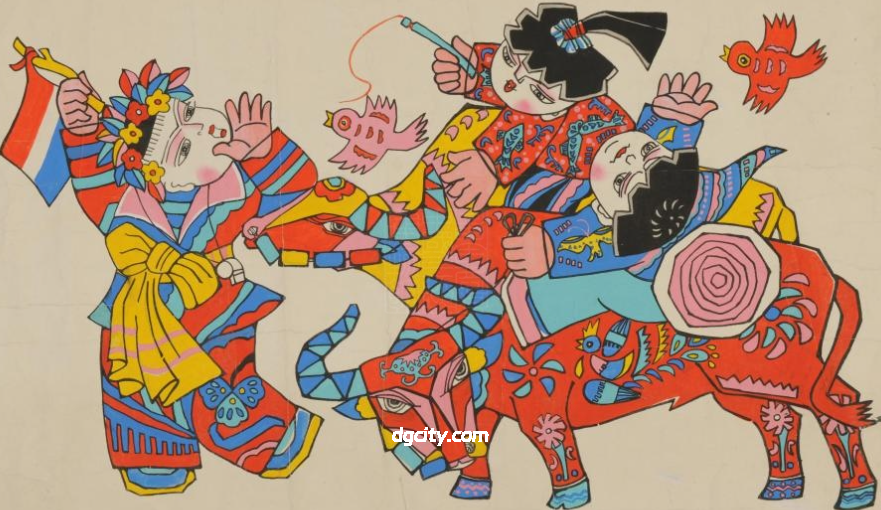
The history of Liangping woodblock New Year paintings dates back to the Jiajing period of the Ming Dynasty, and flourished during the Kangxi period of the Qing Dynasty, reaching its peak in the early years of the Republic of China. According to the Annals of Liangping County, at the height of its prosperity, there were more than 30 workshops and hundreds of craftsmen engaged in this art. The paintings were not only popular in Shaanxi, Southwest China and the Yangtze River Basin, but also exported to Southeast Asia, and collected by Museums in the Soviet Union, the United States, France and other countries, becoming a well-known folk art treasure at home and abroad. After experiencing a decline due to social changes in modern times, this traditional craft has been revived in recent years with the support of intangible cultural heritage protection policies, continuing its inheritance in the new era.
What makes Liangping woodblock New Year paintings unique is their exquisite regional raw materials and rigorous handcrafted production process. All procedures are completed manually, embodying the ingenuity of folk craftsmen. Pear wood with fine texture and high durability is selected for engraving blocks, ensuring clear and powerful lines; the paper used is handmade bamboo paper from the local Baili Bamboo Sea, called “Eryuan Paper”, which is flexible and has good color absorption. The complete production process includes six key steps: draft drawing, block engraving, paper steaming, degumming, color overprinting and manual coloring. Each color corresponds to a separate block, integrating the carving skills of Bashu school, the color overprinting techniques of Hui and Jinling schools, and even Western perspective and light-shadow methods, making the paintings layered and vivid. The main colors are bright red, yellow, green and black, with strong contrast but not gaudy; the iconic “Liangping Red” is derived from local folk customs, adding a festive touch to the solemn door god images, symbolizing good luck and evil avoidance.
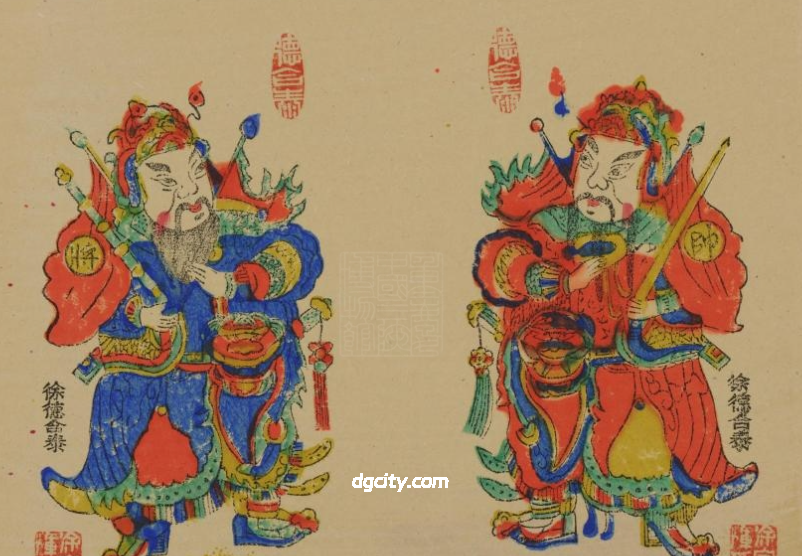
The themes of Liangping Woodblock New Year Paintings are diverse and closely connected with the daily life and spiritual sustenance of ordinary people, mainly divided into three categories. The first and most classic category is door gods, including masterpieces such as General Pictures, Official Promotion and Blessing, and Five Sons Winning the Imperial Examinations. The figures are rustic and exaggerated, with powerful lines, pasted on doors during the Spring Festival to guard the house and pray for good fortune. The second category is myths and legends, such as The Mouse’s Wedding and Qilin Sending Children, which are lively and full of romanticism. The third category is opera stories, adapted from classic Sichuan Opera and traditional Chinese opera episodes, combining opera art with woodblock painting. In addition, there are various auspicious paper decorations, all conveying good wishes such as happiness, good luck, health and prosperity, which are an important part of Chinese Spring Festival folk Culture.
As a representative of Bashu folk art, Liangping Woodblock New Year Paintings have high historical, artistic and cultural value. They truly record the folk customs, social life and aesthetic concepts of the Bashu region since the Ming and Qing Dynasties, serving as precious materials for studying local history and folk art. Its unique craft system fills the gap of woodblock new year paintings in Chongqing, showing the wisdom and creativity of folk craftsmen. Today, with the efforts of inheritors, this intangible cultural heritage has broken through traditional boundaries, integrating into cultural innovation, exhibitions and research activities, entering campuses and markets to revitalize the ancient craft. From a traditional festive ornament to a global cultural card of China, Liangping Woodblock New Year Paintings retain the authenticity of folk art, conveying the unique festive sentiment and cultural heritage of China.
Liangping Woodblock New Year Paintings are not only a symbol of Spring Festival blessings, but also a carrier of China’s excellent traditional Culture. This centuries-old intangible cultural heritage condenses the efforts of generations of craftsmen, and continues to shine in the new era, letting more people around the world appreciate the beauty of Chinese folk art and inherit the ingenuity of traditional culture.



暂无评论内容