




In the core of Beijing, a city with a thousand-year heritage and modern vitality, there is a quiet hidden gem that avoids the crowds of Qianhai and Houhai. With a “simple, wild and natural, long cultural context” posture, it has become another window for foreign tourists to understand Beijing — this is Beijing Xihai Wetland Park. As the only urban wetland in the core area of the capital, Xihai is not only an ecological oasis, but also a living Museum carrying the canal Culture of the Yuan Dadu and the cultural relics of the Ming and Qing dynasties. Without traveling far, you can encounter the most warm side of Beijing among the blue waves and willow shadows.
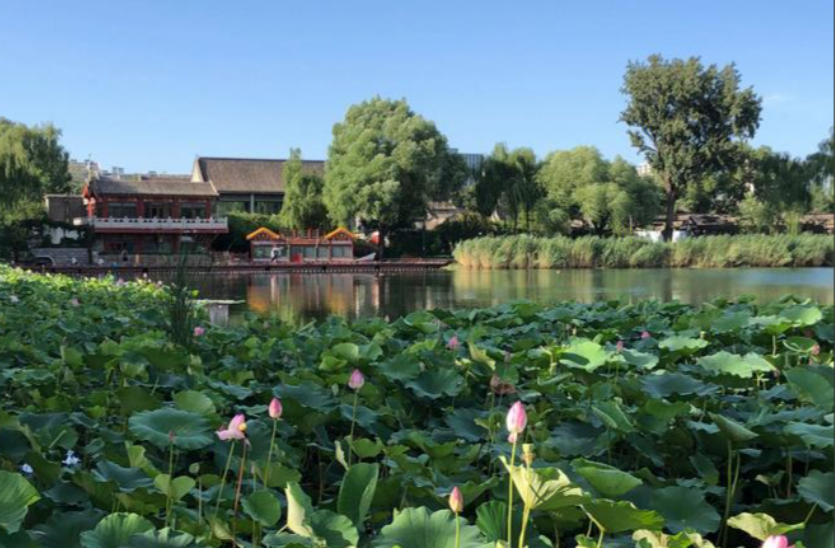
Located on the west side of Deshengmen in Xicheng District, Xihai Wetland Park belongs to the Shichahai water area, formerly known as “Jishuitan”. It was once the terminal dock of the Beijing-Hangzhou Grand Canal in the Yuan Dadu, and also a prosperous place with busy water transport and gathered merchant ships. Today, this 10.9-hectare wetland, of which 7.4 hectares are water areas and 3.5 hectares are surrounding green spaces, was officially opened to the public on October 1, 2018 after ecological restoration, recreating the picturesque scenery described by Mr. Lao She as “rippling blue waves and clumps of reeds”, and has also become a model for Beijing’s urban ecological restoration. Different from the hustle and bustle of other popular scenic spots in Beijing, Xihai always maintains a sense of tranquility and simplicity. Whether it is the misty morning, the warm sun on the shore in the afternoon, or the afterglow dyeing the lake at dusk, you can feel the relaxation and comfort away from the hustle and bustle.
For foreign tourists, the charm of Xihai lies in its perfect integration of natural ecology and human history, with surprises at every step. Admission to the Park is free, and the fully open layout allows you to step into this hidden gem at any time. Walk slowly along the 1,450-meter-long lakeside trail, which is fully connected. In the past, illegal buildings were demolished along the way, and water-friendly plank roads and viewing platforms were added. Walking on it, you seem to be in a water town in the south of the Yangtze River — willows sway gently along the shore, reeds sway in the wind, and more than 50 kinds of aquatic plants such as caltrops and lotus flowers are scattered all over the lake. In summer, lotus flowers bloom in full bloom, with pink and white petals reflecting the blue waves. Occasionally, wild ducks and water birds play in the water, and if you are lucky, you can also see wild duck eggs, which vividly interprets the ecological picture of “clear water, green shores, beautiful scenery and happy birds”. There are also 3 ecological floating islands built in the park, and the largest floating island is equipped with artificial bird nests, providing a safe habitat for water birds and also an intuitive display area for wetland ecological protection.
In addition to the stunning Natural Scenery, the cultural relics around Xihai carry the thousand-year memory of Beijing and are worth exploring in detail by foreign tourists. Huitong Temple, located on the hill in the northwest corner of the park, is now the Guo Shoujing Memorial Hall. As one of the first free Museums open to the public in Beijing, it details the life achievements of Guo Shoujing, a scientist in the Yuan Dynasty. In particular, the Yuan Dadu water system project he presided over made Jishuitan the core hub of water transport at that time, nourishing the entire capital. The memorial hall displays a replica of the ancient astronomical instrument “Armillary Sphere”, with giant dragons carved at the four corners, exquisite craftsmanship, allowing people to intuitively feel the brilliant achievements of ancient Chinese astronomical science and technology. Standing on the high ground of Huitong Temple, you can also overlook the entire Xihai, with the China Zun in the distance and the lake and mountain scenery nearby complementing each other, creating a shocking picture of the integration of ancient and modern times.
Around the park, there are also historical relics such as Sanguan Temple, Jingye Temple and Puji Temple. The ancient buildings with red walls and gray tiles set off against the Natural Scenery of the wetland, forming an elegant and ancient ink painting. In addition, the intelligent facilities in the park also provide convenience for foreign tourists. 120 intelligent light poles have functions such as WiFi coverage, mobile phone charging and PM2.5 monitoring, and the whole park has full wireless network coverage, making it convenient for tourists to query routes and share beautiful scenery at any time. Dozens of sets of leisure seats and ancient-style pavilions along the way are available for tourists to rest at any time, blowing the breeze by the lake, enjoying the scenery in front of them, and feeling the slow life rhythm of Beijing.
To help foreign tourists better experience the beauty of Xihai, here is a practical travel guide. In terms of transportation, take Metro Line 2 to Jishuitan Station, exit from the southeast exit, and walk about 200 meters to reach it. You can also take a bus to Deshengmen West Station, which is very convenient. The opening hours are free all day. It is recommended to spend 1.5 to 2 hours here. The best travel season is summer (June to August), when you can enjoy the beautiful scenery of blooming lotus flowers. In autumn (September to November), the reeds turn yellow, which is very artistic for taking photos. In winter, you can feel the quiet beauty of the frozen lake surface.
The surrounding supporting facilities are also very complete. There are many old Beijing characteristic restaurants near the park, where you can taste local delicacies such as douzhi, jiaoquan and fried sauce noodles, as well as western restaurants and cafes suitable for foreign tourists’ tastes. From Xihai, you can walk to nearby scenic spots such as Tanxi Shengjing and Deshengmen Arrow Tower. As one of the nine city gates of the inner city of Beijing, Deshengmen Arrow Tower still retains the style of an ancient military fortress, and there is a permanent ancient coin exhibition in the building, which is worth a visit.

Here, there are no crowded crowds or commercial hustle and bustle, only clear lakes, lush green plants, profound history and leisurely time. For foreign tourists who are eager to escape the urban hustle and bustle and feel the local charm of Beijing, Xihai Wetland Park is undoubtedly an excellent choice. It has both the gentleness of a water town in the south of the Yangtze River and the profoundness of an ancient northern city, both the vitality of natural ecology and the heritage of human history. Walking into here is walking into the most real and warm side of Beijing, allowing every tourist to leave an unforgettable travel memory.




暂无评论内容