




Between the mountains and rivers of Chongqing, there is a landmark that combines natural beauty and cultural heritage — Hongya Cave Folk Custom Scenic Area. Located at No. 88 Jialing River Binjiang Road, Yuzhong District, in the riverside area where the Yangtze River and Jialing River meet, this building complex built along the mountain and river is not only a national AAAA-level tourist attraction, but also one of the Top Ten Cultural and Tourism New Landmarks in Chengdu-Chongqing, and a window to understand Bayu Culture. It perfectly integrates the simplicity of stilted buildings, the fireworks of the market and the splendor of modernity. During the day, you can enjoy Bayu customs; at night, you can attend a date with lights. Every step hides the unique charm of Chongqing, making it a must-visit place for every tourist to Chongqing.
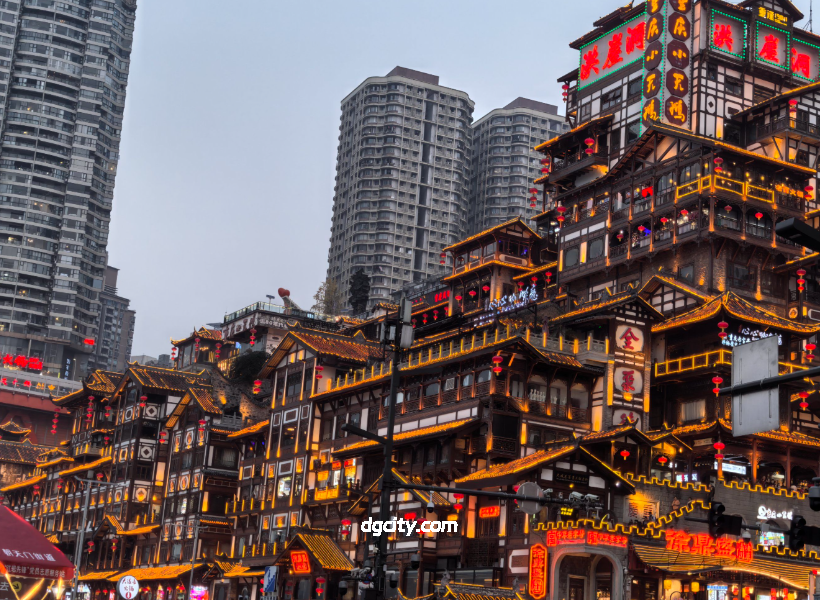
The soul of Hongya Cave lies in its unique architectural style. As a key landscape project in Chongqing, it covers a vast area with a construction area of 46,000 square meters. Taking traditional Bayu stilted buildings as the main body, it adopts mountain architectural techniques such as layered platform construction, stilted feet, staggered stacking and cliffside construction. The overlapping buildings are hung on the cliff, forming a unique landscape of a “three-dimensional sky pedestrian street”. This architectural form originates from the clever use of mountain terrain by old Chongqing people. As early as the 1930s and 1940s, such stilted buildings were widely distributed on both banks of the two rivers. Today, Hongya Cave has restored this memory with modern craftsmanship. The wooden floors and carved window lattices carry national feelings, while the concrete structure endows it with more lasting vitality. What is even more amazing is that both the 11th floor and the 1st floor here are at street level. Taking the elevator up and down is like experiencing a “mountain city space magic”, which perfectly interprets the characteristics of Chongqing as an “8D magical city”. The scenic area has formed an operation form of “one form, three wonders, four streets and eight scenic spots”. Wandering in it, you can watch the stilted buildings and the dripping green of Hongya, stroll through the mountain city old street to appreciate Bayu Culture, eat hot pot to watch the confluence of the two rivers, taste delicious food from all over the world, and immerse yourself in the Bayu cultural leisure format.
In addition to the architectural wonders, Hongya Cave also has profound cultural heritage. Originally known as “Hongya Gate”, it was a closed gate among the 17 gates of the old Chongqing’s “nine open and eight closed” gates. It guarded the key node in the lower reaches of the Jialing River and was an important part of the Ancient City’s defense system, witnessing the beacon fires of the alternation of the Ming and Qing dynasties and the rebirth after the war of resistance against Japanese aggression. Today, the outline of the ancient city wall is carefully preserved, becoming an anchor of the mountain city spirit and telling the perseverance and inheritance of Chongqing people. The “Urban Memory” sculpture, Hongya Han Que and other landscapes in the scenic area further continue this historical context. Hongya Han Que is built imitating the cultural relics unearthed in Wushan of the Three Gorges Reservoir area. The gray stone with simple carvings is an excellent place for taking ancient-style photos. In addition, there are many intangible cultural heritage handcraft shops in the scenic area, where traditional crafts such as Shu Embroidery, bamboo weaving and Rongchang pottery are inherited. Special foods such as Mao’s cold noodles and hand-made sour plum soup adhere to traditional production methods, and each handcraft hides the code of Bayu Culture.
To visit Hongya Cave, mastering the strategy can help you avoid crowds and gain the best experience. In terms of transportation, the most convenient way is to take Metro Line 1/6 to “Xiaoshizi” Station, Exit 9, and walk for 10 minutes to reach the entrance on the 11th floor, which is labor-saving and efficient; if you want to take a panoramic photo, you can take Metro Line 6 to “Grand Theater” Station, Exit 2, where you can capture the beautiful frame of Hongya Cave and its reflection on the river surface. It should be noted that the scenic area is free during holidays but requires advance reservation on the official WeChat account “Hongya Cave Folk Custom Scenic Area”. Try to avoid driving or taking a taxi to the 1st floor, as there will be serious congestion during peak hours.
It is recommended to visit from top to bottom. Start from the 11th floor City Balcony, which is an excellent position to overlook the confluence of the two rivers. With the evening breeze blowing, you can have a panoramic view of the Jialing River and Qiansimen Bridge. Then go to the Reunion 1980 Block on the 4th floor. The retro old street with red lanterns is perfect for taking photos in Hanfu or cheongsam. There are also many time-honored food shops in the block where you can taste authentic Chongqing snacks. Continuing down, you will pass through the food street and cultural and creative street, where you can not only check in Internet-famous snacks such as Laoma Wonton and Ghost Crispy Pork, but also choose souvenirs such as Rongchang folding fans and hot pot base. Finally, arrive at Jialing Road on the 1st floor to enjoy the full view of Hongya Cave up close and feel the atmosphere of the lights reflecting on the river surface.
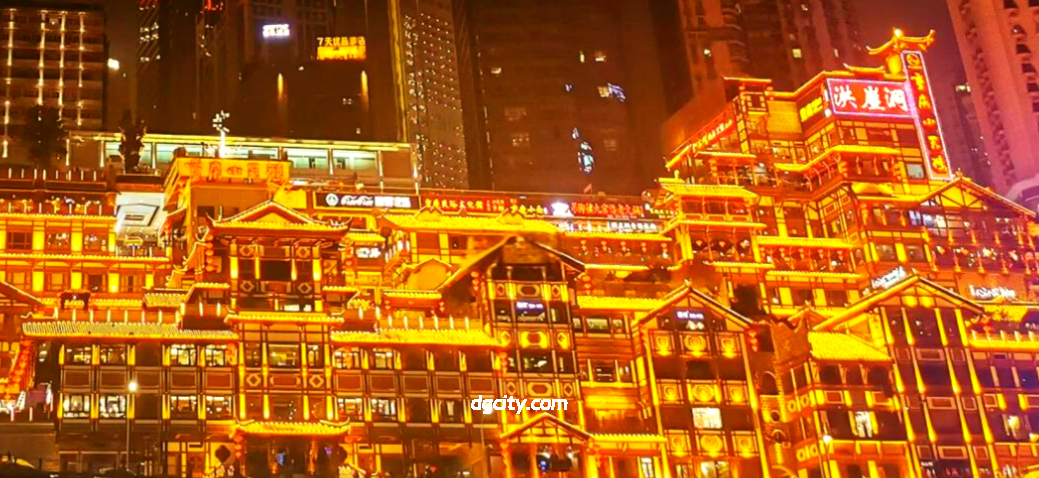
The night view is the highlight of Hongya Cave and the reason why it is known as the “real-life Spirited Away bathhouse”. Every night from 18:00 to 23:00, the lights are turned on on time. The warm yellow light strips outline the cornices of the stilted buildings, reflecting with the lights of the cruise ships on the river. The entire building complex stands on the bank of the Jialing River like a dream castle. In addition to the observation decks in the scenic area, the middle section of Qiansimen Bridge is also a must-visit place. A 0.5x wide-angle lens can capture the shocking picture of the panoramic view of Hongya Cave and the train passing through the river. The Daijia Lane Trail can take a bird’s-eye view of the side panoramic view, forming a unique visual effect of contrast between ancient and modern times. Visiting during off-peak hours can improve the experience. It is recommended to enter before 18:00 or go after 21:00 to avoid the peak of tour groups.
In terms of food, the surrounding area of Hongya Cave hides the most authentic Chongqing fireworks. The Feast Food Street in the scenic area gathers various Chongqing characteristic foods, including nine-grid hot pot, Chongqing noodles, spicy and sour noodles, and cold cakes. It is recommended to try the time-honored hot pot in the alley. The tripe and duck intestines are crispy and tender after boiling, and paired with a bowl of hand-rubbed ice powder to relieve the spiciness, it is absolutely perfect. If you want to avoid the high-priced snacks in the scenic area, walk 5 minutes to Daijia Lane, which is a food paradise often visited by locals, with various authentic small restaurants with high cost performance.
As a business card of Chongqing, Hongya Cave is not only a tourist attraction, but also a microcosm of Bayu culture. It perfectly integrates history and modernity, nature and humanity, fireworks and romance. Here, you can not only feel the market warmth of old Chongqing, but also appreciate the bright vitality of the modern city. Whether traveling alone, dating with lovers or traveling with family, Hongya Cave can satisfy all your imagination of Chongqing. Keep an appointment with Hongya Cave and understand the past and present of the mountain city.



暂无评论内容