




In the landscape of Chongqing’s local dishes, Spicy Chicken is definitely the most recognizable one — piles of bright red chili peppers form a small hill, with golden and crispy chicken cubes hidden among them. The aroma of numbing Sichuan peppercorns and spicy chili peppers interweaves and fills the air. Taking a bite, the outer skin is crispy, the inside is tender, the spicy stimulation reaches the tip of the tongue directly, and it is accompanied by the fresh and sweet aftertaste of chicken. This is the most straightforward and enthusiastic taste expression of the mountain city. Without exquisite plating, this dish has moved from a roadside stall in Geleshan to the whole country with its rough and bold temperament and rich layers of flavor, becoming a “spicy business card” of Chongqing cuisine, and also carrying the bold and tenacious urban character of the mountain city people.
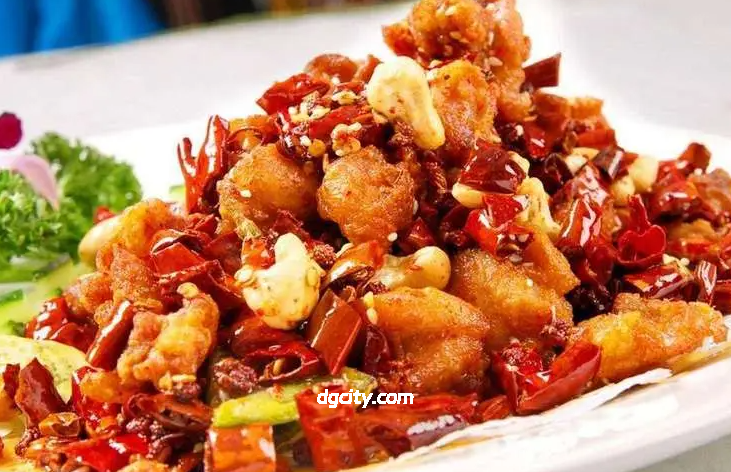
The origin of Chongqing Spicy Chicken hides a story of street fireworks. Its mainstream statement can be traced back to the late 1980s at Sanbaiti, Geleshan, Chongqing. It was originally an unintentional creation of a roadside shop, but it unexpectedly conquered the porters, boatmen and vendors passing by. At that time, Geleshan was rainy all year round with heavy humidity. Since ancient times, local people have had the eating habit of “dispelling dampness with spiciness and dispelling cold with numbness”. The shop owner stir-fried local free-range chicken with a large number of dried chili peppers and Sichuan peppercorns, which not only dispelled dampness and cold, but also soothed the fatigue after work. The unique form of “more chili peppers than meat” became the original appearance of this dish. It is worth mentioning that the predecessor of this dish can be traced back to “Steel Chicken” included in the “Chinese Famous Recipes” in 1957, where “steel” refers to chili peppers and “iron” refers to Sichuan peppercorns. After years of improvement, it has formed the authentic flavor of heavy numbness and spiciness today. In 2011, the production technique of Geleshan Spicy Chicken was included in the list of Chongqing intangible cultural heritage.
An authentic Chongqing Spicy Chicken’s delicious foundation lies in the selection of ingredients, and each ingredient has strict requirements. As the main ingredient, chicken is preferably local free-range native chicken or three-yellow chicken in Chongqing, especially chicken thigh meat. Its fat is evenly distributed, and the meat is firm and chewy. It is neither too greasy nor dry after frying. Cut into cubes of about 2 centimeters, the size is moderate, which can not only be fully flavored, but also easy to “search” among the chili peppers. After cutting the chicken into cubes, soak it in clean water for 1 hour to squeeze out the blood, then marinate it with cooking wine, salt and white pepper for 15 minutes, and finally sprinkle a little potato starch and mix well. The thin paste locks the meat juice to ensure that the outside is crispy and the inside is tender after frying.
Chili peppers are the soul of Chongqing Spicy Chicken and the protagonist of “finding meat among chili peppers”. Their selection directly determines the spiciness and aroma of the dish. The authentic method usually uses a combination of three types of chili peppers: Chongqing Shizhu Red Chili Peppers for enhancing spiciness and aroma, Guizhou Bullet Head Chili Peppers for increasing spiciness, and Sichuan Erjingtiao Chili Peppers for adding burnt aroma. Mix them in proportion, cut into sections and soak in warm water for 5 minutes, which can prevent burning and bitterness during stir-frying, and stimulate their own aroma. The selection of Sichuan peppercorns is also the finishing touch. The preferred choice is Hanyuan Dahongpao Sichuan Peppercorns, which have a strong numbing aroma without astringency and full grains. The ratio of Sichuan peppercorns to chili peppers is usually 1:5, which can highlight the numbing aroma without covering the spiciness of chili peppers and the freshness of chicken. Roasting them in advance will make the numbing aroma more intense. In addition, ginger slices and garlic cloves are used to remove fishy smell and enhance aroma, cooked white sesame seeds improve the taste level, and a little white sugar balances the numbness and spiciness. Each auxiliary material is just right to add points to the deliciousness.
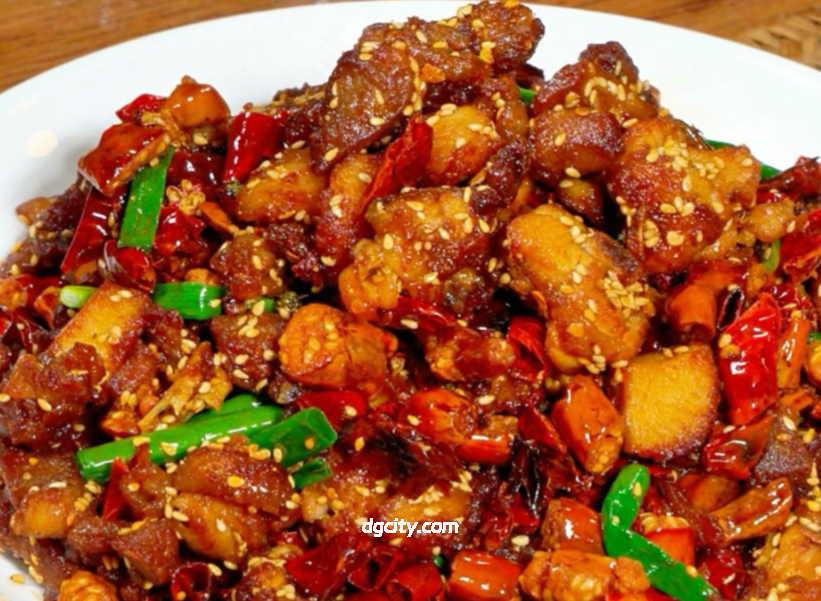
The control of cooking skills is the key to making authentic Spicy Chicken. It seems rough and simple, but in fact, it hides secrets, especially testing the ability to control the heat. The first step is frying, which emphasizes “two times of frying to shape, three times of frying to crisp”: the first frying, control the oil temperature at about 160℃, put the marinated chicken cubes into the oil pan, fry over medium heat until light yellow and set, take out and drain the oil to lock the chicken moisture; the second frying, raise the oil temperature to 180℃, re-fry the chicken cubes for 20 seconds until golden red and crispy, take out and drain the oil to squeeze out excess oil; senior chefs will also add a third frying, raise the oil temperature to 190℃, fry only for 10 seconds to further improve the crispness, so that the chicken will not become soft after cooling.
The stir-frying link emphasizes “stir-frying over low heat to release aroma, stir-frying quickly over high heat”: leave a little bottom oil in the pan, heat it to 50% heat, put in ginger slices and garlic cloves and stir-fry over low heat to release aroma, then add the pre-treated chili sections and Sichuan peppercorns, continue to stir-fry over low heat for 2 minutes until the chili peppers turn reddish brown and the numbing and spicy aroma is fully released. Remember to keep low heat throughout to avoid burning and bitterness of the chili peppers. Finally, pour in the fried chicken cubes, turn to high heat and stir-fry quickly for 1 minute to make each piece of chicken evenly coated with the aroma of chili peppers and Sichuan peppercorns, add a little white sugar to balance the numbness and spiciness, pour in a little rice vinegar to stimulate the aroma, turn off the heat, sprinkle with cooked white sesame seeds and chopped green onions, and use the residual heat to fully integrate the flavors. Throughout the cooking process, the switching of heat and the rhythm of stir-frying have strict requirements. Without years of experience, it is difficult to make the authentic flavor.
Eating Chongqing Spicy Chicken is a fun “treasure hunt” journey. When an authentic plate of Spicy Chicken is served, bright red chili peppers pile up like a hill, with golden and crispy chicken cubes hidden among them. Diners need to open their eyes wide and carefully search among the dense chili peppers. This difficulty makes each bite of chicken particularly precious. After taking a bite, you first feel the burnt aroma of chili peppers and the numbing taste of Sichuan peppercorns, followed by the crispness of the chicken skin and the tenderness of the inside. Multiple tastes interweave in the mouth, numb, spicy, fresh and fragrant, with endless aftertaste. Serve with a bowl of hot white rice, the spicy oil seeps into the rice grains, spicy and appetizing; or serve with a bottle of iced beer, the collision of spiciness and freshness is refreshing and satisfying, which is the most comfortable street time for people in the mountain city.
Today, Spicy Chicken has long transcended the meaning of a dish and become a microcosm of Chongqing Culture. It has witnessed the development and changes of the mountain city and carries the youth memories of generations of Chongqing people. Whether it is the delicious food shared by roommates in the university canteen or the standard configuration for friends to gather at night markets, Spicy Chicken always connects the daily life of Chongqing people with a hot attitude, and makes the joy of “finding meat among chili peppers” the most profound taste memory of Chongqing for countless people.





暂无评论内容